




UK-led Ukraine force could return Russian fire as Europe prepares deployment drill
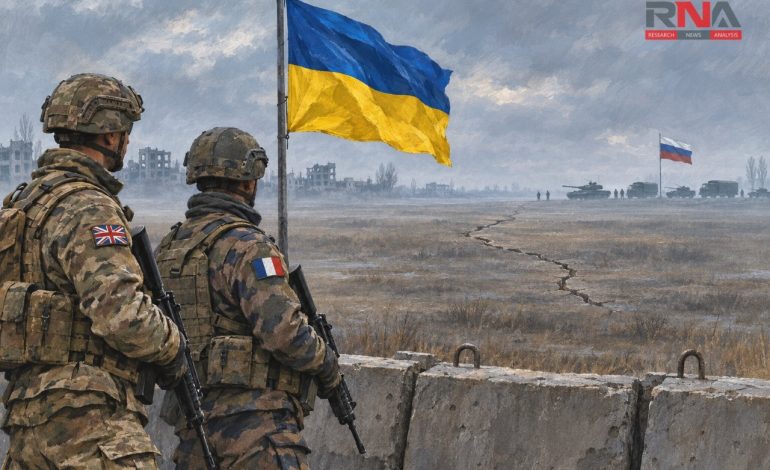
RNA Media illustration for representation.

New Delhi: British troops deployed to Ukraine under a proposed European-led security mission would be authorized to return fire if Russian forces attacked them, western officials have said. Britain and France are preparing a multinational exercise in Poland to test the force’s readiness, although any deployment would depend on fighting ending and an invitation from Kyiv.
The preparations highlight a central difficulty in efforts to secure a lasting settlement: European governments want a military presence that can help prevent another war, while Moscow considers such a deployment a threat. Russia has explicitly opposed the proposed force even in the event of a peace agreement, leaving its acceptability unresolved.
In its announcement on Tuesday, Britain’s defence ministry said Exercise Koalicja would run from November 9 to November 22, 2026, involving about 2,800 personnel from 11 countries. The drill will rehearse moving, protecting and supplying the Multinational Force Ukraine, or MNF-U, the military component of the “coalition of the willing”.
A security force with a different mandate
Although frequently described as a peacekeeping initiative, the proposed mission would have a different remit. Britain’s defence ministry says it would neither conduct conventional peacekeeping nor monitor a ceasefire but would help regenerate Ukraine’s armed forces and improve security in its skies and surrounding waters after hostilities cease.
The force would also operate outside Nato’s command structure, despite drawing personnel from member countries. According to Sky News’s reporting, western officials say its troops would retain the ability to defend themselves against Russian attacks – a provision that creates the possibility of direct military exchanges even under a mission intended to support peace.
A British-French-Ukrainian declaration of intent, published on January 7 already envisaged authority to use necessary force in carrying out the mission and protecting personnel, equipment and infrastructure. It stipulated compliance with international law and coordination with Ukraine’s military, rather than setting out detailed operational rules for individual encounters.
That document also proposed military hubs, protected storage facilities, training arrangements and cooperation between command systems. It called for further agreements governing the deployment and the legal status of foreign personnel, showing that the initiative encompasses a sustained military support structure rather than simply the dispatch of troops.
Rehearsing operations on land, in the air and at sea
Britain will contribute about 300 personnel, including soldiers from its 7 Brigade, alongside Royal Air Force Typhoon fighters and a Voyager refuelling aircraft. The air component will practise support for the eventual reopening of Ukrainian airspace to commercial flights, while ground personnel rehearse the logistics needed to sustain the mission.
The exercise’s land and air activities will centre on Nowa Dęba in south-eastern Poland, roughly 100 kilometres from the Ukrainian border. Separately, Turkey will lead a maritime simulation from Istanbul to prepare for potential Black Sea mine-clearance operations, explaining why accounts distinguish between 10 countries participating in Poland and 11 involved overall.
The participating countries are Belgium, Britain, Estonia, France, Germany, Lithuania, the Netherlands, Poland, Spain, Sweden and Turkey. The force is commanded by Lieutenant General Tom Bateman, with Britain and France sharing leadership.
According to Euronews, the exercise will emphasize coordination, logistics and the ability of national contingents to operate together. Light equipment, including drones, is expected to feature in self-defence and counter-drone training, with no tanks planned for the drill.
American support and Russian opposition
The United States is not participating in the multinational force, and a western official told Sky News that the Poland exercise would not depend on American communications or other systems. Separately, the Guardian reported that the proposed deployment would avoid dependence on US technology, including Starlink.
European planning nevertheless remains bound up with the wider negotiations over Ukraine’s security. The Associated Press reports that disagreements over territory and security guarantees continue to obstruct a settlement, while analysts question whether European governments would accept the escalation risks involved in providing credible military protection.
Moscow’s objection extends beyond the force’s name or organizational structure. On July 15, 2026, the Russian foreign ministry spokeswoman, Maria Zakharova, said contingents from coalition countries would constitute foreign intervention and would be regarded as legitimate military targets, according to Reuters.
Ukraine and its European partners frame the proposed presence as a means of strengthening deterrence after a ceasefire. In their July 13 statement, coalition leaders said security guarantees should be politically and legally binding, defensive in purpose and activated once a ceasefire takes effect.
The Poland exercise will test whether participating militaries can assemble and sustain that proposed force. It cannot settle the underlying diplomatic dispute over its deployment: operational preparations are advancing, but the conditions for sending troops into Ukraine remain unfulfilled.


