




Riyadh airport shut after Houthi strikes. Why Saudi Arabia’s $83 billion military is struggling to stop them
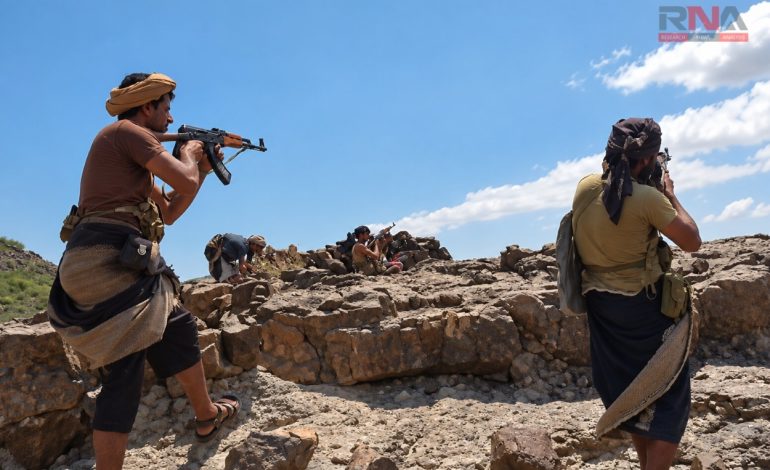
This digitally enhanced screenshot taken from a video posted by the Ansarallah Movement shows Houthi fighters are firing at Saudi-led coalition forces from atop a mountainous feature in Yemen.

New Delhi: Saudi Arabia extended the closure of Riyadh’s King Khalid International Airport on Monday following repeated Houthi attacks. The disruption has exposed the difficulty of protecting the kingdom’s civilian infrastructure while fighting an adversary that combines guerrilla warfare in Yemen with long-range missile and drone strikes.
The death toll from Saturday’s airport strike at 13, with more than 300 people wounded, while a subsequent attack on Sunday killed another person and injured nearly a dozen. Earlier reports had recorded 12 deaths in Saturday’s attack, illustrating how casualty figures have changed as authorities updated their assessments.
The Houthis, who call their movement Ansarallah, claimed responsibility for the attacks and renewed warnings against using Saudi airports. The airport has been struck four times within a week, turning an important international gateway into a recurring target rather than the scene of an isolated security breach.
The consequences now extend well beyond Riyadh as airlines have suspended or cancelled services, affecting passengers across several countries. Lufthansa’s Riyadh suspension runs through October 16, while IndiGo has cancelled flights to Riyadh and Dammam through October 15 and Etihad has suspended Saudi services through October 13.
For India, the immediate concerns include disrupted travel and the safety of nationals working in the kingdom. As RNA Media had reported on Sunday, reported that an Indian national wounded in an earlier airport attack had died, adding a direct Indian dimension to the escalating confrontation.
Saudi authorities nevertheless proceeded with the WPC Energy Congress in Riyadh, although several major oil-company chiefs disappeared from its programme. RNA’s report on BP’s withdrawal described the travel disruption confronting delegates, underscoring how attacks on aviation can obstruct business even when conference venues remain operational.
The airport campaign accompanies a wider struggle inside Yemen, where Houthi territorial advances have increased pressure on the internationally recognized government and its Saudi-backed forces. The Houthi capture of Mokha and nearby strategic positions, brought the contest closer to the approaches to Bab al-Mandab.
That geography matters because the strait connects the Red Sea with the Gulf of Aden and the shipping routes beyond. Chatham House’s assessment of the capture of Mokha argues that the advance has changed both Yemen’s military balance and the regional maritime-security equation.
The connection is strategic rather than operational: the pipeline carries crude towards Yanbu, providing an alternative to exports through the Strait of Hormuz. Houthi pressure around Bab al-Mandab threatens onward shipping from the Red Sea, potentially undermining the usefulness of that alternative even when the pipeline itself is functioning.
Why superior weapons have not delivered a Saudi victory
The central misconception is that Saudi Arabia is confronting little more than loosely organized fighters with rifles and pickup trucks. Ansarallah has developed into a territorial armed movement with experienced commanders, access to former Yemeni military stocks and an increasingly sophisticated arsenal supported by foreign technology.
The Houthis’ takeover of Sanaa in 2014 gave them access to weapons and institutions belonging to the Yemeni state. The International Institute for Strategic Studies (IISS) documents how their arsenal incorporates inherited systems alongside Iranian weapons and adaptations, making the description “ragtag” an inadequate guide to their actual capabilities.
Saudi Arabia’s spending advantage remains enormous. Sipri estimates its military expenditure at $83.2 billion in 2025. But expenditure measures financial resources, whereas battlefield effectiveness depends on how intelligence, personnel, weapons, logistics and command arrangements work together against a particular opponent.
An advanced fighter aircraft can destroy a launcher once it has been identified and located, but it cannot automatically reveal equipment hidden in mountainous terrain. That distinction is crucial in Yemen, where IISS satellite analysis has documented expanding underground military facilities that can protect Houthi equipment against aerial attack.
The movement can also disperse its weapons rather than concentrate them in conspicuous bases. IISS research describes mobile launchers, concealed positions and systems capable of operating from Yemen’s interior, complicating surveillance and reducing opportunities to destroy them before launch.
This creates an intelligence problem before it becomes a firepower problem: aircraft need sufficiently current information to distinguish an active military target from an empty position or civilian vehicle. An IISS assessment of Gulf surveillance capabilities specifically identified shortcomings in intelligence, surveillance and reconnaissance capabilities and their exploitation during Saudi-led operations in Yemen.
Experience compounds the difficulty because the Houthis have spent years adapting to opponents with air superiority. A Royal United Services Institute (Rusi) assessment noted that their missile force regenerated after substantial earlier losses, demonstrating why destroying existing stocks does not necessarily eliminate the ability to replenish them.
Foreign assistance is an important part of that regeneration, particularly for weapons whose manufacture requires specialist engineering and components. The UN panel of experts’ 2024 report concluded that the Houthis lacked the capacity to develop and produce complex weapons independently and identified similarities with systems operated by Iran and its regional allies.
Iranian support nevertheless does not mean that every Houthi decision is dictated from Tehran. Rusi research on the movement’s external relationships describes an organization developing its own partnerships, which helps explain why pressure on Iran alone may not produce an immediate halt to Houthi operations.
Protecting Saudi territory presents a different challenge from attacking targets in Yemen, because the kingdom must defend numerous valuable sites across a large area. The analytical implication is straightforward: the Houthis can choose where and when to attack, while Saudi commanders must distribute protection among airports, energy installations, military facilities and population centres.
Different weapons also demand different defensive responses, and no single missile shield offers universal protection. Rusi’s analysis of earlier Houthi attacks explains that low-flying drones and cruise missiles can be difficult to detect, while capable air defences have successfully intercepted many ballistic missiles.
Consequently, the Riyadh strikes do not establish that Saudi air defences are useless, although repeated penetrations plainly demand investigation. Without the relevant engagement records, it would be premature to attribute each failure to exhausted ammunition, radar coverage, equipment performance or operational decisions.
Defence also imposes a persistent economic burden because interceptors are often considerably more expensive than the weapons they destroy. Rusi identifies this imbalance as a strategic problem: successful interceptions can preserve lives while leaving the defender committed to an expensive campaign whose duration the attacker helps determine.
Political divisions among the Houthis’ opponents further weaken the benefits of Saudi spending and air support. Reporting on September’s coastal reverses identified poor coordination, weak communications and inadequate intelligence among anti-Houthi forces, illustrating how failures within the ground coalition can outweigh advantages in equipment.
Airstrikes can disrupt operations, but recovering territory requires forces able to advance, hold positions and establish credible authority afterwards. The inference from Yemen’s experience is that additional aircraft or bombs cannot substitute for a cohesive local coalition with workable command arrangements and an agreed political objective.
There is also a difference between inflicting military damage and changing an opponent’s behaviour. Chatham House’s analysis of earlier US and British strikes emphasized the Houthis’ combat experience and willingness to confront stronger powers, cautioning against assuming that bombardment alone would compel retreat.
Saudi Arabia therefore faces several connected tasks: improve protection at home, disrupt weapons replenishment and strengthen its partners inside Yemen. A durable outcome also requires a political framework that reduces the incentive to resume attacks, because battlefield losses and temporary pauses do not necessarily amount to a settlement.
For India, the lesson reaches beyond Saudi military performance to the vulnerability of interconnected transport and energy networks. An armed movement does not need to defeat a major power conventionally to impose substantial costs: sustained threats to airports and maritime chokepoints can disrupt travel, trade and confidence far beyond the battlefield.



