Putin’s defence minister personally cleared secret military training for Russian troops in China, report says
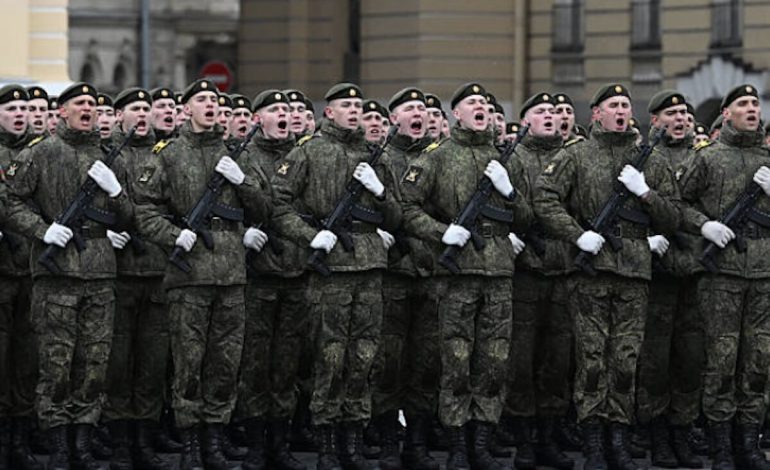
Russian troops during a Victory Day parade rehearsal at St Petersburg.

New Delhi: China’s covert training of Russian military personnel last year was personally sanctioned by Russia’s defence minister, Andrei Belousov, and directly involved at least four generals from the two countries, according to two European officials and documents reviewed by Reuters.
The officials said the seniority of those involved – in a programme tied to Russia’s war in Ukraine – underlined how much value Moscow and Beijing place on the cooperation. That development had unsettled European capitals even as China still continues to deny that any such training took place.
A classified Russian document seen by Reuters cited an internal decree issued by Belousov in August 2025, under which a delegation from Russia’s armed forces travelled to China to take part in exercises at facilities run by the People’s Liberation Army (PLA).
One of the courses detailed in the document ran for three weeks at a military facility in Beijing in November and focused on protection against radiological, chemical and biological warfare. Images accompanying the report showed Russian soldiers being briefed by a Chinese instructor, inspecting a model nuclear reactor, and being trained in radiation and chemical reconnaissance as well as safeguarding ventilation systems from contamination.
Beijing has consistently described itself as neutral in the Ukraine war and has positioned itself as a potential mediator. A Reuters investigation last month, citing European intelligence agencies and military documents, reported that China trained roughly 200 Russian military personnel in November, some of whom subsequently deployed to Ukraine. The Kremlin declined to comment on that report at the time but complained of “false information” being circulated in the west.
The EU’s foreign policy chief, Kaja Kallas, said on June 15 that Brussels had independently corroborated the training and was working through its implications. Beijing dismissed her remarks as “nothing but smears”.
European governments, which have regarded Russia as the continent’s foremost security threat since the 2022 invasion of Ukraine, have watched the deepening of Moscow-Beijing military ties with growing unease – complicated by the fact that China remains one of the EU’s largest trading partners. The bloc has already sanctioned several Chinese firms it accuses of aiding Russia’s war effort.
A third official, based in Brussels, told Reuters that the EU could no longer afford to view China chiefly through an economic lens and needed to treat it, in Kallas’s words, as a “decisive enabler of Russia’s war”.
According to the two European officials, who spoke on condition of anonymity given the sensitivity of the matter, an agreement dated July 2 last year, underpinning the training programme, was signed by a Russian major general, Rustam Khusainov, and a Chinese senior colonel, Sun Dayun.
A senior Russian lawmaker who chairs the state Duma’s defence committee, Andrei Kartapolov, rejected the report as “complete nonsense” in comments to Russia’s RTVI, insisting Russia’s armed forces had nothing to learn from China.
That claim sits awkwardly against internal Russian military assessments reviewed by Reuters, which took a more measured view – a report on a course conducted in Nanjing praised the quality of Chinese equipment, the extensive use of simulators and the theoretical grounding of Chinese instructors, while explicitly flagging Beijing’s lack of recent combat experience. This is a gap that Moscow’s own forces do not share after more than four years of brutal grinding in the Ukraine war.
Separate documents named three more generals involved in the programme. One list, reviewed by Reuters, recorded every participant across all the courses – officers and other ranks alike – along with their rank, date of birth, unit affiliation and security clearance level. A Russian colonel general, Rustam Muradov, deputy commander-in-chief of Russia’s land forces, led the Russian delegation, according to that list and a second document.
A Chinese major general, Li Jinsun, who heads the PLA’s Military Academy of Radiological, Chemical and Biological Defence, took part in the opening of one of the courses. Neither Russia’s nor China’s defence ministry responded to Reuters’ requests for comment.
The disclosures add to a body of reporting this year that has steadily chipped away at Beijing’s declared neutrality in the Ukraine conflict, and are likely to sharpen debate in Brussels and Washington over how far Chinese military assistance – short of direct arms transfers – has propped up Moscow’s war effort.
For countries such as India, which maintains a longstanding defence relationship with Russia while watching China’s military modernization closely along its own contested border, the extent and formality of PLA-Russian military engagement will be of more than passing interest, given its potential bearing on technology transfer, doctrine-sharing and the broader Moscow-Beijing strategic alignment.