
North Korea fires suspected ballistic missile into eastern sea as tensions rise over nuclear programme
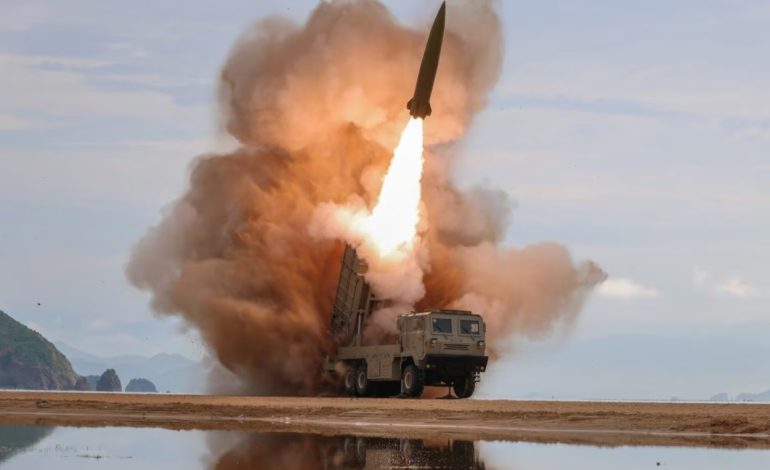
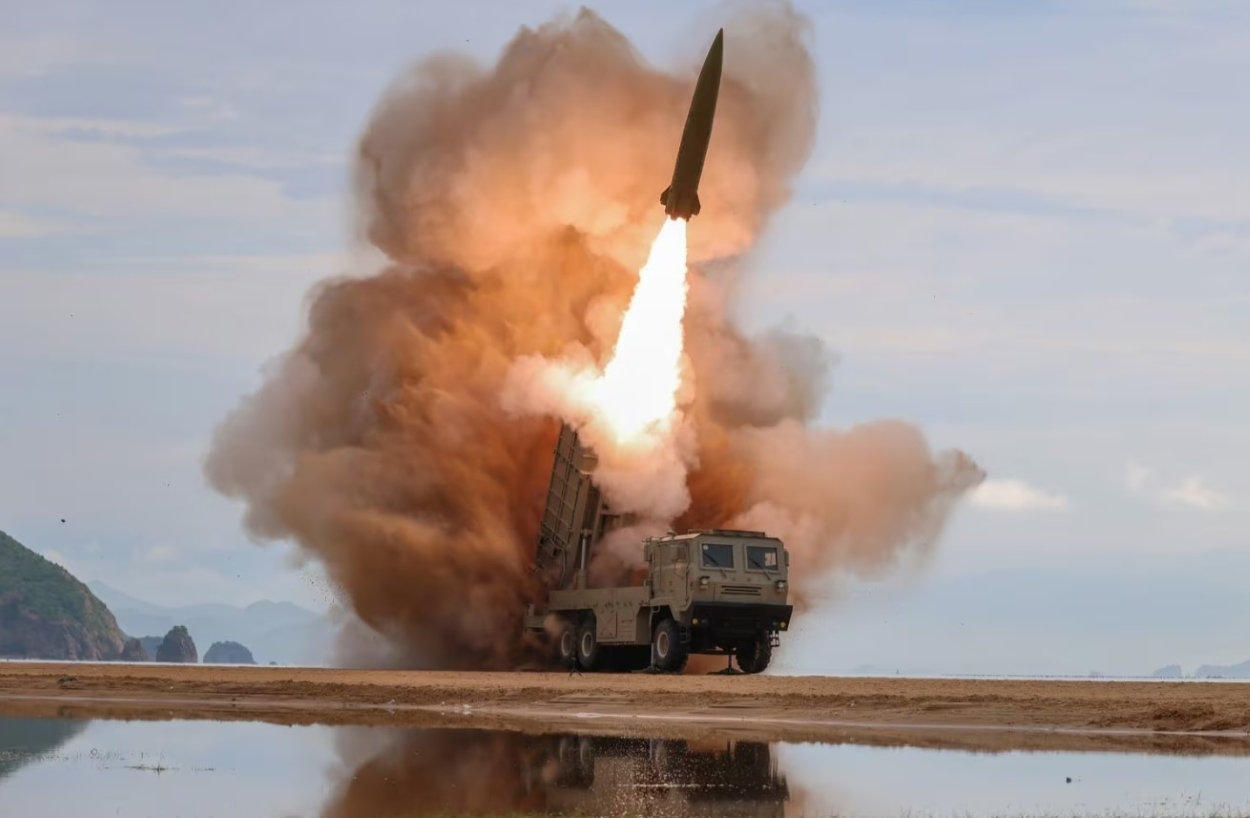
This screenshot from a video released by North Korea’s Pyongyang Rodong Sinmun-News1 shows the firing of the missile.

New Delhi: North Korea fired what appeared to be a ballistic missile towards the sea off its eastern coast on Sunday, prompting Japan and South Korea to begin analysing the projectile’s flight. The launch came days after Pyongyang renewed its opposition to US-led military exercises and declared that its status as a nuclear-armed state was irreversible.
Japan’s defence ministry said the projectile was believed to have already fallen into the sea, with initial assessments indicating that it landed outside the country’s exclusive economic zone. The Japan Coast Guard advised ships in the area to monitor official warnings and avoid approaching any debris they might encounter, Japan’s FNN Prime Online reported.
South Korea’s joint chiefs of staff separately said it had detected an unidentified projectile fired by North Korea towards the eastern sea, also known as the Sea of Japan. Seoul did not immediately disclose the launch point, number of projectiles, maximum altitude or distance travelled, leaving the weapon’s precise category and intended test objectives unclear.
The absence of detailed flight data means it cannot yet be established whether Pyongyang tested a short-range battlefield weapon, a longer-range ballistic missile or a component associated with an advanced system. Military authorities in South Korea, Japan and the United States generally compare radar and satellite observations before issuing a more complete assessment.
According to Japanese media, Sunday’s launch was the ninth occasion in 2026 on which Japan’s defence ministry had announced the firing of a possible ballistic missile by North Korea. None of the projectiles detected by Tokyo this year has been reported to have landed inside Japan’s exclusive economic zone.
The latest firing followed a large North Korean live-fire exercise conducted on September 12, in which several short-range ballistic missiles travelled about 250 kilometres towards waters off the country’s east coast. Pyongyang said that exercise involved five army units and an array of attack drones, tactical cruise and ballistic missiles, long-range artillery and large-calibre multiple rocket launchers.
A South Korean analyst said the earlier drill appeared designed to demonstrate an integrated strike network capable of coordinating weapons with different flight profiles. Such a combination could be used to complicate or saturate South Korean and US missile defences by presenting them with several kinds of threats at the same time, Reuters reported.
That exercise took place immediately after South Korea, Japan and the United States concluded the five-day Freedom Edge trilateral military exercise. The drills, aimed at improving coordination against North Korean threats, ran near Guam from August 29 to September 10 and were condemned by Pyongyang as evidence of hostile military pressure.
The influential sister of the North Korean leader, Kim Jong-un, Kim Yo-jong, said on Friday that US-led exercises were worsening tensions on the Korean peninsula and insisted that Pyongyang would continue strengthening its nuclear arsenal. North Korea has repeatedly characterized allied exercises as rehearsals for an invasion, while Seoul, Tokyo and Washington maintain that they are defensive.
Sunday’s missile launch also followed North Korea’s rejection of a resolution adopted by the International Atomic Energy Agency over its expanding nuclear programme. Pyongyang said its nuclear status could not be reversed and accused the agency of applying double standards, reinforcing its refusal to consider denuclearization under the present security environment.
North Korea is prohibited from conducting ballistic-missile tests under United Nations security council resolutions, but it has continued developing weapons ranging from short-range missiles intended to strike regional targets to intercontinental systems theoretically capable of reaching the US mainland. Diplomatic efforts to limit the programme have remained stalled since negotiations between Kim and the US president, Donald Trump, collapsed in 2019.
The frequency and operational character of the recent launches suggest that Pyongyang is using them not only to develop individual weapons but also to rehearse coordinated wartime operations. Until the three allies release fuller tracking data, however, any assessment of Sunday’s missile’s range, payload or technological significance will remain provisional.