

Jensen Huang honeytrap scandal: Trump, Musk defend Nvidia CEO as he falls to 12th on rich list; $75 billion divorce buzz
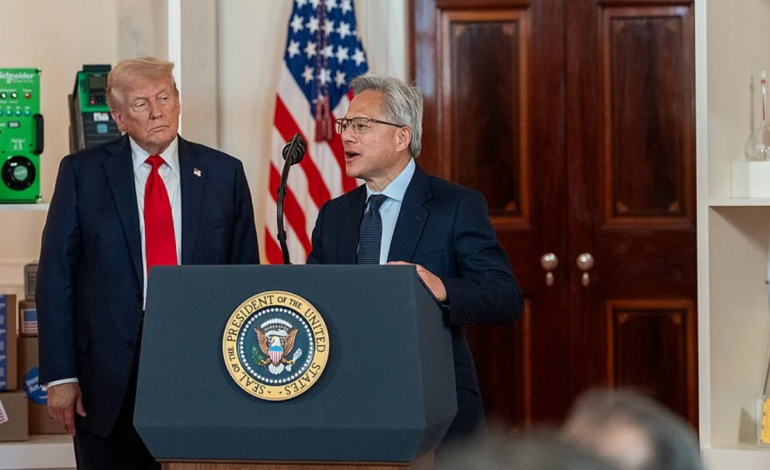
Jensen Huang honeytrap scandal. (Image courtesy: Wikimedia)

New Delhi: The United States president, Donald Trump, has defended Nvidia chief executive, Jensen Huang, over allegations involving a suspected Chinese intelligence operative. Trump said he believed Huang had no knowledge of the woman’s alleged espionage links. Elon Musk, the billionaire owner of X and CEO of Tesla and SpaceX, has also backed the Nvidia chief, while China has rejected the allegations as a smear campaign.
Speaking to reporters at the White House on Monday, Trump said he had spoken to Huang earlier in the day. He said he had directly asked him whether he knew that the woman was a spy.
“He said, ‘I had no idea that she was a spy.’ And I really believe him,” Trump told reporters. He also said he had not heard about the allegations during his visit to China in May.
Musk also expressed support for Huang by reposting a statement from Sequoia Capital partner Shaun Maguire on X. Maguire described Huang as “one of the greatest entrepreneurs of this generation” but said he had made an “incredibly dumb” decision that was bad for America.
Maguire added that he believed Huang had no malicious intention. He also called him irreplaceable for America’s AI leadership. Musk supported the statement by writing, “I agree.”
China, meanwhile, rejected the espionage allegations on Monday. Chinese foreign ministry spokesman, Guo Jiakun, described the claims as baseless and an attempt to discredit Beijing during a regular press briefing, as earlier reported by RNA Media.
Huang drops to 12th in global billionaire rankings
The controversy has coincided with a decline in Huang’s personal fortune. According to the Bloomberg Billionaires Index update on Tuesday, he has slipped out of the world’s 10 richest people and now ranks 12th, with an estimated net worth of $148 billion.
His fortune fell by $6.47 billion, or 4.2 per cent, in the latest update. It has declined by approximately $15 billion, or 9.2 per cent, over the past year.
The decline comes amid pressure on Nvidia shares following the controversy. The company’s board has also initiated an independent investigation into reports that Huang may have been targeted by a foreign intelligence operation.
Divorce speculation
The latest developments follow Huang’s admission of an extramarital affair in an email to Nvidia employees on Sunday. The 63-year-old executive apologized to his wife, Lori Huang, their children and company employees.
“I was unfaithful to my wife. My actions hurt her and our children. There is no excuse for what I did. I am deeply sorry,” Huang wrote.
Huang’s admission has also triggered speculation about the financial consequences of a possible divorce. His wife, Lori Huang, could stand to receive at least $75 billion depending on the couple’s assets and financial arrangements, Forbes reported.
The estimate is linked to California’s community property laws, under which assets acquired during a marriage are generally divided equally in a divorce. Huang’s Nvidia stake and income from the company could form part of the marital assets, subject to their ownership structure and any legal agreements.
The couple married in 1985, eight years before Huang co-founded Nvidia with Chris Malachowsky and Curtis Priem. According to Nvidia’s 2026 proxy statement, several shares attributed to Huang are held in trusts where both spouses are co-trustees and may have a shared beneficial interest.
However, it remains unclear whether the couple signed a prenuptial or postnuptial agreement. There is also no indication that Lori Huang has sought a divorce or that the couple is considering separation.
The espionage controversy centres on Alice Huang, a former executive at Singapore-based cloud computing company Megaspeed International. US intelligence officials reportedly suspected her of having links to Chinese intelligence, although the allegations have not been established as findings of espionage.
Nvidia has maintained that it has found no reason to believe its commercial secrets or US national security have been compromised. The board’s independent investigation is expected to examine whether Huang was targeted by a foreign intelligence operation.