
Israel’s 67-seat dilemma: Thousands urge Eisenkot for Arab parties’ support to end Netanyahu’s rule
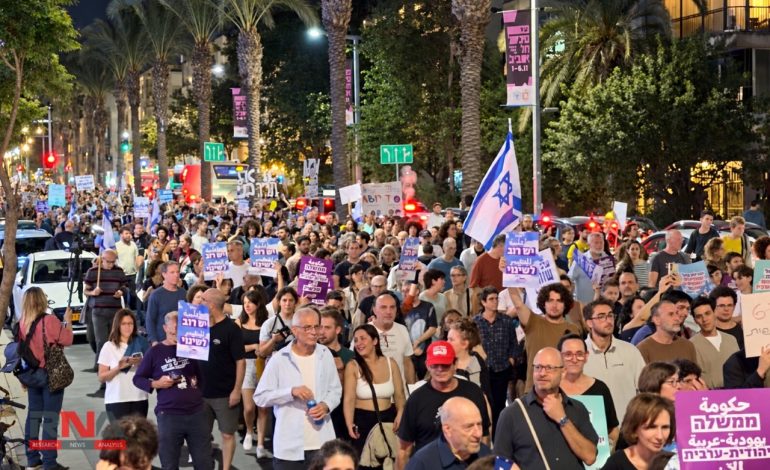
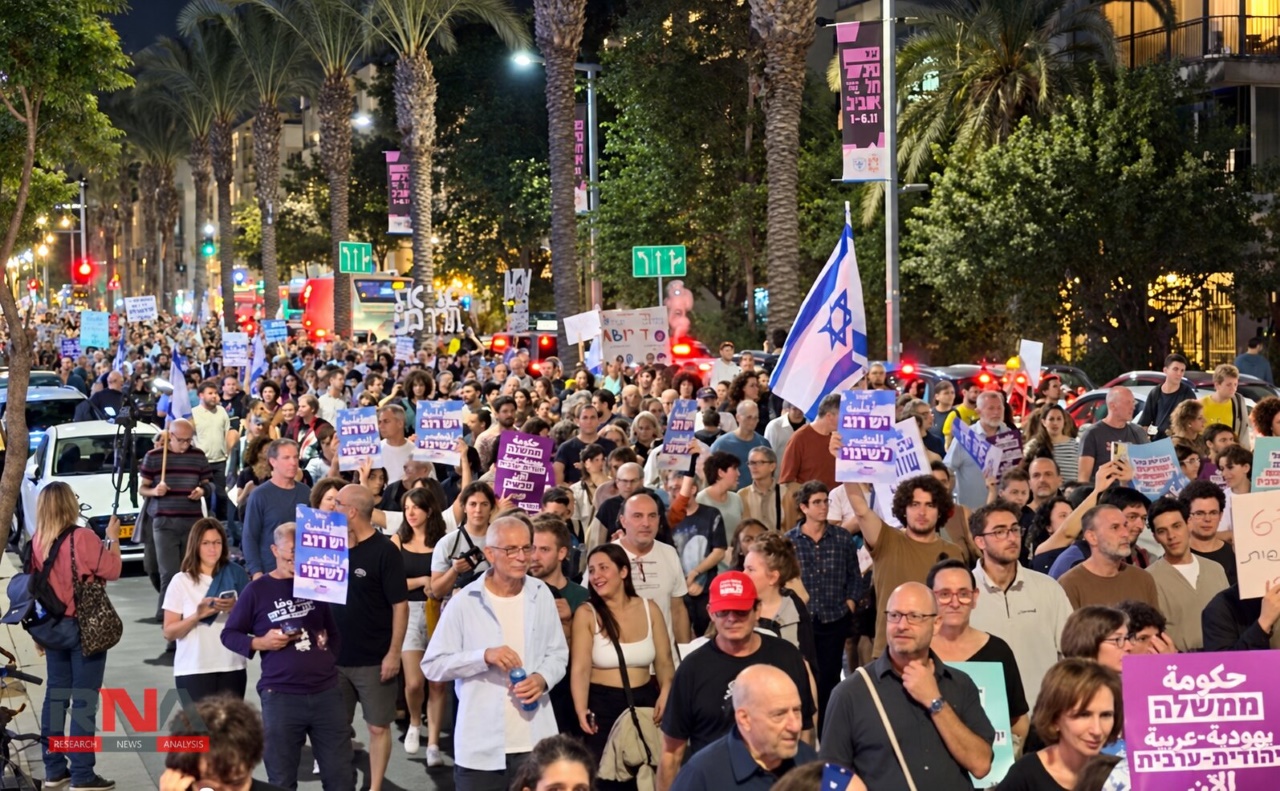
This digitally enhanced screenshot from a widely circulated video on social media shows thousands of people marching in Tel Aviv demanding a Jewish-Arab political coalition from Gadi Eisenkot’s party to oust Benjamin Netanyahu from power.

Tel Aviv: Thousands of Israelis demonstrated on Saturday, urging the opposition leader, Gadi Eisenkot, to cooperate with Arab-led parties to replace the prime minister, Benjamin Netanyahu, after an election that left neither rival bloc with a majority. The protests exposed the central obstacle to a change of government: Netanyahu’s opponents collectively control enough parliamentary seats to remove him but remain divided over accepting Arab political support.
About 2,000 people marched from Tel Aviv’s Habima Square to Rabin Square, while a smaller demonstration took place in Jerusalem, according to the Times of Israel. Demonstrators called for Jewish-Arab cooperation, carrying placards demanding equality and arguing that the election had produced a majority for political change.
The demonstrations were accompanied by a counterprotest by Netanyahu supporters, who opposed any government dependent on Arab parties and repeated allegations that the election had been stolen. Their presence highlighted how the struggle to assemble a parliamentary majority has become intertwined with a wider dispute over Arab citizens’ role in governing Israel.
A majority on paper, but no governing agreement
As RNA Media had reported, the completed vote count gave Netanyahu’s bloc 53 seats in the 120-member Knesset, compared with 48 for the principal opposition bloc led by Eisenkot. The Arab-led Joint List secured 11 seats and Ra’am eight, giving them a combined 19 seats and a potentially decisive role in government formation.
Together, Eisenkot’s bloc and the Arab-led lists would command 67 seats, comfortably exceeding the 61 needed for an absolute parliamentary majority. However, that arithmetic does not amount to an agreement to govern: several opposition politicians have rejected arrangements that would make an administration dependent on Arab support.
Netanyahu’s Likud remained the largest individual party with 27 seats, followed by Eisenkot’s Yashar with 21, while overall turnout reached 77.9 per cent. The result therefore left both leading contenders seeking additional parliamentary backing, despite Netanyahu’s bloc finishing ahead of Eisenkot’s.
The Arab-led parties’ performance has intensified pressure on Eisenkot to reconsider his approach to cooperation with them. Nearly 840,000 people voted for Ra’am and the Joint List – an increase of 64 per cent over the corresponding vote in the 2022 election.
Eisenkot sets conditions as opposition divisions persist
In his latest statement on Saturday, Eisenkot said potential partners would have to accept Israel’s Jewish, democratic, liberal and egalitarian character, uphold its Declaration of Independence, and support compulsory military or civilian national service. His conditions also included recognizing Hamas as a terrorist organization and supporting the destruction of its military and governing capabilities in Gaza.
Eisenkot said any elected representative accepting those principles could be a partner but did not announce an agreement with either Arab-led list. He also met the opposition politician, Yair Lapid, to discuss the results and coordinate their next political steps, according to the Jerusalem Post.
The leader of the left-wing Democrats, Yair Golan, has supported cooperation with Arab parties and met the Ra’am leader, Mansour Abbas, on October 29. By contrast, the leader of the right-wing Yisrael Beytenu, Avigdor Liberman, has rejected joining a government reliant on those parties, including one receiving their support from outside the coalition.
That distinction between coalition membership and external parliamentary support could become central to negotiations. The veteran Joint List lawmaker, Ahmad Tibi, said his alliance was prepared to help establish an alternative government without taking ministerial positions, and indicated support for replacing the Knesset speaker and establishing a state inquiry into the October 7, 2023, Hamas-led attack.
External backing would allow a party to support a government’s establishment and survival while remaining outside the cabinet. A US Congressional Research Service assessment identified a minority administration involving Ra’am and receiving backing from the Joint List as one possible route through the deadlock, although opposition resistance remains a major obstacle.
There is a recent precedent for Arab participation in an Israeli governing coalition: Ra’am joined the eight-party alliance that displaced Netanyahu in 2021. That administration collapsed in 2022, illustrating both the possibility of such cooperation and the difficulty of sustaining an alliance spanning sharply different political positions.
Fraud allegations sharpen the confrontation
Netanyahu has denounced cooperation with Arab parties and alleged that Arab politicians received improper support from Qatar, an accusation Doha has rejected. According to an AFP report published by Arab News, police arrested three suspects in an election-day cash-related incident, but the election authorities described it as an isolated local case.
The Central Elections Committee has rejected claims of widespread electoral fraud and said the investigation would not affect the final results presented to the president. Its clarification is significant because allegations concerning particular incidents do not establish that the national result was invalid.
Alongside coalition negotiations, Eisenkot has outlined a legislative programme that includes an inquiry into the security failures surrounding the October 7, 2023, attack, broader national-service obligations and repeal of the outgoing government’s judicial overhaul measures. He also said that, pending a new administration, he would support military operations only against direct and immediate threats that could not wait.
Process moves towards presidential consultations
The president, Isaac Herzog, is expected to receive the formal election results on November 4, 2026, with consultations involving party representatives due to begin that day. The newly elected Knesset is scheduled to convene on November 10, irrespective of whether coalition negotiations have produced a government.
The lawmaker selected to attempt government formation will initially have 28 days, with a possible 14-day extension, to secure an agreement. If that attempt fails, further procedures allow another candidate to try before the process can ultimately lead to a fresh election.
Herzog has urged political leaders to approach negotiations with an open mind and avoid sending voters back to the polls. Until an alternative administration is established, Netanyahu’s government remains in office in a caretaker capacity, leaving his opponents under pressure to turn their combined parliamentary strength into a workable arrangement.