




Iran unveils underground ‘missile city’, threatens to strike US bases in Europe if war restarts. Can Tehran strike that far?
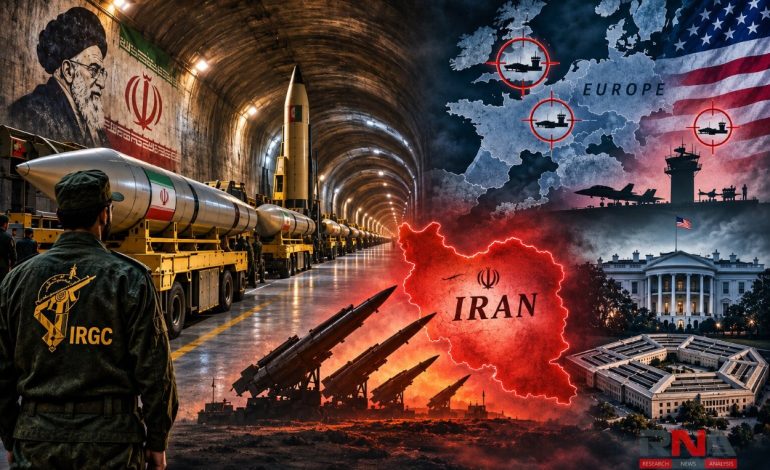
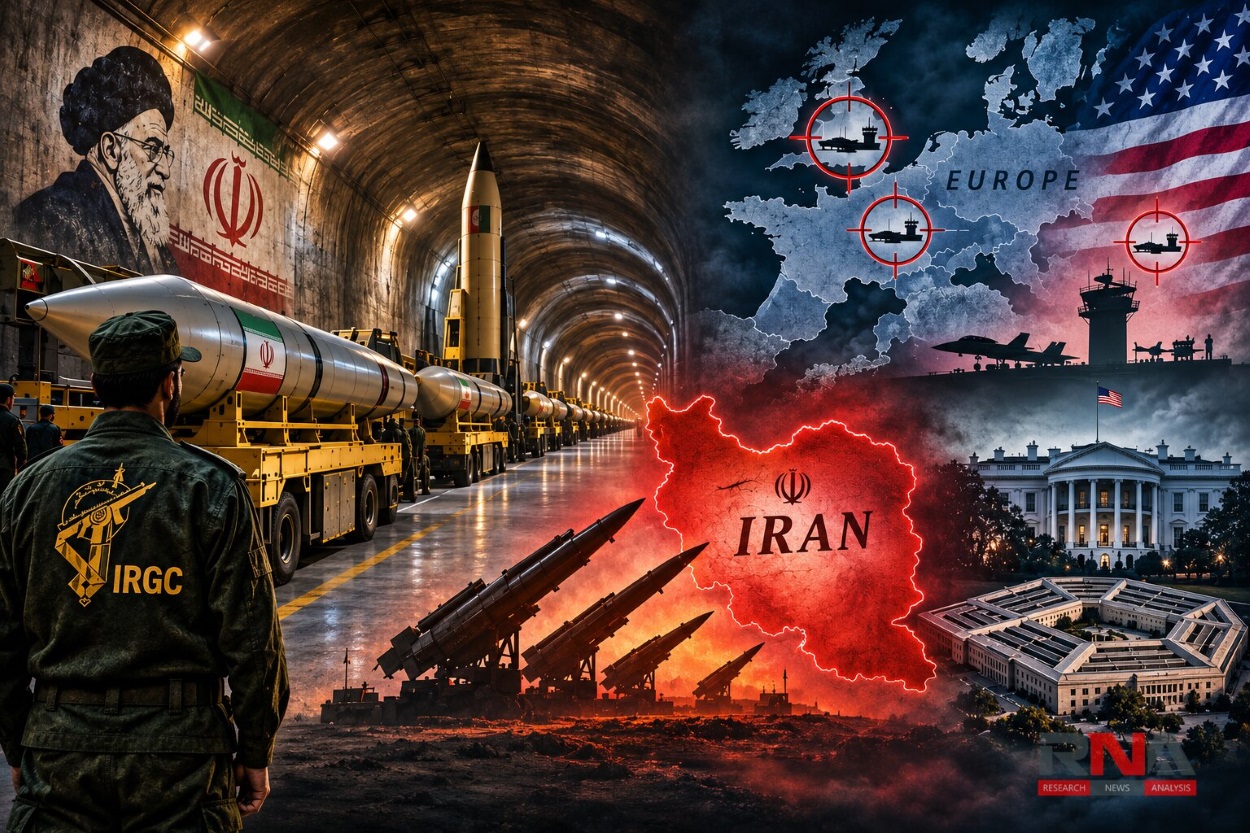
RNA Media illustration for representation.

New Delhi: Iran has unveiled a vast underground missile complex housing ballistic and cruise missiles, signalling that its military capabilities remain operational despite months of American and Israeli attacks. The disclosure comes alongside an unusually explicit warning from Tehran that any renewed US offensive could provoke retaliatory strikes against American military installations well beyond West Asia, including bases in Europe.
The Islamic Revolutionary Guard Corps (IRGC) released footage of the facility on November 10, showing extensive underground tunnels lined with missiles, mobile launchers and associated military equipment. The installation, described by Iranian authorities as a new “missile city”, was presented during the IRGC aerospace force’s commemorative activities as evidence of the country’s ability to withstand sustained aerial bombardment.
The unveiling was attended by the chief of staff of Iran’s armed forces, Major General Ali Abdollahi, and the commander of the IRGC aerospace force, Brigadier General Seyyed Majid Mousavi. Both officers inspected the weapons and launch systems, with Abdollahi suggesting that Iran possessed additional capabilities that could surprise its adversaries in another confrontation.
The footage appeared to show several types of ballistic missiles, including systems resembling the Fattah series, alongside cruise missiles and transportable launch platforms. However, Tehran has neither disclosed the installation’s location nor provided independently verifiable information about its capacity, operational readiness or the number of missiles stored there.
Defence intelligence publication Janes reported that the imagery also suggested the possible development of a new cruise missile with design features intended to reduce its radar signature. Its assessment was based on the appearance of weapons displayed at the complex, rather than independently confirmed performance characteristics.
Tehran extends its warning to Europe
The military demonstration coincided with a warning from the secretary of Iran’s supreme national security council, Mohsen Rezaei, who declared that American military bases outside West Asia would no longer necessarily remain beyond Tehran’s retaliation.
Speaking to the Lebanese television network Al Mayadeen on November 11, Rezaei said Iran would attack military installations in European countries if American aircraft operating from those facilities were used to bomb Iranian territory. He also suggested that Tehran could strike distant islands and bases that Washington considered beyond the reach of Iranian weapons.
The statement represents a potentially significant expansion of Iran’s declared retaliatory doctrine, which has traditionally concentrated on Israel and American military facilities across West Asia. By explicitly identifying European installations as possible targets, Tehran is attempting to increase the political and military costs of any future US operation involving allied territory.
The warning also follows similar statements by Iranian lawmakers, who identified American facilities in Germany and Italy as possible targets if they supported renewed attacks. Such threats could complicate European governments’ decisions over permitting US forces to use their territory, although the warnings do not establish that Iran possesses the capability to strike every installation mentioned.
Can Iranian missiles reach European bases?
The threat has acquired greater significance following Iran’s announcement on November 7 that it had abandoned its longstanding, self-imposed 2,000-kilometre restriction on ballistic missile ranges. Nevertheless, removing a political restriction does not automatically establish that Iran has deployed missiles capable of reaching distant European targets, and the operational capabilities of any longer-range systems remain uncertain.
Iran’s underground infrastructure is another important element of its military strategy, intended to protect missiles, launchers and manufacturing facilities from aerial attacks. An IRGC spokesman, Brigadier General Hossein Mohebbi, recently claimed that Tehran had transferred substantial missile and drone production capacity underground, although the ability of these installations to sustain manufacturing during prolonged bombardment remains unverified.
The European dimension has already raised security concerns. As RNA Media had reported, American forces have relocated 13 aircraft from RAF Mildenhall in Britain following an unspecified threat. The aircraft were moved to facilities in Scotland, Spain and Germany as a precaution, although American officials did not publicly confirm the source of the threat.
Nuclear dispute and wider implications
The latest confrontation follows the US-Israeli military campaign launched on February 28, which killed Iran’s supreme leader, Ayatollah Ali Khamenei, and triggered an extensive regional conflict. Iran retaliated with missiles and drones, exposing the vulnerability of military installations and critical infrastructure across West Asia.
Rezaei has also ruled out transferring Iran’s enriched nuclear material abroad, asserting that Tehran intends to retain its stockpile for domestic applications, including nuclear-powered vessels and small modular reactors. His position complicates diplomatic efforts because the future of Iran’s enriched uranium remains a central dispute between Tehran and Washington.
The diplomatic outlook became more uncertain on November 12 when the US president, Donald Trump, declared that Washington did not need an agreement with Tehran. Separately, Turkey’s president, Recep Tayyip Erdogan, called for negotiations to resume following discussions with his Iranian counterpart, Masoud Pezeshkian.
For India, the confrontation carries implications beyond the immediate military balance, particularly for energy security, shipping through the Strait of Hormuz and the safety of Indian nationals across West Asia. Any further escalation involving American bases in Europe could also widen the diplomatic consequences of a conflict whose economic effects are already being felt internationally.
Tehran’s latest demonstration therefore serves two purposes – reassuring its domestic audience that its military infrastructure has survived the war and warning Washington that another offensive could entail substantially greater risks. Whether the underground facilities and longer-range missile ambitions can support those threats remains unclear, but Iran’s message is that any future confrontation may not remain geographically confined to West Asia.


