


Iran bus crash kills 12 oil workers, injures 16 in one of country’s deadliest road accidents
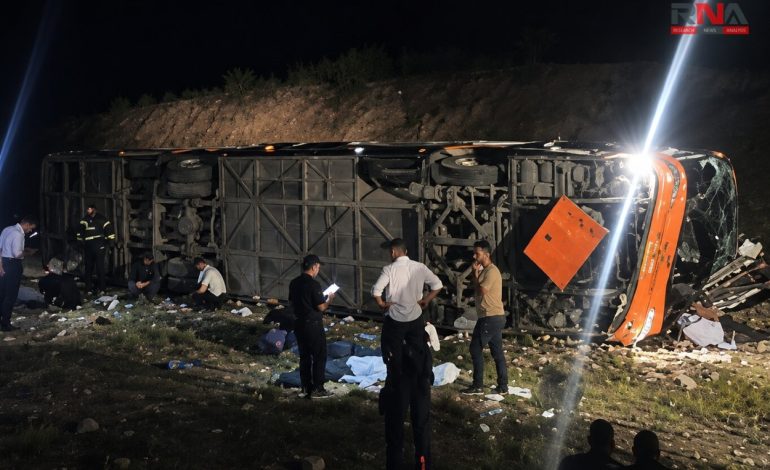
This digitally enhanced screenshot of a video shows the overturned bus.

New Delhi: At least 12 people were killed and 16 others injured when a bus transporting oil and gas industry workers overturned in western Iran’s Ilam province on Saturday, prompting an emergency response ordered by the country’s president, Masoud Pezeshkian. The accident, which occurred near the Iraqi border, has renewed concerns over Iran’s deteriorating road safety record, with more than 10,000 people losing their lives in traffic accidents during the first six months of the current Iranian calendar year.
The bus was carrying employees associated with the Dehloran NGL oil and gas project when it overturned on the Dasht Abbas–Murmuri road, connecting areas of Dehloran and Abdanan counties, at approximately 7.25pm local time. According to the Islamic Republic News Agency (Irna), the accident left several passengers critically injured, raising concerns that the death toll could increase.
The governor of Abdanan county, Behzad Nourmohammadi, said the bus was carrying 28 people, including 27 passengers and the driver, when the accident occurred. Three victims reportedly died after being transferred to medical facilities, taking the confirmed death toll to 12, according to a subsequent Anadolu Agency report.
The injured were transported to medical facilities across Ilam and neighbouring Khuzestan province, with 10 patients admitted to a hospital in Dezful, five receiving treatment in Abdanan and one in Ilam. Initial reports had placed the death toll between five and 11, but provincial authorities subsequently revised the figures as emergency teams completed rescue operations and hospitals assessed the casualties.
President orders emergency response
Following the accident, Pezeshkian directed provincial authorities to mobilize medical personnel, emergency vehicles and other resources to assist the victims and their families. The governor of Ilam, Ahmad Karami, said the president and the interior minister, Eskandar Momeni, had ordered an extensive rescue operation involving 50 ambulances and medical teams drawn from Ilam and Khuzestan provinces, Irna reported.
The provincial administration announced one day of public mourning across Ilam and two days in Abdanan, where several victims reportedly lived. Authorities have also initiated an investigation into the circumstances of the accident, although no official conclusion regarding its cause had been released by November 15.
The prosecutor of Abdanan, Amrollah Misai, said investigators would examine possible negligence, violations and other contributing factors, with legal action promised if responsibility was established. His remarks, reported by the Kurdish news organization Rudaw, suggest that the inquiry could extend beyond the driver’s conduct to other aspects of the incident, although investigators have not publicly identified any responsible party.
Iran’s worsening road-safety record
The disaster has drawn attention to Iran’s persistent road-safety problems, which have continued despite repeated government commitments to improve transport infrastructure and vehicle standards. According to figures released by the country’s forensic medicine authorities, road accidents killed 10,357 people during the first six months of the Iranian calendar year beginning March 21, 2026, compared with 10,401 during the corresponding period a year earlier.
The statistics, reported by Iran International, also showed that 224,220 people injured in road accidents were referred to forensic medical centres during the same six-month period, an increase of 10.8 per cent year on year. Although fatalities declined marginally by 0.4 per cent, the figures indicate that Iran continues to experience a substantial road accident burden, with the number of injured people rising despite the small reduction in deaths.
Iran recorded nearly 20,000 road fatalities during the 12 months ending in March this year, according to official figures cited by international news agencies. Analysts and road safety campaigners have repeatedly identified ageing vehicles, inadequate road infrastructure, inconsistent enforcement of traffic regulations and concerns over vehicle manufacturing standards as major challenges confronting the country’s transport system.
The economic consequences extend beyond emergency medical expenditure and vehicle damage, encompassing disability, lost productivity and long-term rehabilitation costs for survivors. Iranian police estimates cited in domestic reporting suggest that road accidents impose an annual economic burden equivalent to approximately seven to eight per cent of the country’s output, underlining the scale of the problem.
The latest accident also raises questions about the safety arrangements governing buses used to transport workers serving industrial facilities, particularly those travelling between remote operational sites and residential areas. Investigators will need to establish whether vehicle condition, road conditions, driving practices or other factors contributed to the overturning before any responsibility can be assigned.
For Iran, the immediate priority remains the treatment of the surviving passengers and the identification of the circumstances that caused the crash. Beyond the ongoing investigation, the deaths of 12 energy-sector workers have once again exposed the human cost of a road safety problem that continues to claim thousands of lives every year.


