




China’s 400km electric plane takes flight: Can it transform short-haul air travel?
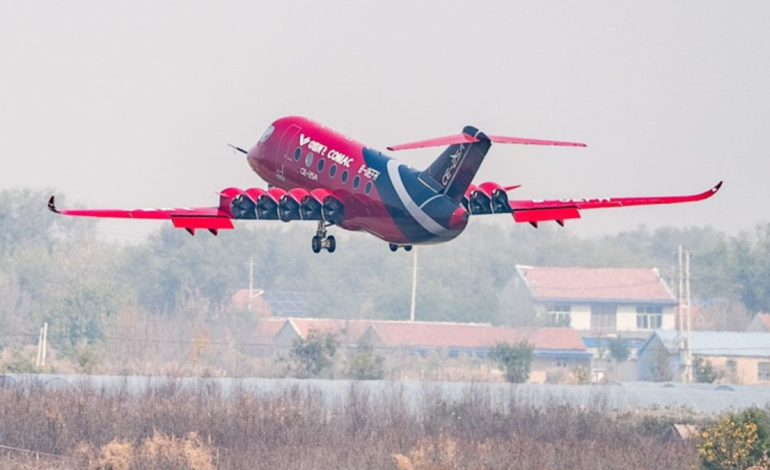
China’s 400km electric plane takes flight. (Image courtesy: Xinhua)

New Delhi: China’s 10-tonne electric commercial aircraft has completed its first piloted test flight, marking a milestone in the country’s push to develop battery-powered passenger planes. The CE-25A flew in Shandong province on Saturday, with a capacity for 19 passengers and a stated range of 400 kilometres.
Developed by the Commercial Aircraft Corporation of China (COMAC), the aircraft carried two pilots and a flight-test engineer during the test. The flight lasted 57 minutes and 46 seconds, including 16 minutes and 38 seconds in the air, covering a distance of 60.4. COMAC said the aircraft performed normally and all test results met expectations, China Daily reported.
The aircraft has a maximum take-off weight of 10 tonnes, a cruising speed of 300 kilometres per hour and a cruising altitude of 2,400 metres. It is designed primarily for commercial flights between cities.
What makes the CE-25A different?
Unlike conventional passenger aircraft that rely on fuel-powered engines, the CE-25A uses a distributed electric ducted-fan propulsion system mounted on its wings. The system uses multiple electrically driven fans instead of conventional jet or turboprop propulsion.
The aircraft is COMAC’s first electric commercial aircraft. It is being jointly developed with Chinese battery manufacturer Contemporary Amperex Technology Co Ltd (CATL), Shanghai Jiao Tong University and other domestic partners.
The CE-25A completed its first unmanned autonomous test flight on February 2. COMAC said the aircraft subsequently completed 19 unmanned autonomous flight tests before its first piloted flight.
China’s Civil Aviation Administration has accepted the aircraft’s application for a type certificate. China Daily reported that the aircraft is being developed under CCAR-25 airworthiness regulations, which also apply to large commercial passenger aircraft. However, acceptance of the application is only one step in the certification process and does not mean the aircraft is approved for commercial operations.
Can electric aircraft replace conventional planes on short routes?
The CE-25A’s 400km stated range makes regional connectivity its most immediate potential market. It could eventually connect nearby cities and smaller airports without requiring airlines to operate larger aircraft on routes with limited passenger demand.
Electric propulsion also offers potential advantages. It can eliminate direct combustion emissions during flight and reduce dependence on aviation fuel. Quieter operations and potentially lower maintenance costs could make electric aircraft attractive to regional operators.
However, replacing conventional aircraft will not be straightforward. The CE-25A can accommodate only 19 passengers, which limits its earning capacity on busy routes. Airlines will also have to consider charging time, battery replacement costs and the availability of charging facilities at airports.
A US government accountability office (GAO) report published in May, identified limited charging infrastructure as a major challenge for electric aviation. Airports face installation costs, uncertainty over future demand and the need for reliable electricity supplies.
Why long-distance electric flights remain difficult
Extending electric aircraft technology to longer routes is a much bigger challenge. The biggest obstacle is battery weight. Aircraft need considerable energy to remain airborne, but carrying additional batteries increases their weight and raises their energy requirements.
Nasa identifies weight and heat management as major challenges for electrified aviation. Its research notes that current technologies make fully electric propulsion more practical for smaller, short-range aircraft. Larger and longer-range aircraft may require hybrid electric systems that combine conventional engines with electric motors.
Both Nasa and GAO reports point out various problems related to the electric aviation industry. Both reports provide an overview of the overall technological problems of electric aircrafts without mentioning China’s CE-25A program.
The CE-25A’s immediate next important task is to successfully complete the certification process of the aircraft. The Civil Aviation Administration of China has received its application for type certificate; however, further assessment is needed before the aircraft is allowed to operate commercially.