


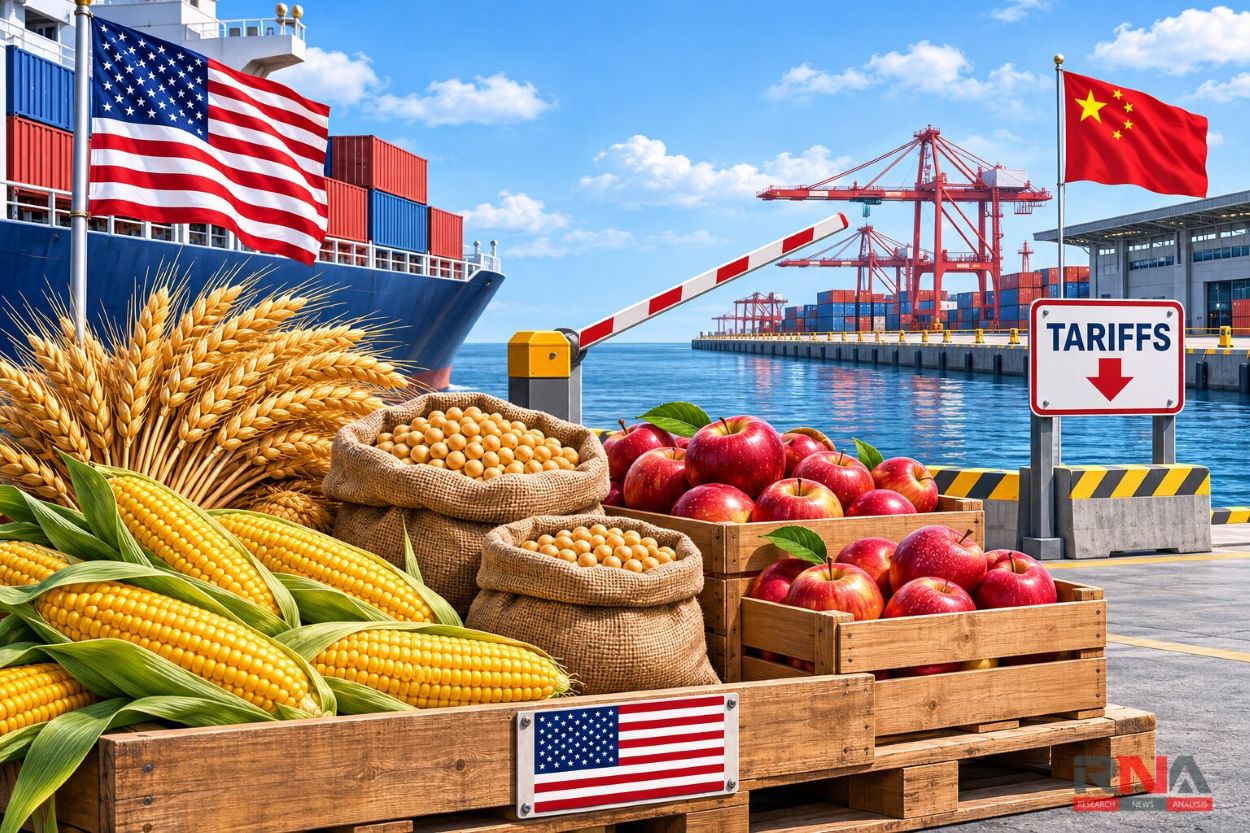



China says it’s willing to make more US farm purchases, but sets tariff cuts as condition
RNA Media illustration for representation.

New Delhi: China said on Thursday that an increase in purchases of American agricultural products would depend on implementing reciprocal tariff reductions covering $60 billion in bilateral trade. The statement puts tariff relief at the centre of efforts to expand farm exports to China, despite earlier announcements of progress between the world’s two largest economies.
The Chinese commerce ministry spokesperson, Huang Ling, said Beijing remained receptive to buying more US agricultural goods, but linked that willingness to the proposed arrangement covering $30 billion of imports on each side. According to a Global Times report, she also urged Washington to reduce non-tariff barriers and widen market access alongside cutting duties.
Huang presented agricultural cooperation as beneficial to both countries, saying it could broaden food choices for consumers and provide steadier earnings for farmers and businesses. Her remarks nevertheless made clear that Beijing’s readiness to expand purchases remained conditional on changes to the terms under which goods enter each market.
What the tariff arrangement covers
The proposed “30-for-30” framework would provide lower tariffs on selected imports valued at approximately $30 billion in each direction, using 2024 trade figures as the reference. The combined $60 billion therefore represents the value of goods covered by the arrangement, rather than the amount of tariff revenue to be waived or a commitment to make $60 billion in additional purchases.
Under the Chinese commerce ministry’s published framework, more than 90 per cent of the covered products would be exempted from additional tariffs imposed by the two countries on each other and receive most-favoured-nation treatment. This would remove the extra bilateral duties on those products, rather than necessarily make them entirely duty-free.
China’s proposed concessions cover agricultural goods, personal care products, medical devices and coal, while the US list includes Chinese toys, household appliances, baby products, kitchen and bathroom goods, and festive gifts. Beijing has said the reductions would take effect simultaneously after both governments complete their respective domestic legal procedures.
Agreement announced, implementation awaited
The distinction between an agreed framework and effective tariff relief is central to the latest statement. In its September 27 announcement, the Office of the US Trade Representative described the selected goods as recommendations for more favourable tariff treatment in the future.
The US trade representative, Jamieson Greer, said the arrangement could improve market access for approximately 30 per cent of American exports to China. He also emphasized Washington’s intention to secure compliance with agricultural and energy purchase commitments, highlighting the US focus on translating negotiations into sales.
The mechanism grew out of the decision by the US president, Donald Trump, and the Chinese president, Xi Jinping, to establish a bilateral Board of Trade during their May meeting in Beijing. Subsequent negotiations in New York and Washington from September 20 to September 23 developed the tariff framework and related arrangements for managing trade.
Farm purchases lag behind expectations
The latest Reuters report places China’s statement against a substantial gap between purchase expectations and recorded imports. Although China was on course to meet its separate soybean purchase target, imports of other US agricultural products totalled only $7.2 billion between January and September, their lowest level for that period since 2019.
The White House said in May that China had agreed to buy $17 billion of American agricultural goods annually from 2026, with a proportionately adjusted target for this year, in addition to the soybean commitment. However, Reuters reported continuing uncertainty over whether that timetable began with the May announcement or would start only after the tariff reductions were finalized.
Tariffs are not the only obstacle to a substantial increase in purchases. A separate Reuters examination of agricultural trade identified weak Chinese demand, domestic supplies of corn and meat, competing Brazilian exports and restrictions affecting US beef as additional constraints.
The two governments have also agreed to an agricultural working group, jointly led by China’s commerce ministry and the office of the US trade representative, with its first meeting planned before the end of this year. Its remit includes regulatory issues and two-way market access – matters that will help determine whether tariff concessions produce a sustained expansion in agricultural trade.


