

China captures 81.8% of global shipbuilding orders as output surges
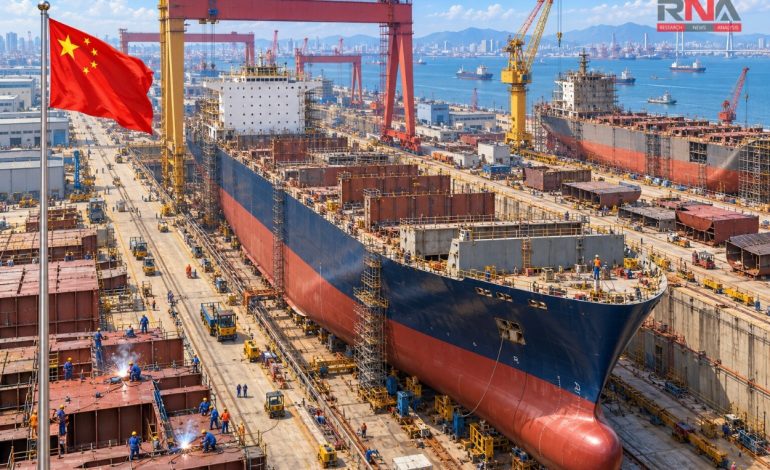
RNA Media illustration for representation.

New Delhi: China secured 81.8 per cent of global new shipbuilding orders by deadweight tonnage in the first nine months of 2026, strengthening its dominance of an industry central to international trade. Official figures released on Friday showed that Chinese shipyards also increased completed output and outstanding orders sharply, expanding both their immediate production and future workload.
According to China’s ministry of industry and information technology, shipyards received new orders totalling 175.29 million deadweight tonnes (DWT) during January–September, an increase of 163.2 per cent over the corresponding period a year earlier. Completed shipbuilding output reached 58.05 million DWT, up 50.7 per cent, accounting for 63.6 per cent of the global total.
The order backlog – vessels contracted but not yet completed – stood at 399.13 million DWT at the end of September, a year-on-year increase of 64.8 per cent. China consequently held 72.4 per cent of the world’s outstanding shipbuilding orders, placing it ahead of competitors across all three measures reported by the ministry.
The figures measure carrying capacity rather than the number of vessels or the financial value of contracts, a distinction that matters when comparing shipbuilding markets. As UN Trade and Development explains, deadweight tonnage covers the weight a vessel can carry, including cargo, fuel, water, provisions and people; it does not measure the ship’s own weight or technological complexity.
New orders, completed output and the backlog also describe different stages of the industry’s production cycle. Read together, the latest figures indicate that China’s position extends beyond ships currently leaving its yards to a substantial share of future construction, although outstanding orders are not the same as completed deliveries.
Chinese builders also increased their share of orders for vessels described in the reporting as green-powered. A Global Times report put China’s share of that global new-order market at 74.1 per cent during the first nine months, up 5.7 percentage points from the January–June period.
Industry publication SteelOrbis reported the same figures citing the China Association of the National Shipbuilding Industry for the principal production and order statistics. The published summaries did not provide a detailed breakdown of the propulsion technologies included in the green-vessel category, limiting conclusions about the environmental performance of those orders.
China’s performance builds on a longstanding concentration of shipbuilding capacity in East Asia. According to UN Trade and Development’s review of maritime transport, China, South Korea and Japan together accounted for about 95 per cent of global shipbuilding output in 2023, illustrating how heavily fleet renewal depends on a small group of manufacturing economies.
For India, the scale of China’s order book provides a measure of the competition facing its efforts to expand domestic commercial shipbuilding. New Delhi approved a ₹69,725 crore shipbuilding and maritime package on September 24, 2025, aimed at strengthening shipyard capacity, improving access to long-term finance and supporting technical skills and infrastructure.
The package includes ₹24,736 crore for shipbuilding financial assistance, a ₹25,000 crore maritime development fund and a ₹19,989 crore shipbuilding development scheme. In a parliamentary update on July 24, the government said the financial assistance component was intended to address the cost disadvantages faced by Indian shipyards against overseas competitors.
India’s development scheme targets annual shipbuilding capacity of 4.5 million gross tonnage, a measure of vessel size that cannot be directly compared with China’s deadweight-tonnage figures. Nevertheless, the latest Chinese data underline the scale of the established industrial base against which India’s expansion will compete for contracts, investment and skilled workers.