


Bangladesh advances Chinese J-10CE fighter plan as ageing Dhaka’s air force seeks generational leap
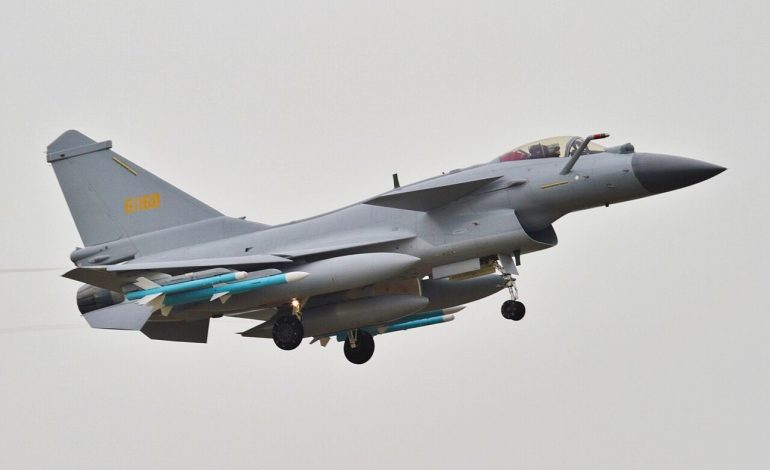
J-10B with PL-10 and PL-12 air-to-air missiles. (Wikimedia Commons photo for representation)

New Delhi: Bangladesh has moved closer to formal negotiations with China for J-10CE multirole fighter aircraft, with an official committee preparing a draft agreement for one of Dhaka’s largest defence acquisitions in years. The proposal remains subject to government approvals and budgetary support, and no contract, fleet size, price or delivery schedule has yet been officially announced.
The information and broadcasting advisor to the prime minister, Zahed Ur Rahman, disclosed the progress at a government briefing in Dhaka on Wednesday. He said Bangladesh was pursuing new multirole combat aircraft, attack and VIP helicopters and unmanned aerial systems as part of a wider programme to modernize the Bangladesh Air Force.
Rahman said draft agreements covering the J-10CE proposal and attack helicopters had been sent to the Armed Forces Division and relevant ministries for consideration. The procurements could be funded during the current financial year or transferred to the next budget if sufficient resources were not immediately available, according to his briefing.
The government has not identified the model or prospective supplier of the attack helicopters, leaving unclear whether that acquisition would form part of the Chinese package or proceed separately. Rahman also withheld the proposed number of fighters, their negotiated cost and the timeframe within which the air force expects them to enter service.
Bangladeshi media reported in October 2025 that Dhaka was preparing to acquire 20 J-10CEs by 2027 for an estimated $2.2 billion, including training, equipment, freight, insurance, infrastructure and maintenance support. More recent accounts have suggested that as many as 24 aircraft could be considered, but these figures remain provisional because the government has not confirmed either configuration.
The J-10CE is the export version of China’s J-10C, a single-engine, medium-weight and all-weather fighter designed for both air-combat and ground-attack missions. The aircraft is generally assessed to incorporate an active electronically scanned array radar, an infrared search-and-track system, integrated electronic countermeasures and compatibility with modern short- and beyond-visual-range air-to-air missiles.
Pakistan is currently the only confirmed foreign operator of the J-10CE, having inducted its first batch in March 2022. Its selection by Bangladesh would therefore give China a second overseas customer for one of its most advanced export fighters and strengthen Beijing’s position in the competitive international combat-aircraft market.
Rahman said Dhaka had taken note of the aircraft’s reported performance during the India-Pakistan military confrontation in May 2025, when Pakistan said its J-10CEs had shot down Indian fighters, including Rafales. India has not accepted Pakistan’s claimed tally or its full account of the engagements, and the precise number, circumstances and causes of the Indian combat losses remain disputed.
For Bangladesh, the proposed acquisition addresses a clear capability gap in an air force whose frontline fleet continues to depend heavily on ageing Chinese and Russian designs. The 2026 World Air Forces directory lists 35 Chengdu F-7s and eight MiG-29s in active combat service, although fleet estimates differ because Bangladesh does not publish a comprehensive operational inventory.
The F-7, which traces its design lineage to the Soviet MiG-21, forms the numerical backbone of the fighter fleet, while the eight MiG-29s provide its principal higher-performance air-defence capability. Introducing the J-10CE would give the Bangladesh Air Force a substantially newer radar, electronic-warfare and beyond-visual-range combat architecture, but its effectiveness would also depend on weapons, airborne surveillance, data links, training standards and aircraft availability.
The Bangladeshi air force’s wider inventory includes Yak-130 lead-in fighter trainers, Chinese K-8 jet trainers, Mi-17-series helicopters and C-130J Super Hercules tactical transports. These acquisitions have gradually expanded its training, transport and disaster-response capacity, but the absence of a sizeable modern fighter fleet has remained a central weakness in Bangladesh’s Forces Goal 2030 modernization programme.
Dhaka has simultaneously explored a western route to modernization, with its air force signing a letter of intent with Italy’s Leonardo on December 9, 2025, to begin discussions over Eurofighter Typhoon aircraft. The government has not explained whether the J-10CE and Eurofighter proposals are competing options or components of a possible mixed fleet, although operating both would increase training, weapons-integration and logistical costs.
China is already Bangladesh’s largest source of military hardware, having supplied combat aircraft, tanks, missile systems, naval vessels and submarines over several decades. Selecting another Chinese fighter could reduce transition costs because the air force already operates Chinese aircraft and training systems, but it would also deepen Dhaka’s long-term dependence on Beijing for spares, upgrades, weapons and technical support.
From an Indian perspective, the arrival of J-10CEs in Bangladesh would represent a notable qualitative improvement on New Delhi’s eastern flank, particularly if the aircraft were supplied with advanced radar-guided missiles and networked surveillance systems. It would not, by itself, overturn the regional air-power balance, but Indian planners would closely examine the proposed weapons package, deployment bases, training arrangements and the extent of Chinese technical involvement.
The draft agreement is therefore an important procurement milestone rather than evidence of a completed purchase. Financing, final configuration, weapons, training, infrastructure, maintenance guarantees and delivery terms must still be negotiated before the programme can translate into operational combat capability.