
44-page Russia-Iran document reveals plans for SWIFT alternatives, nuclear power, oil and aviation
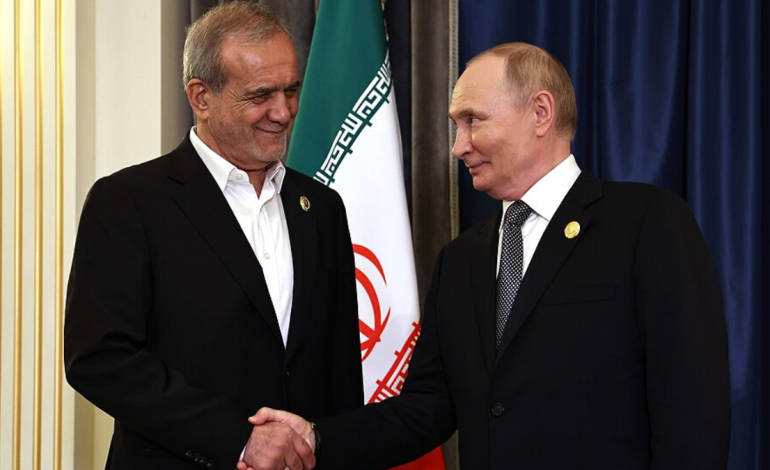
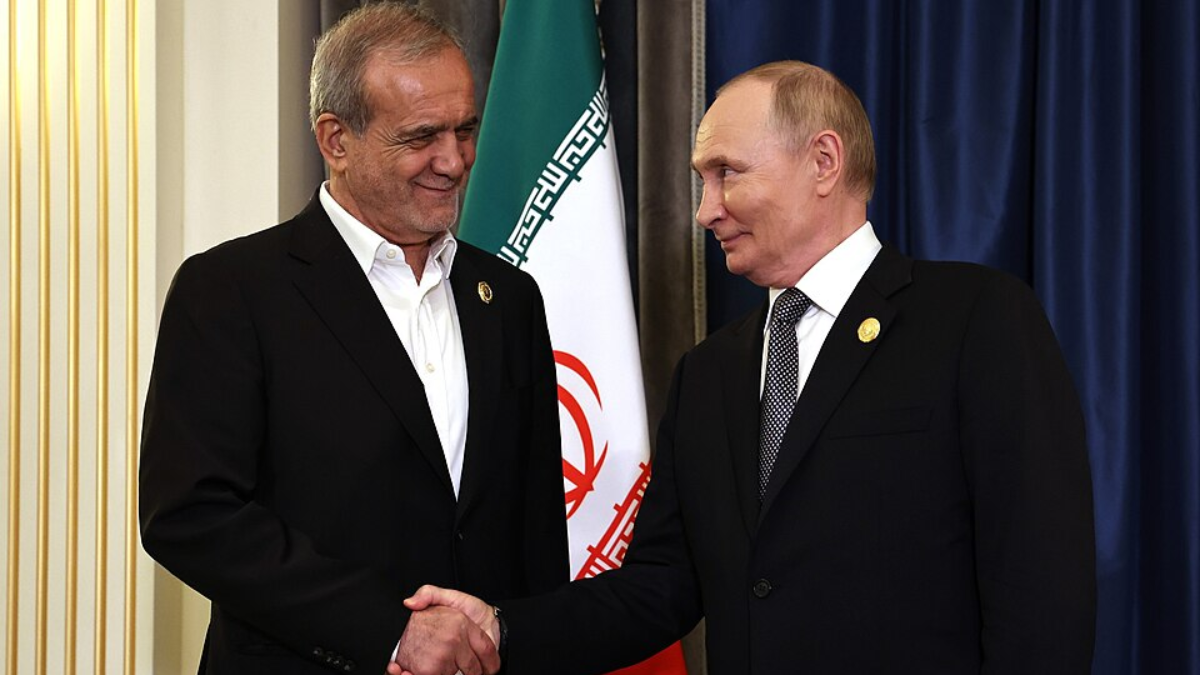
Russian President Vladimir Putin and Iranian President Masoud Pezeshkian. (Image courtesy: Wikimedia)

New Delhi: Russia and Iran were working towards a broader economic and strategic partnership by 2026, with plans covering everything from cross-border payments and oil production to nuclear power, aviation and transport. Details of the cooperation are contained in a 44-page Russian government document approved in September 2024, which sets out projects and responsibilities for the two sides.
The document, titled “Plan for Cooperation Between the Russian Federation and the Islamic Republic of Iran for 2024-2026”, was marked “For official use”. It was issued before the current Iran-US conflict by more than a year, and therefore does not show whether all the projects remain active or how the conflict has affected their implementation.
Some of the plans, however, were followed by developments in the following two years. The areas covered by the document also show that Moscow and Tehran were seeking to build systems that could support their bilateral trade and economic ties despite pressure from Western sanctions.
Fox News Digital reported that Keti Korkiya, a research analyst with the Foundation for Defense of Democracies’ Russia Program, reviewed the document and said its importance was in the wider structure of the partnership rather than any single project. She said the plans for finance, transport, energy and aviation could reduce the two countries’ dependence on systems vulnerable to Western pressure.
A major part of that effort involved changing how Russia and Iran handle money between them. The two countries planned to raise the share of bilateral trade settled in their national currencies from 68 per cent in 2024 to 71 per cent by 2026, while expanding correspondent banking accounts in rubles and rials.
Their central banks were also tasked with exploring the use of digital currencies for cross-border payments. Another provision called for financial institutions to be connected through independent systems for transmitting financial messages, although the document does not name a particular system or explicitly refer to replacing SWIFT (society for worldwide interbank financial telecommunication).
The report also noted that the Russian deputy prime minister, Alexei Overchuk, said in February 2025 that Moscow and Tehran had almost completely moved their bilateral settlements into national currencies and were using their own financial and banking messaging systems. Iran’s ambassador to Russia said around the same time that the two countries no longer needed SWIFT for their bilateral banking relations and had developed confidential alternatives, following the linking of Iran’s Shetab system with Russia’s Mir network.
The financial cooperation was also tied to BRICS and other international forums. Russia and Iran planned to coordinate against what the document calls “unilateral trade restrictions” and examine ways to counter them through expert groups, discussions and international platforms.
A US official told Fox News Digital that Washington was closely watching such alternative financial arrangements and could impose sanctions on institutions or intermediaries involved in sanctions evasion or unlawful finance. The official also said Russia and Iran could not easily reproduce the global reach, liquidity and trust provided by the US dollar-based financial system.
The same push for long-term cooperation appears in the energy sector. Russia’s state nuclear corporation Rosatom was given responsibility for work at Iran’s Bushehr nuclear plant, including fuel and maintenance for Unit 1 and continued construction of Units 2 and 3.
Bushehr Units 2 and 3 were already an established Russian-Iranian project before the 2024 plan was prepared. On September 2, 2026, Rosatom said Russian specialists had begun returning to the site, with Unit 1 preparing for scheduled maintenance and partial fuel replacement and nuclear fuel already delivered.
Moscow was also expected to expand its role in Iranian oil and gas production. The document identifies the Shadegan, Kish and North Pars fields and assigns Russia’s energy ministry and unnamed Russian companies’ responsibility for related work, with some financial details classified as confidential.
There has been subsequent movement on at least one of those projects. Interfax reported in February 2026 that Russian state-owned ZN-Vostok was developing the Shadegan field, while Iranian officials said they hoped to attract Russian investment to additional oil and gas projects.
Aviation formed another part of the planned partnership, with Russia seeking to help Iran produce selected aircraft components and assemblies. Russian authorities were expected to identify suitable parts, find Iranian manufacturers and work with Rosaviatsiya to certify production facilities, with a localization agreement targeted for March 2026 and prototype production by the end of 2026.
The two countries have since expanded cooperation in aircraft maintenance. In February 2025, the head of Rosaviatsiya said three Iranian companies had been approved to carry out maintenance and airworthiness work on Russian-operated aircraft, after an Aeroflot A330 underwent maintenance in Tehran.
Transport links were another way Moscow and Tehran sought to deepen their economic relationship. The plan includes the proposed Rasht-Astara railway, a missing 162-kilometre section of the International North-South Transport Corridor, as well as a railway connection from the Iran-Azerbaijan border towards ports on Iran’s Persian Gulf coast.
The plan also envisaged Iranian investment at Russia’s Astrakhan port, including a terminal, warehouses, a logistics park and facilities for grain and vegetable oil. Korkiya later identified an Iranian-owned terminal with a railway connection and similar storage projects, although the company could not be definitively matched to the one mentioned in the Russian document.
The cooperation extended beyond physical infrastructure. Russia and Iran planned to exchange media content, train journalists and produce at least two joint media projects, while Russian technology companies were expected to secure at least two Iranian contracts in areas such as telecommunications, information security and video games.
The Russian side of the permanent Russian-Iranian commission on trade and economic cooperation is headed by energy minister, Sergei Tsivilev. His wife, Anna Tsivileva, is a Russian deputy defence minister and the daughter of Putin’s late cousin, Reuters reported that Putin appointed her to the defence ministry in June 2024.
A European intelligence source cited by Fox News Digital in the report described the document as evidence of broad and sensitive cooperation between Moscow and Tehran, including nuclear programmes, energy and financial transactions. Korkiya said the involvement of government ministries, regulators, central banks and state companies suggested that Russia was seeking to turn a politically useful partnership into a more permanent, institutional relationship.