


Rajnath Singh launches ₹472 crore Jabalpur project to keep T-72, T-90 tanks battle-ready, says tanks still very relevant
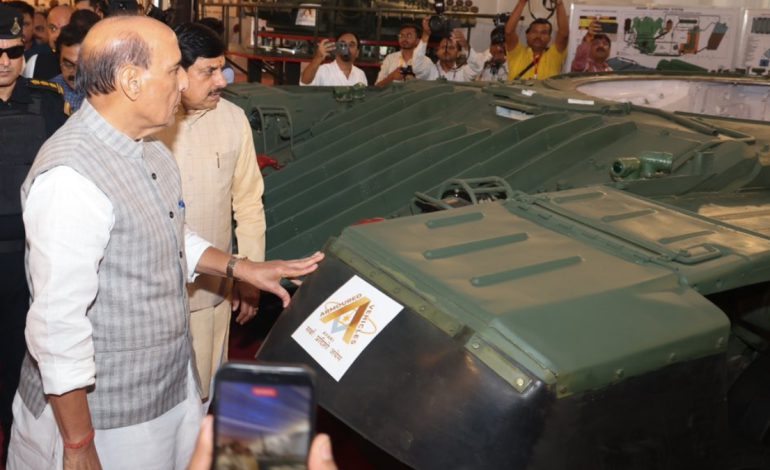
Rajnath Singh launches ₹472 crore Jabalpur project. (Image courtesy: X/@rajnathsingh)

New Delhi: The defence minister, Rajnath Singh, and Madhya Pradesh chief minister, Mohan Yadav on Thursday performed the Bhoomi Pujan for the T-Series Tanks Overhaul Project at Vehicle Factory Jabalpur (VFJ), launching work on a ₹472 crore facility for the overhaul of T-72 and T-90 tanks. The new facility will overhaul 80 tanks annually and is aimed at strengthening the Indian Army’s operational readiness while expanding India’s domestic defence capabilities.
The project will help meet the Army’s annual requirement for tank overhauls. The Indian Army needs around 230 T-72 and T-90 tanks to be overhauled every year, while the heavy vehicles factory (HVF) at Avadi currently has the capacity to overhaul around 150 tanks annually, leaving a gap that the Jabalpur facility will help fill.
The Jabalpur location will also reduce the logistical burden involved in tank maintenance. Singh said the facility’s proximity to Army field formations will cut transportation time and other logistical requirements, helping tanks return to operational service more efficiently.
Tanks remain crucial despite rise of drones
Singh said the growing use of drones, precision-guided weapons, missiles, satellites, artificial intelligence and cyberwarfare has changed the nature of modern combat but has not made tanks irrelevant. Instead, he said their role has evolved and tanks must now operate alongside other military capabilities as part of a combined combat system.
“Modern warfare demands combined capabilities rather than dependence on a single platform,” Singh said, stressing that tanks, infantry, artillery, drones, air power, surveillance and precision weapons must work together. He cited the Army’s integrated battle group concept as an example of this approach.
He said tanks should also be equipped with better sensors and capabilities suited to modern battlefields. Describing T-72 and T-90 tanks as an “iron wall” on India’s borders, Singh said they remain important for ground warfare, act as a death knell for the enemy and strengthen the morale of soldiers deployed in forward areas.
Singh also pointed to India’s existing expertise in tank manufacturing and maintenance. The HVF at Avadi has supplied around 4,400 tanks to the Indian Army over four decades, while AVNL (Armoured Vehicles Nigam Limited) has about 25 years of experience in overhauling T-72 and T-90 variant tanks.
He said the Jabalpur project would strengthen the city’s position as a centre for defence technology, maintenance, modernization and manufacturing. Singh also expressed confidence that AVNL would improve quality, productivity, innovation and global competitiveness through the project.
The new facility is expected to benefit local industry as well. Its operations will create demand for mechanical, electrical, electronic and hydraulic components, assemblies and subsystems, opening opportunities for MSMEs involved in manufacturing and ancillary services.
The defence minister said the project was part of the government’s broader push to make India self-reliant in defence. He said the aim is not only to manufacture defence equipment within the country, but also to carry out repairs and maintenance domestically, upgrade existing systems with modern technologies and develop next-generation capabilities in India.
India’s defence manufacturing base has expanded significantly over the past decade, Singh said. Defence production has risen from ₹46,000 crore in 2014 to around ₹1.80 lakh crore in financial year 2025-26, while defence exports have increased from less than ₹1,000 crore to approximately ₹39,000 crore.
Singh said India is working towards becoming one of the world’s leading defence manufacturing and export hubs. He also stressed that countries with advanced technologies, resilient supply chains, strong industrial capacity and innovation capabilities would be better prepared for prolonged conflicts.
The minister highlighted Madhya Pradesh’s efforts to build a larger defence manufacturing ecosystem. He cited the Global Investors Summit 2025, Invest MP 3.0 and industry-friendly policies, along with plans for defence manufacturing across 3,073 hectares in the Gwalior-Chambal region and proposed investments of more than ₹16,960 crore.
Vehicle Factory Jabalpur is a major military vehicle manufacturing unit under AVNL. Established in 1969, it initially produced Shaktiman 3-tonne vehicles in collaboration with Germany’s MAN, besides manufacturing Nissan 1T and Jonga vehicles in collaboration with Japan’s Nissan Motors Co.