

Race to build India’s first stealth fighter heats up, AMCA bid winner to be named within a month
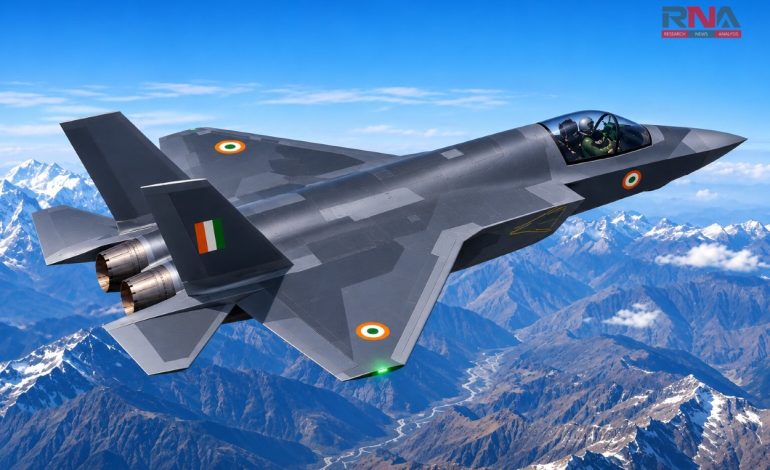
AMCA concept image by RNA Media for representation.

New Delhi: India is preparing to select an industrial partner for its ambitious fifth-generation stealth fighter programme within a month, bringing the long-awaited AMCA (advanced medium combat aircraft) project closer to prototype manufacturing. Three contenders – Tata Advanced Systems Limited (TASL), a consortium led by Larsen & Toubro (L&T) and another headed by Bharat Forge – are competing for the strategically important contract, which could reshape India’s military aviation industry.
The defence secretary, Rajesh Kumar Singh, disclosed the revised selection timeline at the ANI National Security Summit in New Delhi on Monday, confirming that the government had received proposals from all three shortlisted bidders. He expressed confidence that the evaluation would be completed in approximately a month, allowing the Aeronautical Development Agency (ADA) to move ahead with developing India’s first indigenous fifth-generation combat aircraft.
The announcement represents an important development for a project that has encountered repeated scheduling challenges, particularly over the selection of its industrial partner. More significantly, the competitive process marks a departure from India’s traditional fighter-development model, under which state-owned Hindustan Aeronautics Limited (HAL) has dominated aircraft manufacturing and production.
Three contenders, one landmark contract
According to reports, the L&T-led consortium includes Bharat Electronics Limited (BEL) and Dynamatic Technologies, while Bharat Forge has partnered with BEML and Data Patterns. Tata Advanced Systems is competing independently, making it the only standalone bidder among the three contenders.
The companies submitted their proposals by the October 30 deadline, with the bids subsequently opened for evaluation in early November. A committee constituted by the defence ministry is examining their technical capabilities and commercial proposals before recommending the development-cum-production partner for the approximately ₹15,000 crore prototype programme.
Tata Advanced Systems has emerged as a prominent contender because of its growing involvement in military aircraft manufacturing and collaborations with international aerospace companies. However, its industrial experience does not guarantee selection, as the government must assess each bidder’s engineering capabilities, manufacturing infrastructure, financial commitments and ability to meet demanding delivery schedules.
Under the execution model approved by the defence ministry in May 2025, Indian private and public sector companies were permitted to compete individually or through joint ventures and consortia. HAL’s absence from the final shortlist reflects the government’s willingness to develop an alternative aerospace manufacturing ecosystem, although the public sector manufacturer could still participate in subsequent production activities.
Building India’s first indigenous stealth fighter
The AMCA is being designed as a twin-engine, approximately 25-tonne, multirole combat aircraft incorporating low-observable technology, advanced avionics, sophisticated electronic warfare systems and internally carried weapons. These features are intended to improve its ability to penetrate heavily defended airspace, engage hostile aircraft and attack strategically important targets while reducing its exposure to enemy radar systems.
Unlike conventional fourth-generation fighters, fifth-generation aircraft combine reduced radar signatures with integrated sensors, sophisticated data processing and enhanced situational awareness. The AMCA is also expected to incorporate advanced sensor fusion and networked combat capabilities, enabling pilots to identify and engage threats more effectively in contested operational environments.
The selected industrial partner will collaborate with ADA, which retains responsibility for the aircraft’s design, to manufacture five flying prototypes and a structural test airframe. The prototypes are expected to undergo approximately 1,800 test sorties over seven years, covering flight performance, aerodynamic stability, stealth characteristics, radar, electronic systems, weapons integration and engine performance.
The programme’s industrial infrastructure will include facilities at Puttaparthi in Andhra Pradesh, where the government is establishing a major aircraft integration and flight-testing centre. In May, the defence minister, Rajnath Singh, outlined the importance of this facility as part of a broader effort to develop a domestic ecosystem for advanced aerospace manufacturing.
Engine development another major challenge
Even as the government prepares to choose the aircraft manufacturer, the question of developing a powerful indigenous engine remains unresolved. The initial AMCA-Mk1 variant is planned around the American GE F414 engine, while the more advanced Mk2 is expected to require a substantially more powerful propulsion system developed through international collaboration.
Singh revealed that a workshop would be organized in Bengaluru in December to examine competing proposals and encourage greater cooperation across India’s aerospace industry. One proposal involves the Defence Research and Development Organisation’s Gas Turbine Research Establishment and France’s Safran, while another has emerged from a partnership announced by Reliance Industries and Britain’s Rolls-Royce in August 2026.
The government must balance immediate propulsion requirements against its longer-term objective of securing indigenous design capabilities and intellectual property rights. An aircraft assembled in India but dependent indefinitely on foreign engines would leave a critical component of its operational readiness exposed to overseas supply restrictions.
Race against time for Indian Air Force
The industrial decision comes as the Indian Air Force confronts a widening gap between its sanctioned fighter strength of 42.5 squadrons and its operational fleet of approximately 29 squadrons. China has already fielded fifth-generation stealth aircraft, including the J-20, strengthening the argument for accelerating India’s own programme without compromising flight safety or development standards.
The AMCA’s first flight had been targeted for September 2028, but the contractual requirement allowing 30 months from agreement signing makes that deadline increasingly difficult to achieve. Operational induction remains an ambition for the mid-2030s, subject to successful testing, certification, engine availability and the establishment of production capacity.
Meanwhile, the chief of the air staff, Air Chief Marshal Ashutosh Dixit, said at the same summit that the Tejas-Mk1A could enter Air Force service during the current financial year, following efforts to resolve outstanding technical issues. Progress on the Tejas-Mk2 and AMCA will be crucial to India’s broader strategy of replacing ageing aircraft while developing more sophisticated indigenous combat platforms.
The AMCA selection will therefore represent more than the award of a major defence contract, but it will not by itself resolve India’s fifth-generation fighter capability gap. The decisive test will be whether the chosen manufacturer, ADA and their suppliers can transform an advanced aircraft design into a fully tested, operationally credible fighter within a realistic and enforceable development schedule.