

India’s defence blacklist names 22 firms as decade-old bans face fresh scrutiny
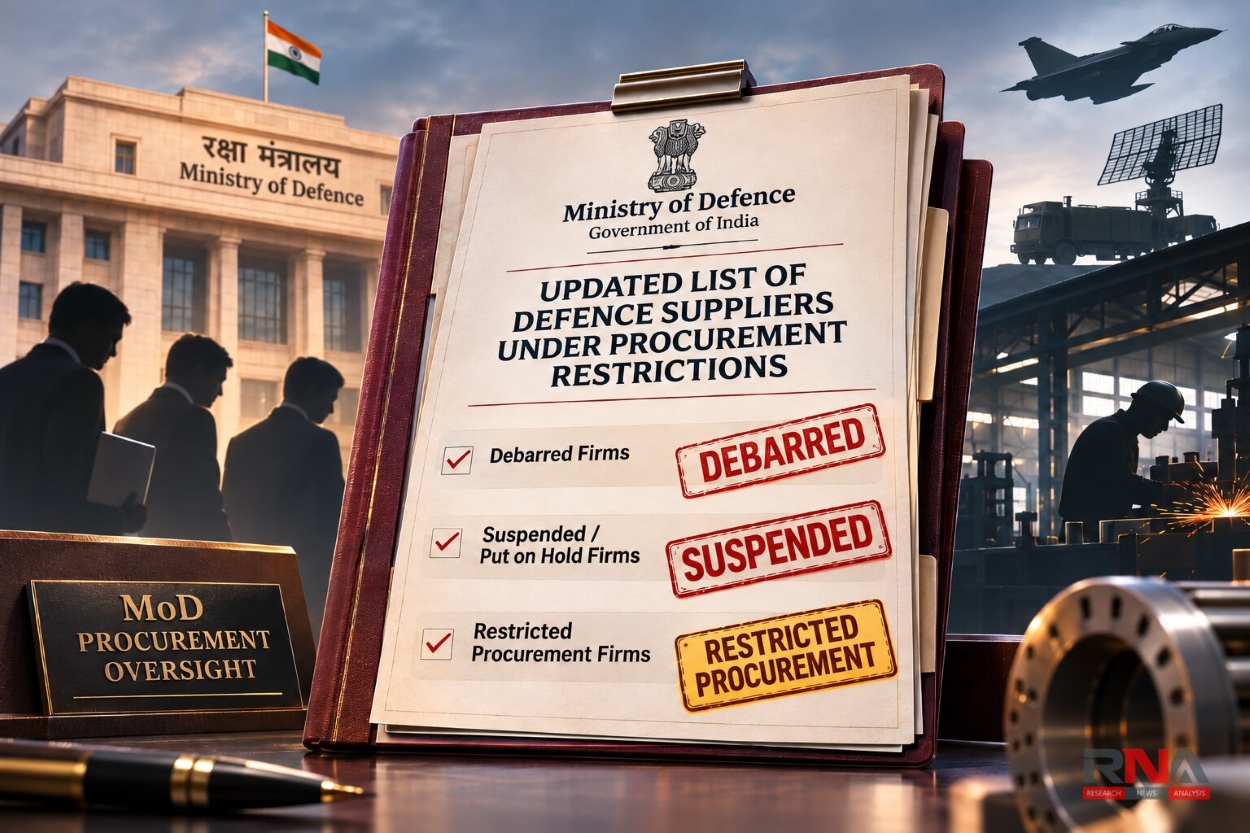
RNA Media illustration for representation,

New Delhi: The Ministry of Defence has released an updated list of 22 Indian and foreign companies facing various restrictions on military procurement, including six debarred firms, 15 suspended or put on hold, and one manufacturer subject to restricted purchases. The October 19 notification contains no new additions but has brought renewed attention to longstanding sanctions, particularly after the government revised its rules on penalizing defence suppliers and reportedly initiated a review of older blacklisting cases.
The list includes Singapore Technologies Kinetics, Israel Military Industries, Rheinmetall Air Defence, Pilatus Aircraft, Tatra Trucks and several Indian companies, although the restrictions imposed on them differ considerably. Issued by the ministry’s vigilance division, the document cites the amended guidelines for penalties in business dealings with entities, dated April 27, 2026, and directs that the consolidated list be uploaded to the ministry’s website.
The distinction between debarment, suspension and restricted procurement is important because these measures carry different implications for participation in defence contracts. A supplier facing restricted procurement may still be considered for certain purchases under specified conditions, unlike a company prohibited from entering into business dealings within the scope of its debarment.
Six firms remain debarred more than a decade
The six debarred companies are Singapore Technologies Kinetics Ltd, Israel Military Industries Ltd, Corporation Defence of Russia, RK Machine Tools Ltd of Ludhiana, Rheinmetall Air Defence of Zurich and T S Kisan & Co Pvt Ltd of New Delhi. Their inclusion is significant because the original government decision to debar these companies was announced in March 2012 for a period of 10 years.
The action followed an investigation by the Central Bureau of Investigation (CBI) into allegations of illegal gratification involving the former director-general of ordnance factories, Sudipta Ghosh, and others. According to the defence ministry’s March 5, 2012, announcement, the six firms were recommended for blacklisting on the basis of evidence gathered during the investigation, and the ministry decided to debar them after considering their responses to show-cause notices.
In a written reply to Parliament in March 2013, the government confirmed that ongoing contracts between the Ordnance Factory Board and the six firms had been cancelled. The latest list, however, cites an April 1, 2025, order concerning the companies without explaining its relationship with the original 10-year debarment or specifying fresh expiry dates.
The continued inclusion of these firms therefore raises an important administrative question about how older penalties are being treated under the revised framework. Their appearance in the register establishes the ministry’s published classification, but the document alone does not explain the individual legal basis for maintaining each restriction beyond its originally announced duration.
Pilatus, Vectra among 15 suspended companies
The substantially larger suspended or put-on-hold category includes Infotech Design System of Mauritius, IDS of Tunisia, IDS Infotech of Mohali, Aeromatrix Info Solution of Chandigarh, Shanx Oceaneering, Inter Spiro India, Experts Systems, Unitech Enterprises and Kelvin Engineering. Also listed are the Atlas group, including Atlas Telecom and Atlas Defence Services, Offset India Solutions and its associated companies and functionaries, Pilatus Aircraft, Vectra Advanced Engineering, Adigear International and Microcomm India.
These restrictions originate from separate orders issued between 2006 and 2025, rather than a single investigation or procurement controversy. Vectra Advanced Engineering, which the ministry identifies by its present name, VERT Equipment Private Limited, appears against a September 1, 2025, order, while Microcomm India’s entry refers to an order dated July 22, 2025.
Pilatus Aircraft’s inclusion is particularly relevant to the Indian Air Force because the Swiss company supplied 75 PC-7 Mk-II basic trainer aircraft. India suspended business dealings with Pilatus in July 2019 over alleged procurement irregularities, but subsequently partially relaxed the restrictions to permit essential maintenance and spare-parts support for the existing fleet.
Microcomm India’s continued appearance also warrants clarification because its suspension was announced in August 2025 as a one-year measure effective from May 28 that year. The October 2026 register retains the company without explaining whether the penalty was subsequently extended or whether its listing reflects an administrative update yet to be completed.
Tatra restricted as Leonardo, Rolls-Royce remain absent
Tatra Trucks of the Czech Republic is the only manufacturer identified under restricted procurement, based on a December 22, 2014, order. Unlike a complete prohibition, this category permits specified procurement dealings subject to the applicable restrictions, a distinction particularly relevant where alternative sources of military equipment or components are limited.
The latest list also excludes some prominent international manufacturers that previously faced restrictions, including Leonardo, formerly Finmeccanica, and Rolls-Royce. Leonardo and its former AgustaWestland subsidiary were removed from the restrictive list in November 2021, subject to conditions, following the controversy surrounding India’s cancelled VVIP helicopter contract.
Rolls-Royce had appeared alongside Tatra under restricted procurement in earlier ministry lists, including the November 2021 register. Its absence from the October 2026 document confirms a change in the published list, although the notification does not specify the order or reasoning behind that change.
Revised rules put old sanctions under the spotlight
The ministry’s amended guidelines, issued on April 27 this year provide for penalties of up to 10 years for serious integrity-related violations and up to five years for contractual non-performance, according to a May 2026 ET report. The 10-year ceiling was not entirely new, having appeared in an amendment to the earlier guidelines in December 2016, but the latest framework further distinguishes categories of misconduct and their consequences.
More significantly, a September 16 report by ET Now said the ministry had approved a broader review of longstanding bans, with committees expected to examine individual cases. The reported decision reflected concerns that prolonged restrictions could limit access to specialized technologies, reduce competition and complicate partnerships with foreign manufacturers.
There is also an unresolved legal qualification involving SARR Freights Corporation and its associated firms, whose business dealings were suspended under a February 19, 2021, order. The October notification records that the Delhi high court stayed the operation of that order and extended the stay until the scheduled hearing on November 6, but it does not establish the position following that hearing.
For India, the larger challenge is to reconcile procurement accountability with the operational requirements of its armed forces and the government’s push for defence indigenization. The latest register demonstrates that longstanding restrictions remain part of the procurement system, but it also underscores the need for transparent reviews, clearly defined penalties and timely decisions on whether individual sanctions should continue.