

Chinese parts in 689 Indian military drone tenders raise security alarm, expose gaps in self-reliance push
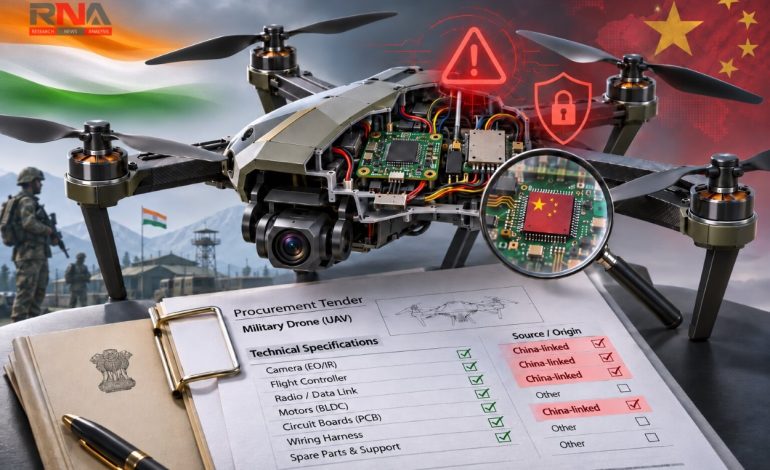
RNA Media illustration for representation.

New Delhi: A major security concern has emerged over the Indian military’s drone procurement practices after an industry investigation identified 689 government tenders specifying Chinese-made drones or components, including hundreds issued by Indian Army units. The findings have raised questions about the integrity of military unmanned systems, the effectiveness of procurement safeguards and India’s efforts to reduce its dependence on Chinese technology in sensitive defence equipment.
The Drone Federation of India (DFI), an industry association representing domestic drone manufacturers, submitted its findings to the defence secretary, Rajesh Kumar Singh, and the chief of defence staff, General NS Subramani, on Friday. Its examination of public procurement records on the Government e-Marketplace (GeM) between March 10, 2021, and November 19, 2026, found that 580 tenders – approximately 84 per cent of the total – originated from Army units.
More significantly, the number of tenders mentioning Chinese drones or components has increased sharply despite the government’s emphasis on indigenous defence manufacturing and supply-chain security. According to the federation, 355 such tenders were issued between January and November 19 this year, compared with 190 throughout 2025, indicating a growing reliance on Chinese-origin equipment in at least some procurement requirements.
Of the 355 tenders identified in 2026, Army units accounted for 328, representing more than 92 per cent of the annual total. The findings point to a possible disconnect between the military’s stated objective of eliminating potentially vulnerable foreign technologies and procurement practices at the unit level.
Chinese technology in critical drone systems
The industry investigation identified specifications mentioning several Chinese brands, including DJI, RadioMaster, SpeedyBee, HGLRC, GEPRC, Skydroid, T-Motor, EMAX, RunCam, Caddx, Hobbywing, Holybro, Foxeer, iFlight, FlySky and SIYI. DJI and RadioMaster alone reportedly appeared in 450 of the 689 tenders, demonstrating the extent to which established Chinese suppliers feature in the requirements.
The components involved are not confined to inexpensive accessories but include flight controllers, motors, electronic speed controllers, radio receivers, cameras and video transmission equipment. These systems directly influence how drones navigate, communicate, transmit information and respond to commands, making their origin and technical integrity particularly important for military operations.
The federation has warned that components sourced through insufficiently scrutinized supply chains could introduce cybersecurity vulnerabilities or create dependence on suppliers based in a potential adversary. However, the presence of Chinese-manufactured hardware does not automatically establish that a drone contains malicious software, permits unauthorized access or has compromised military information.
Another concern is the possibility of supply disruptions during a military confrontation, particularly when replacement parts are urgently required to maintain operational readiness. China’s export controls covering several drone-related technologies have reinforced fears that excessive dependence on external suppliers could leave Indian formations vulnerable during a prolonged crisis.
Defence procurement safeguards under scrutiny
Defence officials, responding to the allegations, have emphasized that GeM operates as a neutral procurement platform where buyers specify technical requirements rather than select particular manufacturers. They maintain that competitive bidding, price discovery and established Army checks provide safeguards, with suppliers facing blacklisting if they misrepresent the origin or composition of equipment.
Nevertheless, the controversy highlights a distinction between specifying a product in a tender and actually purchasing or deploying it, since the federation’s figures concern procurement notices rather than confirmed deliveries. The number of tenders therefore cannot, by itself, establish how many Chinese components have entered operational military inventories.
The findings are particularly significant because the Army has already established mechanisms to identify potentially compromised drone technology. As RNA Media reported, the AASHVAST laboratory at Delhi Cantonment was created to examine the origins of drone components and detect vulnerabilities involving embedded software, concealed access mechanisms and electronic systems.
The facility was inaugurated on August 14, 2026, as part of efforts to strengthen military cybersecurity and verify the integrity of unmanned platforms. Yet the federation identified 104 Army tenders specifying Chinese-origin equipment after its inauguration, raising questions about whether centralized technical safeguards adequately cover purchases made by individual formations.
The issue also reflects an earlier concern examined in an RNA Media report on India’s proposed military drone-security framework. That framework envisaged closer examination of hardware, firmware, communications and navigation systems to prevent vulnerabilities from entering military equipment through complex international supply chains.
India’s drone self-reliance faces a practical test
India has substantially expanded its military drone acquisitions, particularly following operational lessons from recent conflicts that demonstrated the importance of inexpensive unmanned aircraft in surveillance, precision strikes and electronic warfare. The government has simultaneously encouraged domestic manufacturers to develop critical technologies rather than rely on imported components assembled into supposedly indigenous platforms.
The defence minister, Rajnath Singh, has repeatedly emphasized that genuine self-reliance must extend beyond finished drones to their motors, batteries, software and other essential systems. However, Indian manufacturers continue to face challenges involving component availability, production scale, technological maturity and competition from established international suppliers.
The federation has consequently urged the government to prohibit Chinese-origin components in military drone procurement, introduce mandatory country-of-origin declarations and establish traceability throughout the supply chain. It has also recommended preferential consideration for domestically manufactured alternatives, arguing that consistent military demand is essential for building a competitive Indian component industry.
The larger challenge is to reconcile operational urgency with technological security without compromising equipment availability or performance. For India, where drones are increasingly central to military preparedness along the borders with China and Pakistan, the controversy demonstrates why indigenous manufacturing, credible component verification and secure procurement practices must advance together.