
CCS likely to clear ₹13,500 crore for multi-role helicopter design development, reports say
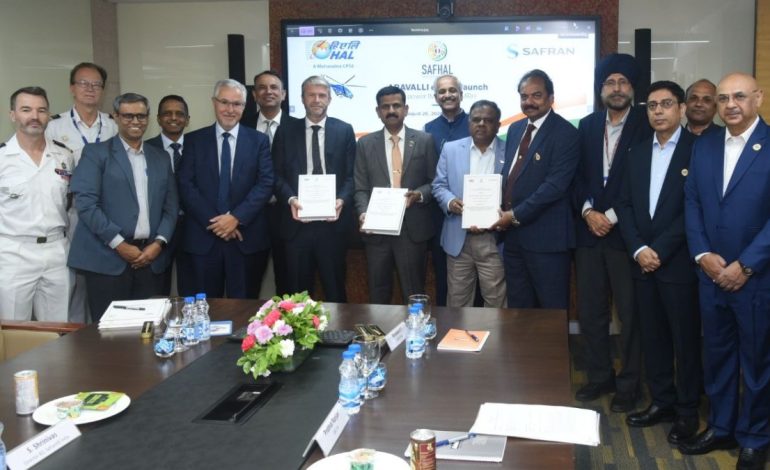
HAL, Safran Sign Contract for New ‘Aravalli’ Helicopter Engine. Image credit: X/@HALHQBLR

New Delhi: The Cabinet Committee on Security is likely to consider a ₹13,500 crore proposal for the design development of India’s 13-tonne Indian multi-role helicopter (IMRH), sources familiar with the matter told CNBC-Awaaz. The proposal has cleared the costing committee and is expected to move to the CCS next, in what could mark the next major step for a programme under development for several years.
Hindustan Aeronautics Limited (HAL) is developing the IMRH for the Indian Army and the Indian Air Force as a medium-lift platform. It is expected to eventually replace the Mi-17 fleet, the Russian-origin helicopters that form a major part of India’s existing medium-lift capability.
The proposal before the government is for design and development, not production or induction. The programme has been in preliminary design and configuration work for several years, alongside a naval version known as the deck-based multi-role helicopter (DBMRH).
HAL had already committed its own resources to the programme while government sanction was awaited. The company said in 2025 that it was investing about ₹4,000 crore in preliminary development work.
The IMRH is expected to carry a high level of indigenous content. HAL’s longer-term aim is to build a helicopter that can be designed, manufactured and supported within India, cutting dependence on foreign suppliers across its lifecycle.
Why the engine matters
The helicopter’s progress is tied closely to another Indian aerospace programme: the Aravalli turboshaft engine. HAL and Safran Helicopter Engines signed the final contract last month through their joint venture, SAFHAL Helicopter Engines, to develop and manufacture it.
The engine falls in the 3,500-4,000 shaft-horsepower class and is being built specifically for India’s next-generation medium-lift helicopter requirement, according to reports. It is meant to power both the IMRH and the DBMRH, since both are planned as twin-engine platforms.
That leaves the programme with two development timelines running in parallel. The helicopter must go through detailed design and prototype testing, while the engine must mature separately before it can be cleared for integration and flight testing.
Naval version widens programme
The IMRH is also meant to form the basis for the DBMRH, the naval variant. HAL places the DBMRH in the 12.5-tonne class, with blade folding for ship-deck operations, per Deccan Herald.
A naval version needs substantial changes in the basic platform to operate from warships and fly maritime missions. It is therefore not simply the land-based IMRH with minor tweaks, but a separate development effort built around the same helicopter family.
The Navy’s requirement gives the programme a second major customer within the armed forces. It could also expand the eventual production scale of the helicopter if the platform clears development and testing.
Larger opportunity for HAL
For HAL, the IMRH is a move into one of the most important segments of India’s military helicopter fleet. The company already builds and supports several helicopter platforms, but the IMRH would give it an indigenous medium-lift design meant to serve the Army and Air Force at a scale larger than some of its existing indigenous programmes.
The same underlying engine and helicopter technologies could also support civilian uses, such as offshore operations, utility transport and other heavy-lift work. Those applications, though, would depend on later certification and commercial decisions.
If the CCS approves the ₹13,500 crore proposal, the IMRH moves from preliminary work into a formally funded design-development phase. The milestones after that would be detailed design, prototype construction, ground and flight testing, certification and, eventually, a production decision.