


Indian Army seeks indigenous mortar specialist vehicle to speed up battlefield fire control
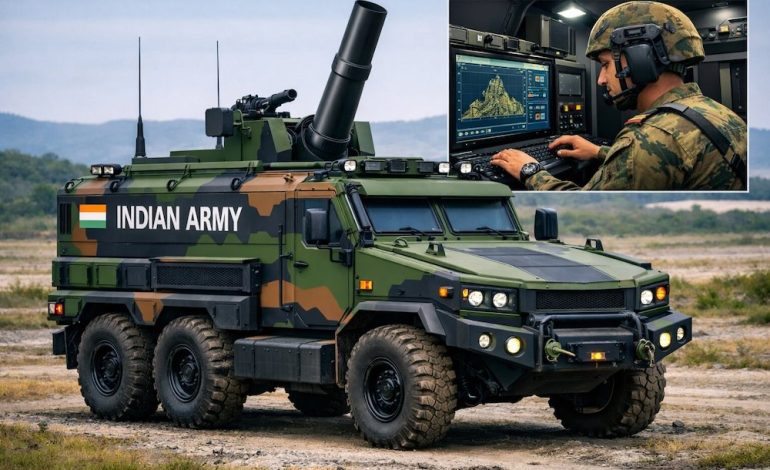
Concept image of an Indian Army mortar specialist vehicle

New Delhi: The Indian Army has issued a request for information to domestic manufacturers for a mortar specialist vehicle, signalling a sharper push to automate fire-control for 8mm and 120mm mortar systems and improve tactical mobility in demanding operating conditions.
The proposal, floated under the Defence Acquisition Procedure 2020, is an early but significant step towards a formal procurement plan. It reflects the Army’s growing preference for networked, faster and more accurate indirect-fire systems, especially for formations deployed in high-altitude and fast-changing battle spaces along the northern frontier.
The need is clear. Conventional mortar crews still rely heavily on manual computation, which can slow down response times, reduce first-round accuracy and expose detachments to counter-fire. By contrast, a vehicle-mounted ballistic computer would allow the crew to receive target data, calculate firing solutions automatically and displace quickly after firing, supporting the “shoot and scoot” concept that has become increasingly relevant in modern warfare.
What the Army wants
The vehicle is expected to be crewed by two personnel and carry around 54 rounds. The system should be able to deploy and aim within 20 seconds, and re-aim within five seconds after firing, with an accuracy requirement of zero to two mils in both axes. It is also expected to support future integration with larger-calibre mortar systems, which suggests that the Army is looking beyond a narrow point solution.
Mobility and endurance are central to the requirement. The proposed platform should reach at least 80kmph on highways, maintain a road range of 400km and a cross-country range of 250km, while also operating at altitudes of up to 17,000 feet and in temperatures from –25°C to 50°C. Those specifications strongly indicate that the platform is being shaped with the realities of deployment in J&K and along the line of actual control (LAC) in mind.
Design for modern combat
The RFI also calls for selectable 4×2 and 4×4 drive modes, independent suspension, automatic transmission, run-flat tyres and a central tyre inflation system. Survivability standards include STANAG Level 1 protection against small-arms fire and shell splinters, along with anti-drone cages, a feature increasingly seen on frontline platforms after lessons drawn from the Ukraine war.
The Army has also asked for military-grade touchscreen displays and compatibility with in-service communications equipment, including future software-defined radios. That points to a broader effort to bring mortar units into a more connected battlefield architecture, where observers, fire controllers and manoeuvre elements can work faster and with fewer errors.
Bigger modernization push
This requirement fits neatly into the Army’s wider artillery and indirect-fire modernization drive. In recent years, the force has inducted the M777 ultra-light howitzer, advanced the indigenous advanced towed artillery gun system, and expanded Pinaka multi-barrel rocket launcher inventory. An automated mortar vehicle would extend that networked firepower deeper into infantry battalions, which remain the decisive level in many tactical engagements.
There is also a clear industrial dimension. By seeking an indigenous solution under DAP 2020, the Army is giving domestic defence firms an opportunity to develop a platform that could be produced at scale and, potentially, exported later. That approach aligns with India’s broader push for self-reliance in defence manufacturing while still meeting demanding operational requirements.