




World’s freshwater is shrinking: Record heat drains rivers, lakes and reservoirs, raising fears over water security
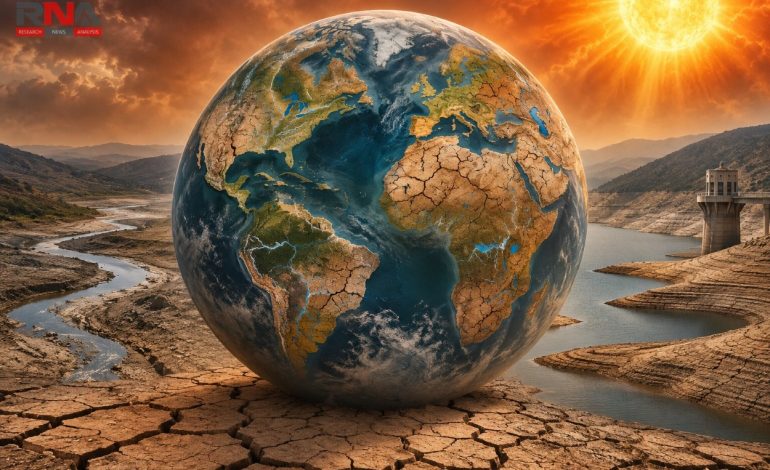
RNA Media illustration for representation.

New Delhi: An international scientific study has revealed that the exceptional global heat of 2023 and 2024 triggered the steepest simultaneous decline in freshwater resources across the world’s rivers, lakes and reservoirs in more than three decades. The findings raise serious concerns over long-term water security, agricultural productivity, energy generation and the ability of nations to manage increasingly unpredictable freshwater supplies.
The study, published in the journal Science on Thursday, found that global river discharge during the two years fell by 5.7% against the 1991–2020 average, while active water storage in lakes and reservoirs declined by 9.5%. The simultaneous contraction of these freshwater resources was the most severe recorded during the entire study period, spanning 1991 to 2025.
Led by Yongqiang Zhang of the Chinese Academy of Sciences, the international research team examined river discharge data from 150 major river basins and satellite observations covering more than 1.2 million lakes and reservoirs. Scientists used hydrological modelling and machine learning to reconstruct changes in freshwater availability across the planet over 35 years.
The findings indicate that annual global river discharge fell by approximately 2,000 cubic kilometres during 2023 and 2024 compared with the long-term average, while lakes and reservoirs experienced a storage deficit of around 640 cubic kilometres. The latter alone represents about 640 trillion litres of water.
Why a warmer world could have less freshwater
One of the most significant findings of the research is that an increase in global precipitation does not necessarily translate into greater freshwater availability on land. Rising temperatures are altering the geographical distribution of rainfall while accelerating the loss of moisture through evaporation.
A warmer atmosphere can hold more water vapour, creating conditions for heavier rainfall when that moisture condenses. However, during 2023 and 2024, much of the additional precipitation occurred over the oceans, leaving large terrestrial regions with insufficient rainfall to replenish their freshwater reserves.
Higher temperatures also accelerate evaporation from lakes, reservoirs and soil, while vegetation loses more moisture through transpiration under suitable conditions. Together, these processes can reduce the amount of water available to sustain river flows, particularly during prolonged periods of heat.
This helps explain an apparent contradiction increasingly evident in climate-related disasters – regions can experience devastating floods and still face chronic water shortages. Short-lived episodes of intense rainfall may generate enormous volumes of surface runoff without adequately restoring groundwater or sustaining river discharge throughout the year.
South America bears the brunt
South America emerged as the region most severely affected during the two-year period, with river discharge falling by 17.8% and water storage in lakes and reservoirs contracting by 16.5%. The decline extended to traditionally water-rich regions, including the Amazon basin, which contains the world’s largest river system.
According to a research assessment released by Austria’s Vienna University of Technology, the warming of the tropical Pacific during El Nino coincided with unusually high temperatures in the tropical North Atlantic. The interaction between these two oceanic conditions disrupted atmospheric circulation, depriving large parts of South America of rainfall.
The ecological consequences were particularly severe in the Brazilian Amazon, where more than 200 pink river dolphins died in Lake Tefé in 2023 following extreme drought and exceptionally high water temperatures. Falling river levels also threaten inland navigation, fisheries and communities dependent on waterways for essential supplies.
A growing global water crisis
The latest research reinforces concerns raised by the World Meteorological Organization (WMO) in its State of Global Water Resources 2025 report, released on September 17, 2026. The agency identified a persistent decline in terrestrial water storage since the middle of the previous decade.
The WMO found that 36% of the global river basin area experienced below-normal discharge in 2025, while glaciers across all major glaciated regions registered net ice losses for the fourth consecutive year. The agency also documented persistent groundwater depletion across several regions, including northwestern India.
Although the new study found some recovery in aggregate global river discharge in 2025, scientists cautioned against interpreting the improvement as a reversal of the underlying risks. The severity of future freshwater shortages will depend on the interaction between global warming, natural climatic fluctuations and human consumption.
What it means for India and South Asia
The findings carry particular significance for India, where agriculture, hydroelectric power generation, industrial activity and urban water supplies are heavily dependent on seasonal rainfall and river systems. Increasingly erratic monsoon patterns could complicate the management of reservoirs, forcing authorities to balance flood prevention against the need to conserve water for subsequent dry months.
The WMO has already identified recurring freshwater storage deficits in the headwaters of the Ganga and Indus river systems between 2021 and 2025. Significantly, parts of northern India experienced below-normal terrestrial water storage in 2025 despite relatively strong river flows across much of South Asia.
Water availability also has geopolitical implications for the subcontinent, where several major rivers cross international boundaries. Greater uncertainty over seasonal flows could complicate water-sharing arrangements involving India, Pakistan, Bangladesh, Nepal and China, particularly during prolonged droughts.
Water security becomes a strategic imperative
Beyond agriculture and drinking water supplies, declining freshwater availability could disrupt electricity generation, industrial production and global food supply chains. Hydroelectric facilities are directly exposed to fluctuations in reservoir levels, while conventional power stations and several manufacturing industries require substantial quantities of water for cooling and other processes.
The research underlines the importance of improved satellite-based monitoring, groundwater conservation, modernized irrigation systems, better reservoir management and international cooperation over shared river systems. It also highlights the need to incorporate changing climatic conditions into infrastructure planning rather than relying exclusively on historical rainfall and river-flow patterns.
For governments, the emerging challenge is not simply managing a world with potentially less accessible freshwater but preparing for increasingly unpredictable supplies. As global temperatures rise, even historically water-abundant regions may find themselves vulnerable to severe shortages.