


Attacks on West Bank healthcare workers surge over 350 per cent as Palestinian medics report assaults and intimidation
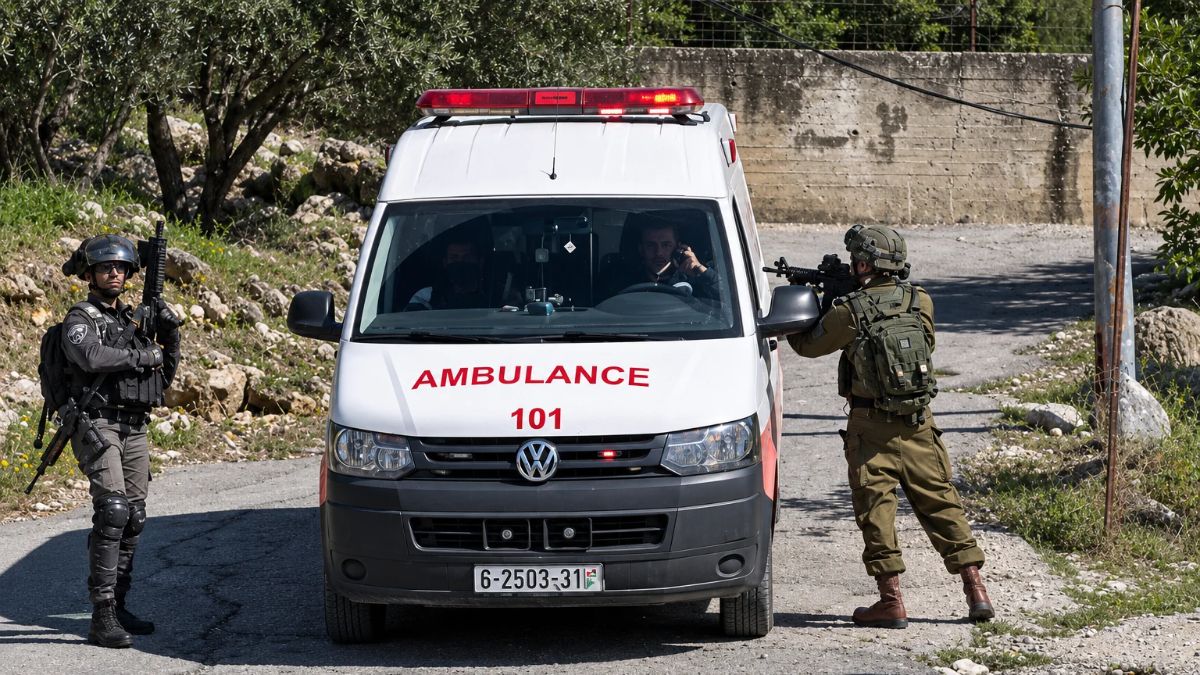
Palestinian medics report assaults and obstruction of emergency care in the West Bank. (A digitally enhanced photo shared by X/@pal_gcc_en)

New Delhi: Violent incidents affecting healthcare in the occupied West Bank rose from 93 in 2022 to 422 in 2024, an increase of more than 350 per cent. Palestinian ambulance crews have described being assaulted, threatened at gunpoint and prevented from reaching wounded patients as restrictions on emergency medical access intensify.
The figures come from a report by Physicians for Human Rights Israel (PHRI), titled To Reach, To Treat, To Survive, published on November 22. Based on 25 in-depth interviews with paramedics, ambulance drivers and medical volunteers around Nablus, the report documents allegations of physical assaults, threats, humiliating searches and obstruction of emergency assistance by Israeli soldiers and settlers.
Medics recount dangerous rescue missions
The dangers associated with delayed medical intervention are illustrated by an account from a paramedic operating near Nablus. According to his testimony recorded by PHRI, Israeli troops denied him permission to approach an injured Palestinian despite the victim being within reach. Recalling the incident, he said, “He lay there bleeding until he died.” The ambulance crew was eventually allowed access, but the man had already succumbed to his injuries.
The interviews reveal an atmosphere of insecurity surrounding emergency medical operations in the occupied West Bank. All 25 participants expressed concerns about their personal safety and the possibility of being denied access to patients. Their accounts included allegations of physical violence, armed intimidation and degrading treatment, with some reporting that threats continued even while they were administering medical assistance.
The danger has also taken a psychological toll, according to the report. “Every phone call means taking a risk. And every time I leave home, there’s a chance I won’t come back,” one ambulance driver said in testimony also cited by Al Jazeera.
Imran Anati, who authored the PHRI report, linked the worsening conditions to developments following October 7, 2023. He described the situation as a “dangerous escalation” and argued that repeated interference with emergency services reflected an organized pattern rather than unrelated incidents. Speaking to Al Jazeera, Anati accused Israel of a “systematic assault on Palestinian emergency medical care”, an allegation that raises serious concerns over the protection of medical personnel.
WHO figures reveal wider healthcare crisis
The World Health Organization (WHO) recorded 233 attacks on healthcare in the occupied West Bank in 2025, affecting 165 ambulances, according to the United Nations Office for the coordination of humanitarian affairs (OCHA). Of those attacks, 196 involved obstructed healthcare access, including checkpoint delays, searches and restrictions on medical transport, rather than necessarily physical assaults.
OCHA documented 925 movement obstacles across the occupied West Bank in December 2025, compared with 642 in June 2023, an increase of approximately 44 per cent. The restrictions include staffed checkpoints and road gates that can force ambulances onto longer routes or prevent crews from reaching patients.
In 2025, 36 per cent of 87,427 patient permit applications for treatment in east Jerusalem or Israeli facilities were denied or remained pending, compared with 18 per cent in 2022, OCHA reported. Such barriers can be particularly dangerous for wounded patients, pregnant women and others requiring urgent medical attention.
The PHRI findings and WHO figures cover different reporting periods and categories and are not directly comparable. Together, they underscore mounting concerns over emergency medical access and the protection owed to healthcare personnel and medical transport under international humanitarian law.