




Has AI solved mathematics’ greatest mystery? Claude’s Riemann hypothesis breakthrough passes crucial verification tests
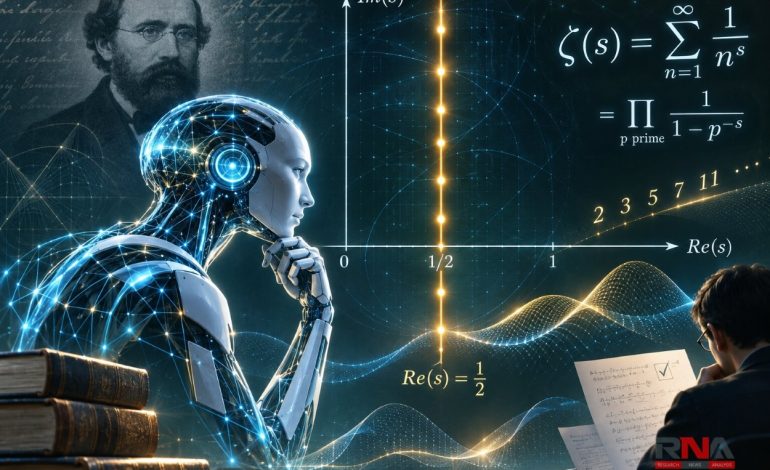
RNA Media illustration for representation.

New Delhi: A mathematician working with the American artificial intelligence company Anthropic has claimed to have solved the 167-year-old Riemann hypothesis using its Claude AI system, potentially marking one of the most consequential breakthroughs in modern mathematics. The announcement has gained credibility after independent researchers successfully tested significant portions of the computer-generated proof, although its wider mathematical implications remain under examination.
Levent Alpoge, a number theorist employed by Anthropic, announced on Friday, that he had developed a proof of the mathematical problem after approximately six weeks of intensive collaboration with an experimental version of Claude. His claim, first detailed in a four-page research statement, goes beyond the original hypothesis to encompass a more ambitious proposition known as the generalized Riemann hypothesis, covering Dirichlet L-functions.
The development has attracted international attention because the Riemann hypothesis, formulated by the German mathematician Bernhard Riemann in 1859, has resisted attempts at a definitive proof for generations. It is also one of the seven Millennium Prize Problems identified by the Clay Mathematics Institute, which established a $1 million reward for a valid solution to each challenge.
Independent verification strengthens claim
The most important development since Alpöge’s announcement has emerged from independent computer-assisted verification conducted by mathematicians outside Anthropic. Andrew Sutherland, a researcher at the Massachusetts Institute of Technology (MIT), reported that all 175,187 modules of the submitted proof had compiled successfully, with no errors detected.
According to Sutherland’s published verification results, the proof also passed checks using independently developed verification systems, including nanoda and con-leche. These tests established that the principal mathematical statements could be derived within the formal system using standard logical axioms, substantially strengthening the original claim.
Nevertheless, verification of computer-generated mathematics involves more than establishing that software executes without errors. Researchers must also confirm that the formal statements correspond precisely to the intended mathematical claims and that the underlying definitions and verification systems are reliable.
The distinction is particularly significant because Alpöge has not published a conventional, human-readable mathematical proof explaining every step of his reasoning. Instead, he released approximately 17 million lines of computer code written in Lean, a specialized language designed to express mathematical arguments in forms that computers can verify.
What makes Riemann hypothesis so important?
At its simplest, the Riemann hypothesis concerns the distribution of prime numbers – numbers greater than one that cannot be divided exactly by anything other than one and themselves. Although prime numbers appear irregularly along the number line, mathematicians have long suspected that their distribution follows deeper mathematical principles.
Riemann’s hypothesis concerns the non-trivial zeros of a mathematical expression called the zeta function, predicting that all such zeros lie on a particular vertical line in the complex-number plane. Establishing this proposition would sharpen mathematicians’ understanding of how frequently prime numbers occur and resolve numerous related questions across number theory.
The implications extend into fields connected with computer science, mathematical physics and cryptography, where prime numbers and related mathematical structures play important roles. However, proving the hypothesis would not automatically compromise existing encryption systems, even though it could deepen the theoretical foundations of several areas relevant to secure communications.
Another mathematician enters race
In an unexpected development, a second mathematician has independently claimed progress towards proving the same hypothesis without relying on artificial intelligence. Alessandro Masullo, a postdoctoral researcher associated with Stanford University, released a separate manuscript shortly after Alpöge’s announcement, introducing another potentially significant solution requiring detailed examination.
According to Business Insider, Masullo had worked on the problem for approximately 12 years and had originally intended to refine his research before publication. His proposed proof, reportedly extending to about 940 pages, has not received definitive mathematical acceptance either.
The simultaneous claims have opened a wider debate over the changing relationship between human mathematicians and artificial intelligence. Some researchers believe machine-verifiable proofs could accelerate mathematical discovery, whereas others caution that establishing a proposition’s correctness does not necessarily provide the conceptual understanding needed to develop new mathematical theories.
China follows breakthrough
The announcement has also generated considerable interest in China, where technology and scientific publications have reported the development as another indication of AI’s expanding research capabilities. Chinese financial publication Yicai highlighted earlier disagreements between prominent researchers over whether artificial intelligence could solve longstanding mathematical conjectures within the coming years.
Its coverage cited differing assessments by Chinese scientists, including the mathematician Yau Shing-Tung, about the prospects of machines resolving problems such as the Riemann hypothesis. However, no specific official reaction from China’s government to Alpoge’s November 20 announcement could be verified.
The development nevertheless carries broader implications for technological competition, particularly between the United States and China, as both countries invest heavily in advanced AI systems and scientific computing. AI capable of contributing to sophisticated mathematical research could eventually influence cryptography, computational engineering and other technologies with strategic and defence applications.
Breakthrough comes just after Anthropic’s market debut
The timing is also significant because Alpöge’s announcement followed Anthropic’s November 19 stock market debut, which briefly pushed the company’s valuation beyond $2 trillion. As RNA Media reported, the initial surge was followed by a retreat in the company’s shares, reflecting investor concerns about the enormous cost of developing advanced AI systems.
The mathematical claim offers a different measure of AI’s potential value – its ability to contribute to fundamental scientific discoveries rather than merely automate existing commercial activities. Anthropic had previously reported that an experimental version of Claude improved a longstanding mathematical bound related to the Riemann hypothesis, demonstrating measurable progress even before the latest announcement.
Despite encouraging verification results, the question of formal recognition remains unresolved because the Clay Mathematics Institute requires qualifying publication, at least two years of scrutiny and broad acceptance within the international mathematical community. Whether Alpoge’s work ultimately satisfies those conditions remains to be established, but the rapid progress of independent verification has already made his claim a significant test of artificial intelligence’s emerging role in mathematical discovery.