




Jordan sentences three to death by hanging for church massacre. Why attack carries wider security implications?
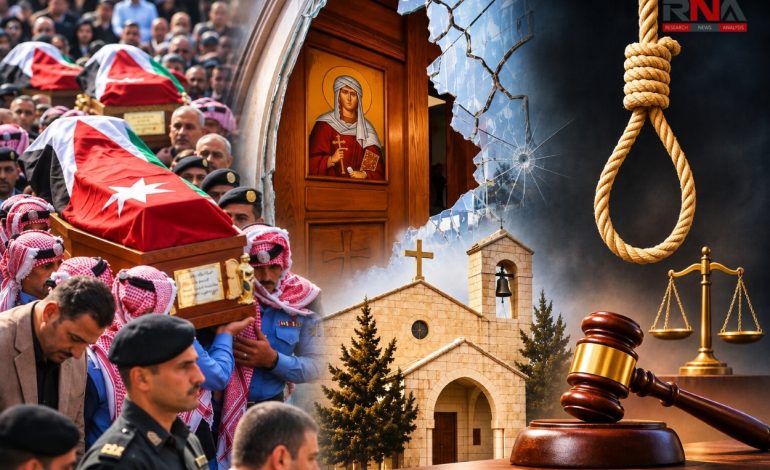
RNA Media illustration for representation.

New Delhi: A court in Jordan has sentenced three men to death by hanging for a terrorist attack on a Greek Orthodox church that killed nine worshippers during a funeral service last month, bringing a significant development in a case that has shaken the kingdom’s religious communities. The verdict on Sunday comes as Jordan continues to confront the security and diplomatic consequences of the October 23 massacre, including cross-border military operations against suspected militants in neighbouring Syria.
The state security court in Amman convicted the three defendants of carrying out terrorist acts resulting in multiple deaths, illegally possessing weapons and ammunition, conspiring to commit terrorism and promoting extremist ideology. According to Jordan’s official news agency, Petra, one of the defendants was additionally found guilty of financing terrorist activities under the country’s anti-money laundering and counterterrorism legislation.
The death sentences are not immediately final, as Jordanian law provides for an automatic review by the court of cassation, the country’s highest judicial authority. The ruling followed an unusually rapid investigation and prosecution, with security authorities arresting the principal suspects within three days of the attack and the court beginning proceedings in early November.
Funeral shooting that shocked Jordan
The attack occurred at St George’s Greek Orthodox Church in Hammoud village, in the southern governorate of Karak, where mourners had gathered for a funeral on October 23. Witnesses described how armed men arrived in a pickup truck at about 2pm and opened fire on people assembled in the church courtyard, killing nine men and injuring dozens of others.
According to eyewitness accounts, women and children were largely inside the building when the shooting began, and people inside hurriedly secured the doors to prevent the gunmen from entering. The attackers reportedly fired through windows after failing to force their way inside, turning what should have been a solemn religious ceremony into one of Jordan’s deadliest attacks against its Christian minority in decades.
The suspects, identified by investigators as two Jordanian brothers and a relative by marriage, escaped but were located on October 26 in an abandoned building in Karak. Security personnel arrested all three after an exchange of gunfire in which the suspects were wounded, although no members of the security forces were reported injured.
Investigators subsequently recovered weapons and ammunition and examined evidence linking the defendants to the shooting, leading prosecutors to file several terrorism-related charges. The wider proceedings also involved two other suspects accused of supplying the weapons used in the assault, although Sunday’s death sentences concerned the three principal attackers.
Why the attack carries wider security implications
The massacre has particular significance in Jordan, a predominantly Muslim country where Christians account for roughly two to three per cent of the population and have historically maintained a visible place in national life. Karak itself has a longstanding Christian community, making the deliberate targeting of mourners at a church especially disturbing in a country whose authorities have consistently emphasized religious coexistence and internal stability.
Although authorities identified the attackers as followers of extremist ideology, investigators have not publicly established that the three convicted men operated under the direct command of an organized terrorist group. This distinction is important because ideological sympathy, operational support and formal membership in a terrorist organization represent different levels of involvement, particularly when assessing the scale of a possible militant network.
The consequences have already extended beyond Jordan’s borders, with the Jordanian military launching airstrikes against suspected militant positions in southern Syria on October 26, as RNA Media had reported. The operation, presented by Amman as a response to the church massacre, reportedly killed seven people, including three children, and triggered a diplomatic dispute after Syrian authorities challenged Jordan’s account of prior coordination.
However, the two countries subsequently moved to contain the dispute, with officials meeting in Damascus on November 9 and agreeing to establish a joint security and technical committee to investigate the airstrikes. Jordan also expressed condolences over the civilian deaths and agreed to address the resulting harm, illustrating the difficult balance between conducting counterterrorism operations and maintaining workable relations with a strategically important neighbour.
Jordan’s security concerns have been reinforced by another attack in Amman on November 5, when a police officer was stabbed to death and another injured near the Sri Lankan embassy. Authorities treated that incident as suspected terrorism but had not established a direct connection with the Karak church shooting, underscoring the importance of distinguishing separate investigations from evidence of a coordinated campaign.
The church massacre has also affected religious life, with Christian leaders deciding to cancel Christmas festivities this year while allowing church services and prayers to continue. Sunday’s verdict represents an important judicial response to the killings, but the broader challenge for Jordan remains preventing extremist violence without allowing religious divisions or cross-border tensions to undermine the kingdom’s internal security.


