



India plans 70 per cent cut in visa application fields, overhaul expected in 2027
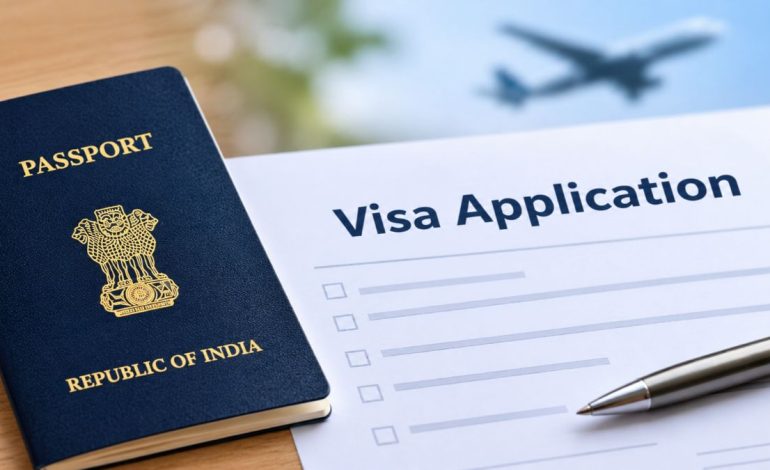
RNA Media illustration for representation.

New Delhi: India is planning to reduce visa application fields by approximately 70 per cent across 22 categories, with the changes expected to take effect in 2027. The proposed overhaul aims to eliminate repetitive questions, simplify documentation and make the application process easier for international travellers.
A senior government official told the Hindu on November 3 that the redesigned forms would be brought closer to international standards by removing unnecessary administrative requirements.
Among the proposed changes is eliminating the district field from applicants’ address details, since several countries lack an equivalent administrative designation. Foreign visitors may also be permitted to provide their hotel or guesthouse address instead of furnishing a separate local contact address.
India’s existing e-visa application reportedly extends to nine pages, requiring extensive personal information and background disclosures.
Applicants must answer questions concerning involvement in cybercrime, terrorism, espionage, sabotage, genocide and political violence. The proposed simplification targets redundant information, with no indication that security-related screening requirements will be withdrawn.
The initiative comes as India struggles to restore foreign tourist arrivals to pre-pandemic levels.
According to the Ministry of Tourism, foreign tourist arrivals fell to 91.5 lakh in 2025, compared with 1.093 crore in 2019. Arrivals stood at 95.21 lakh in 2023 and increased to 99.52 lakh in 2024 before declining again.
The 2025 figure represents an 8.07 per cent decline from 2024 and remains approximately 16 per cent below the pre-pandemic benchmark.
Tourism industry representatives have proposed additional measures, including a uniform 120-day advance application window for travellers from eligible countries and extending e-visa access to Chinese nationals.
They have also requested application forms in Spanish, German and Italian to improve accessibility for international visitors.
Another recommendation involves issuing protected-area permits (PAP) and restricted-area permits (RAP) alongside visas, eliminating the need for separate applications.
Foreign visitors currently require special permits to enter designated sensitive regions. These include Arunachal Pradesh, Manipur, Mizoram, Nagaland, Sikkim, the Andaman and Nicobar Islands, and specified areas of Jammu & Kashmir, Himachal Pradesh, Rajasthan and Uttarakhand.
India’s existing e-visa system covers nine sub-categories, including tourism, business, medical treatment, education and transit. The facility is intended to streamline legitimate international travel while maintaining immigration controls.
The Ministry of Home Affairs has convened meetings to examine further liberalization of the visa regime.
In an August 2025 parliamentary response, the ministry described visa liberalization as an ongoing process that considers security, inbound tourism, investment and bilateral relations.
However, the proposed 2027 changes have yet to be formally notified, and the government has not announced a definitive implementation date.