

‘Operation Sindoor showed India’s resolve,’ Rajnath Singh tells Asean, offers counterterror expertise
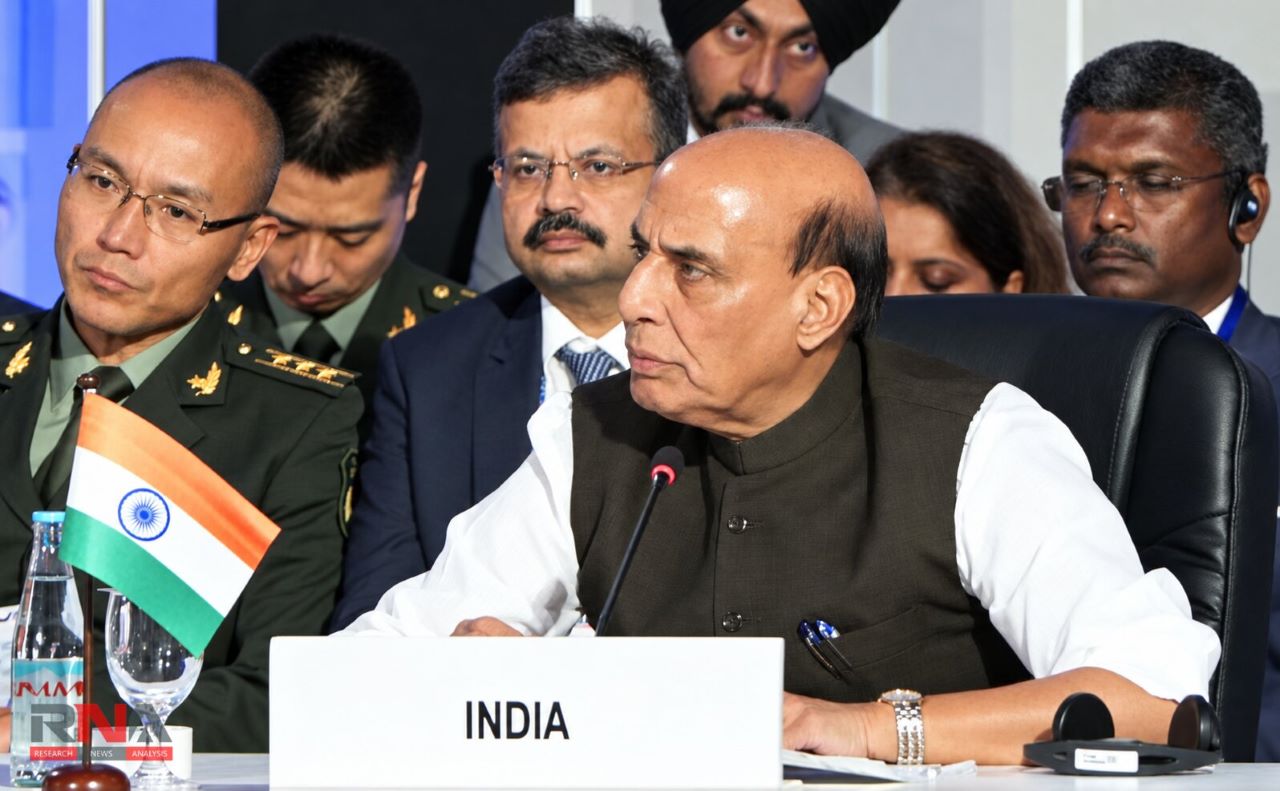
Rajnath Singh during his address at ADMM-Plus 2026 in Cebu, Philippines, on October 29, 2026.

New Delhi: The defence minister, Rajnath Singh, on Thursday, offered to share India’s operational experience in counterterrorism with regional partners, citing Operation Sindoor as a demonstration of its resolve against state-sponsored terrorism. Addressing the 13th Asean Defence Ministers’ Meeting-Plus (ADMM-Plus) in Cebu, the Philippines, he called for stronger joint exercises, intelligence exchanges and training to tackle threats that cross national boundaries.
Singh said India’s approach had evolved through decades of confronting cross-border security challenges, with its methods tested and refined during actual operations. His address combined that offer of practical cooperation with proposals to strengthen maritime security and build closer links between young people in India and Southeast Asia.
Counterterrorism beyond classroom
Describing India’s experience as “not theoretical classroom knowledge”, Singh said the country had acquired its expertise through sustained engagement with complex security threats. He presented Operation Sindoor as an example of that approach, saying the destruction of terrorist infrastructure had also conveyed India’s position on state-sponsored terrorism.
The offer to share that experience would involve joint military exercises, capacity-building programmes and more extensive intelligence cooperation. Singh argued that terrorism’s ability to operate across geographical boundaries made stronger collective capabilities necessary.
India and Malaysia already co-chair the ADMM-Plus experts’ working group on counterterrorism for the 2024–2027 cycle, providing an existing mechanism for such cooperation. Singh placed his proposal within that framework while reiterating India’s support for an open, inclusive and rules-based Indo-Pacific.
India launched Operation Sindoor on May 7, 2025, following the Pahalgam terrorist attack in which 25 Indians and a Nepali citizen were killed. The defence ministry said the opening strikes targeted nine locations in Pakistan and Pakistan-occupied Kashmir (POK) that it identified as terrorist infrastructure used to plan and direct attacks against India.
The operation was followed by several days of military exchanges between India and Pakistan. The two countries’ directors general of military operations subsequently agreed to stop firing and military action on land, in the air and at sea from 5pm on May 10, 2025.
Maritime security and open sea lanes
Singh also highlighted the Navy’s deployment in the Gulf of Aden since 2008, saying Indian warships had protected thousands of merchant vessels and foiled numerous hijacking attempts. That protection, he said, had been extended irrespective of a vessel’s flag or nationality, reflecting India’s view that safeguarding commercial shipping was a shared responsibility.
According to the defence ministry’s statement, Singh said India’s support for the United Nations Convention on the Law of the Sea, freedom of navigation and freedom of overflight was intended to protect the interests of countries dependent on open maritime routes. He said these positions were not directed against any particular country and called for regular operational engagement and international cooperation to address threats to shipping.
He identified maritime safety, search and rescue, humanitarian assistance, professional exchanges and capacity building as areas for closer cooperation with Asean. Referring to 2026 as the Asean–India Year of Maritime Cooperation, he also highlighted the second Asean–India Maritime Exercise as part of the expanding engagement.
The maritime discussions took place against continuing friction between China and the Philippines over the South China Sea. China was represented at the Cebu meeting by a military attaché, and its defence ministry alleged that an unnamed Philippine politician had obstructed its participation; the Philippines said it had invited its Chinese counterpart to attend.
A defence ‘youth bridge’
Singh proposed a defence “youth bridge” to promote institutional exchanges, digital innovation and capacity building between India and Asean. He linked the proposal to the aspirations of their young populations and to the meeting’s emphasis on youth, peace and security.
He also recalled the second Asean–India defence ministers’ informal meeting in Kuala Lumpur in October 2025, where the two sides reaffirmed their commitment to the security dimensions of their comprehensive strategic partnership. That engagement is also guided by the Asean–India Plan of Action for 2026–2030.
At the beginning of his address, Singh expressed condolences over an October 23 aircraft accident that killed four Philippine Air Force pilots. He conveyed India’s solidarity with the Philippine armed forces and the bereaved families.
Bilateral talks widen defence agenda
The counterterrorism message also featured in Singh’s meeting with the US defence secretary, Pete Hegseth, Wednesday. According to the Indian defence ministry, Singh sought zero tolerance towards countries supporting, training or financing terrorist organizations, while Hegseth reaffirmed US support for India against cross-border terrorism.
The two reviewed progress under the 10-year India–US defence framework and discussed operational readiness, technology sharing and defence industrial cooperation. Their talks also covered military exchanges, maritime security and stronger defence supply chains.
In a separate meeting with the South Korean defence minister, Kang Shin-chul, Singh discussed the co-development of military technologies, closer industry partnerships and maritime security. As RNA Media had reported, both sides reviewed their expanding defence relationship and opportunities to strengthen security in the Indo-Pacific.
The Philippines is chairing this year’s ADMM-Plus, which brings Asean members together with eight dialogue partners – India, Australia, China, Japan, New Zealand, Russia, South Korea and the United States. First convened in Hanoi on October 12, 2010, the forum has held annual ministerial meetings since 2017 and provides a platform for practical defence cooperation alongside discussions on regional security.