


BRICS parliamentary forum adopts New Delhi declaration on UN reforms, counterterrorism
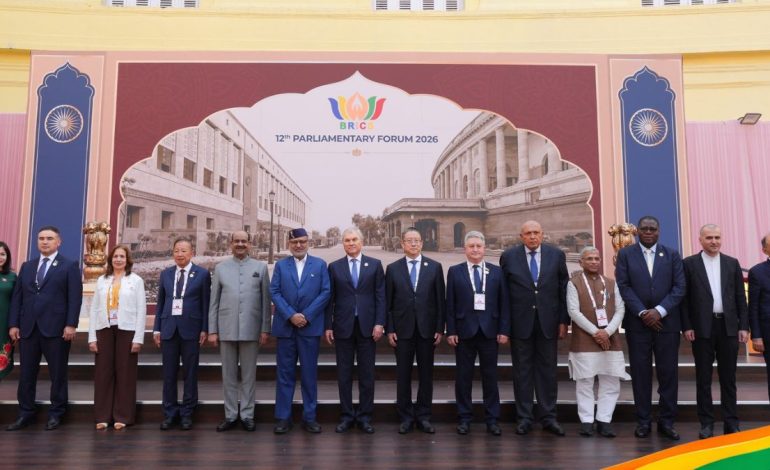
Delegates at the 12th BRICS Parliamentary Forum in New Delhi. (Image courtesy: X/@ombirlakota)

New Delhi: The 12th BRICS Parliamentary Forum adopted the New Delhi Joint declaration on Tuesday, calling for comprehensive reform of the United Nations, stronger multilateral cooperation and coordinated action against terrorism. The document also condemned the April 2025 terrorist attack in Pahalgam, Jammu & Kashmir, which killed 26 people.
The two-day forum, held at Samvidhan Sadan under the chairpersonship of Lok Sabha Speaker, Om Birla, brought together parliamentary representatives from BRICS countries under the theme “Fostering Parliaments for People-Centric Development”.
The participating delegations included representatives from Brazil, China, Egypt, Ethiopia, India, Indonesia, Iran, Russia, South Africa and the United Arab Emirates. The prime minister, Narendra Modi, also interacted with visiting parliamentary leaders during the gathering.
BRICS seeks greater representation in UNSC
The declaration called for comprehensive reform of the UN, including its security council, to make international decision making more democratic, representative and effective. It emphasized the need for developing countries to have a stronger voice in global governance, reflecting the growing influence of emerging economies in international affairs.
The UN security council currently has five permanent members with veto powers and 10 elected members serving two-year terms. India has long sought permanent membership, arguing that the existing structure does not adequately represent contemporary geopolitical realities.
The parliamentary declaration reaffirmed the broader reform agenda outlined in the separate BRICS leaders’ New Delhi declaration adopted in September. That document supported greater representation for developing countries from Africa, Asia and Latin America, although it did not establish an agreed formula for expanding permanent membership.
Declaration condemns Pahalgam attack
In a significant development for India, the forum strongly condemned the April 22, 2025, terrorist attack in Pahalgam, which killed 26 people and injured several others.
The declaration rejected double standards in counter-terrorism efforts and called for stronger international cooperation against terrorist organizations and individuals designated by the UN.
It echoed earlier BRICS commitments to combat terrorist financing, cross-border movement of terrorists and safe havens, while emphasizing accountability under international law.
The forum also called for the early finalization and adoption of the comprehensive convention on international terrorism at the UN, a proposed international legal framework whose negotiations have remained unresolved over differences concerning its definition and scope.
The declaration stressed that counter-terrorism measures must comply with international legal obligations, including applicable human rights and humanitarian law.
Wider diplomatic priorities
Beyond security, the declaration opposed unilateral economic sanctions that violate international law, warning that such measures and secondary sanctions could adversely affect human rights, healthcare, food security and economic development, particularly in developing countries.
It supported a peaceful resolution of the Israeli-Palestinian conflict through a two-state solution and called for protecting civilians and civilian infrastructure.
On sustainable development, the forum identified poverty eradication as a major global challenge and reaffirmed support for the UN’s 2030 agenda. It called for stronger climate action under the Paris agreement, including predictable financial assistance, capacity-building and technology transfer from developed to developing countries.
The declaration also encouraged responsible use of artificial intelligence, equitable access to emerging technologies and stronger data privacy safeguards. It welcomed proposals for a BRICS digital public infrastructure repository and pilot projects, alongside sharing digital tools for parliamentary research, public engagement and citizen feedback.
Participants acknowledged Russia’s proposal to consider establishing a BRICS plus grouping within the inter-parliamentary union, without announcing its formation.
Birla emphasized the importance of parliamentary cooperation in strengthening mutual trust, promoting dialogue and addressing international challenges through peaceful means.
The declaration represents shared parliamentary positions rather than a binding international treaty. It does not establish a timetable for security council reform or commit individual governments to specific legislative changes.
Marking the 10th anniversary of the BRICS women parliamentarians’ forum, delegates recalled the 2016 Jaipur declaration and encouraged closer exchanges among parliamentary committees. They also acknowledged Russian proposals for greater cooperation on sport, training and capacity-building.
The forum concluded with participants looking forward to reconvening in 2027 under China’s incoming chairship.