
Rajnath Singh to unveil India’s new land-warfare doctrine. What changes are expected in Army’s areas of focus?
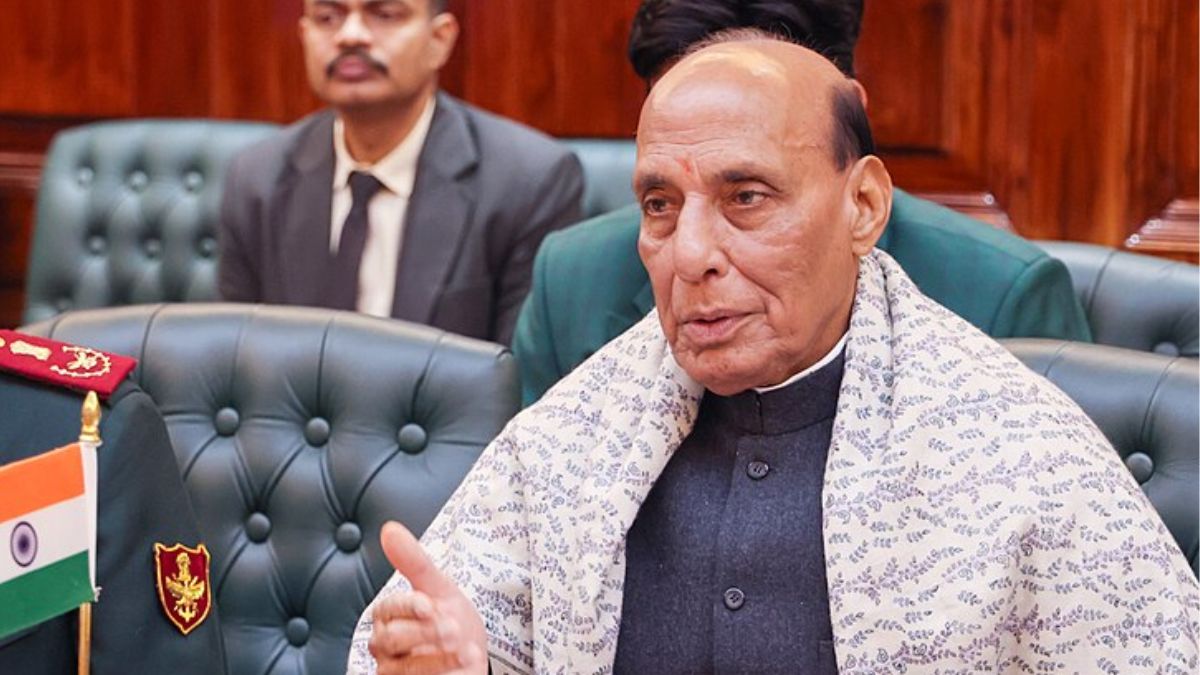
The defence minister, Rajnath Singh, is scheduled to unveil the Indian Army’s new Land Warfare Doctrine.(Image courtesy: Wikimedia Commons)

New Delhi: The Army commanders’ conference continued in New Delhi on Thursday as senior officers examined future operational preparedness ahead of the scheduled release of the Army’s new land-warfare doctrine. The defence minister, Rajnath Singh, is expected to unveil the document on Friday, with drones, precision strikes and operations across multiple military domains emerging as key areas of focus.
The three-day meeting opened on Wednesday under the chief of Army staff, General Dhiraj Seth, as RNA Media reported earlier. It brings together commanders of the Army’s six operational commands, one training command and senior headquarters officers to review evolving threats, military capabilities and transformation priorities.
The Economic Times reported on Thursday that the revised doctrine is expected to draw on experience along the line of actual control (LAC) with China, Operation Sindoor and recent fighting in Ukraine and West Asia. The defence ministry has not publicly detailed the document’s provisions or issued a separate account of decisions taken during Thursday’s closed-door deliberations.
How the Army’s battlefield approach may evolve
The Army’s previous land-warfare doctrine was released in December 2018, following the Joint Doctrine of the Indian Armed Forces issued in April 2017. Earlier editions were published in 1998 and 2004. The 2018 doctrine covered hybrid warfare, multi-front operations, surveillance, precision strikes, information warfare, space warfare and special forces, providing the foundation for operational planning along India’s northern and western fronts.
Since then, inexpensive unmanned aircraft, loitering munitions and persistent aerial surveillance have complicated the movement and concealment of troops. Electronic warfare can disrupt navigation and communications, while precision weapons can strike headquarters, supply depots and other targets far from the front line.
According to military experts, the new document is expected to examine the integration of conventional land operations with cyber, space and electronic warfare, as well as the role of artificial intelligence in processing surveillance data and supporting military decisions. These are pre-release expectations, not confirmed provisions of the doctrine.
In August 2025, Singh separately released the joint doctrine for multi domain operations, covering coordination across the armed forces. At the same event, he highlighted lessons from Operation Sindoor and the Army’s initiatives to train soldiers in drone technology and develop specialized capabilities, including Bhairav battalions and Shaktibaan regiments.
Operational readiness and Friday’s agenda
Along the China frontier, high-altitude deployment, logistics and reliable surveillance remain demanding tasks. The western front combines conventional threats with drones, missiles and cross-border terrorism. The forthcoming doctrine may provide common planning principles, but no newly approved strategy against either neighbour has been announced.
The emphasis on unmanned threats coincides with a separate defence procurement announced on Wednesday. The ministry signed a contract worth approximately ₹770 crore with Bharat Electronics Limited for improved low-level lightweight radars capable of detecting and tracking fighter-sized aircraft as well as mini and micro drones. It has not identified the purchase as an outcome of the conference.
Rajnath Singh is scheduled to address commanders and release the land-warfare doctrine on Friday. The conference programme also includes talks by the chief of defence staff, General NS Raja Subramani; the chief of naval staff, Admiral Krishna Swaminathan; and the secretary of the ministry of electronics and information technology.
The defence minister is also scheduled to release the Army’s annual UN Journal and honour personnel for peacekeeping service, while Gen Seth will present awards for green military stations and aviation flight safety. Until the doctrine is published, its precise operational guidance remains unconfirmed.