


Benjamin Netanyahu seeks Saudi Arabia’s backing to fight Houthis, but Mohammed bin Salman resists, report says
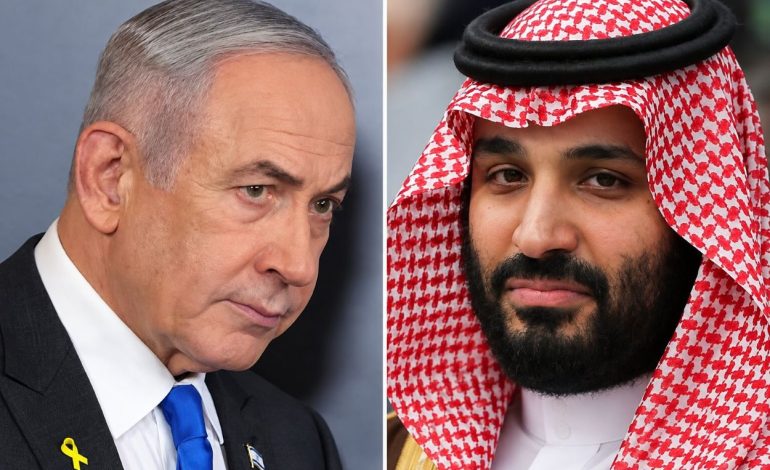
Benjamin Netanyahu (L) and Mohammed bin Salman.

New Delhi: The Israeli prime minister, Benjamin Netanyahu, is seeking Saudi Arabia’s approval for Israeli participation in the military campaign against Yemen’s Houthis, but the Saudi crown prince, Mohammed bin Salman, reportedly opposes the proposal. The initiative, being pursued through US intermediaries, comes as deadly Houthi attacks on Saudi airports put Riyadh under mounting pressure to strengthen its response.
Haaretz reported on Monday, citing an unnamed diplomatic source, that Netanyahu hopes cooperation against the Iran-backed movement will improve relations with Riyadh and help advance a future normalization agreement. Mohammed bin Salman, however, is concerned that Israeli involvement would provoke a backlash among the Saudi public, according to the report.
The Israeli broadcaster i24NEWS also covered the proposed intervention, attributing the information to Haaretz rather than presenting it as independently confirmed. The available accounts do not establish an agreed military arrangement or explain whether Saudi consent would involve operational coordination, access to airspace or another form of cooperation.
The reported approach therefore has both military and diplomatic objectives: countering a shared adversary while opening a route towards closer bilateral ties. The crown prince’s reported resistance indicates that Netanyahu’s proposed cooperation faces a political obstacle even as Saudi Arabia confronts an increasingly serious security threat.
Airport attacks intensify pressure on Riyadh
The immediate backdrop is a succession of attacks on King Khalid International Airport in Riyadh, including an October 10 strike that killed at least 13 people and wounded more than 300. Another attack the following day killed one person and injured nearly a dozen others, Reuters reported.
Authorities subsequently extended the airport’s closure until October 17, disrupting international services and the capital’s connections with the outside world. Saudi Arabia said it intercepted another ballistic missile heading towards Riyadh on October 12, while the Houthis said they had targeted the airport again.
Saudi Arabia has also begun investigating the failure of its air defences, according to two regional officials quoted by the Associated Press. Their preliminary account suggested that the Houthis launched drones ahead of a combination of cruise and ballistic missiles, exposing weaknesses in the kingdom’s protection against coordinated attacks.
Washington has supplied intelligence, targeting assistance and planning support for the Saudi-led offensive, but had stopped short of conducting strikes in the current campaign, AP reported on October 12. The US president, Donald Trump, has said he is considering military action, although the extent of any American intervention remains uncertain.
The disruption is also affecting Saudi Arabia’s effort to project itself as an international business destination. The chief executives of ExxonMobil, TotalEnergies, Shell, Chevron and BP were removed from the WPC Energy Congress programme in Riyadh, although Saudi authorities continued with the gathering and BP attributed its absence to travel disruption.
A shared adversary, but a difficult diplomatic opening
Israel already has a history of direct military confrontation with the Houthis, who have attacked Israeli territory as well as shipping in the Red Sea. On July 20, 2024, Israeli aircraft struck targets near Yemen’s Hodeidah port, a day after a Houthi drone hit Tel Aviv.
Those strikes demonstrate that Israel has previously attacked the movement independently; the significance of Netanyahu’s reported proposal lies in linking Israeli action to Saudi Arabia’s campaign. Such cooperation could carry diplomatic weight, but it would not by itself settle the political conditions Riyadh has attached to establishing relations.
Saudi Arabia’s foreign ministry reaffirmed on February 5, 2025 that the kingdom would not establish diplomatic relations with Israel without the creation of a Palestinian state. That publicly stated condition provides essential context for Netanyahu’s reported attempt to use military cooperation as a bridge towards normalization.
Meanwhile, the renewed fighting is imposing further costs on Yemen’s population, making the conflict more than a contest over regional alignments. The International Organization for Migration said more than 200,000 people had been displaced since early September, as clashes between Houthi forces and Saudi-supported government troops intensified after years of relative calm following the 2022 UN-brokered truce.