
Iraq blocks return of 4,000 Syrian Islamic State suspects as troop exit raises resurgence fears
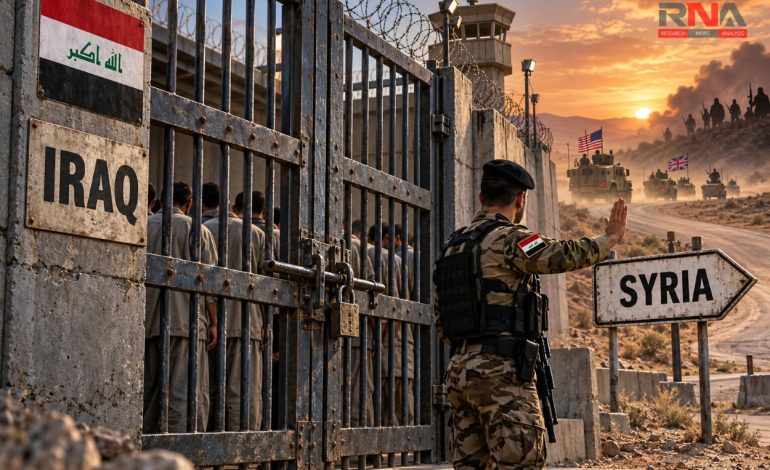
RNA Media illustration for representation.

New Delhi: Baghdad has refused Syria’s request to take back about 4,000 suspected Islamic State members for prosecution. The dispute comes as the withdrawal of American and British coalition forces places greater responsibility on Iraq to prevent the extremist group from rebuilding.
The Iraqi national security advisor, Qasim al-Aboudi, said suspects responsible for crimes in Iraq would face Iraqi law. Around 400 Syrians had been cleared of IS membership and about 50 returned home. Baghdad was also seeking $500 million in coalition support for detention costs.
The detainees belong to a much larger group moved from northeastern Syria after fighting between government forces and the Kurdish-led Syrian Democratic Forces (SDF) disrupted the region’s detention system in January. The US-organized transfer operation followed fears that prisons could become vulnerable as Kurdish forces lost territory and withdrew from facilities they had guarded for years.
Nearly 5,700 men and boys were transferred to Iraq, according to Human Rights Watch, which has questioned both the conditions of their detention and the evidence against some prisoners. Their suspected affiliation does not establish individual guilt, and the presence of children and people allegedly detained for unrelated reasons complicates decisions about prosecution and repatriation.
Baghdad’s concern about renewed militant activity across the border predates the latest disagreement. In an interview with Reuters in February, the foreign minister, Fuad Hussein, warned that IS had become more active in Syria following fighting between Damascus and the SDF, and sought international assistance to manage the security burden of holding thousands of detainees.
There is also evidence that the breakdown of detention arrangements created opportunities for extremist recruitment. In February, an internal European Union assessment warned militant organizations could recruit among people who had escaped from al-Hol, a camp holding relatives of suspected IS fighters, after its chaotic transfer to Syrian government control.
Those findings support concern about escape, recruitment and a possible IS revival, but they do not establish that Damascus intends to release these prisoners and deploy them against Iran-backed Iraqi militias, Lebanon’s Hezbollah or Yemen’s Houthis. No such plan, or Iraqi allegation of such a plan, was substantiated in the reports reviewed for this story.
The militant background of the transitional president of Syria, Ahmed al-Sharaa, nevertheless makes the question politically sensitive. Formerly known as Abu Mohammad al-Golani, he joined al-Qaida in Iraq before leading the Nusra Front in Syria, later breaking publicly with al-Qaida in 2016 and heading Hayat Tahrir al-Sham before the overthrow of Bashar al-Assad.
However, when then-Islamic State leader Abu Bakr al-Baghdadi announced the merger of his Iraqi organization with Nusra in 2013, al-Sharaa rejected absorption into the new formation and maintained Nusra’s separate identity and allegiance to al-Qaida’s leadership. Nonetheless, their objectives remained more or less the same.
A separate development has brought Syria into the wider confrontation involving Iran’s allies. Reuters reported on Wednesday, that Damascus was considering military assistance to Saudi Arabia against Houthi attacks, although al-Sharaa’s media adviser denied that Riyadh had requested Syrian troop deployment; the report provided no evidence connecting those discussions to IS detainees.
For Iraq, the immediate concern is whether extremist networks can exploit the changed security environment following the coalition’s departure. Iraqi security officials and analysts told Reuters that the withdrawal could create room for an IS comeback, even as Iran-backed factions celebrated it as a strategic victory.
The end of the coalition’s military mission does not mean international counterterrorism cooperation has ceased. Britain’s official announcement said defence cooperation with Baghdad and the wider Operation Shader campaign would continue, while Iraqi forces and the Kurdish Peshmerga assumed primary responsibility for security.
The prisoners’ fate also carries consequences beyond immediate security calculations. Human Rights Watch warned this week, of alleged torture, serious illness, deaths in custody and the risk of unfair trials followed by execution, underscoring the need to distinguish responsibility for atrocities from unproven association with the group.