
Henri Kagan and Kenso Soai win 2026 Nobel prize in chemistry for cracking the puzzle of mirror-image molecules
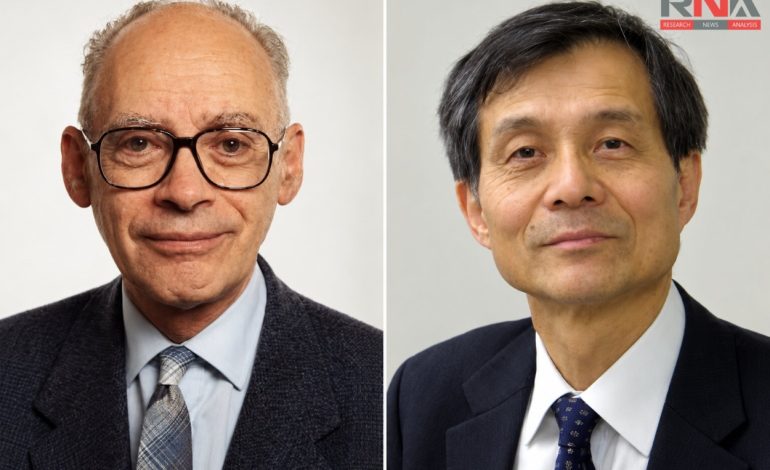
Henri Kagan (L) and Kenso Soai.

New Delhi: The French chemist Henri Kagan and the Japanese chemist Kenso Soai have won the 2026 Nobel prize in chemistry for discovering non-linear effects and autocatalysis in asymmetric organic synthesis, the Royal Swedish Academy of Sciences announced in Stockholm on Wednesday. Their work explains how a tiny imbalance between two mirror-image forms of a molecule can grow until one form dominates, a question that has occupied chemists and origin-of-life researchers for more than a century.
Kagan, 95, is affiliated with Université Paris-Sud at Orsay, while Soai, 76, works at the Tokyo University of Science. They will share the prize money of 12 million Swedish kronor, about $1.2 million.
At the heart of the award lies chirality, the property by which a molecule and its mirror image cannot be superimposed, much like a left hand and a right hand. The term comes from the Greek word for hand, and the two forms usually behave identically in a flask but can act very differently inside a living body.
Nature, however, is strikingly one-sided, as the amino acids in living organisms occur almost entirely in a single mirror-image form. The chair of the Nobel Committee for Chemistry, Heiner Linke, said the two laureates had solved a mystery more than a century old, namely how such uniform handedness, known as homochirality, can arise spontaneously.
Kagan’s contribution dates to the mid-1980s, when he showed that the purity of a chiral catalyst and the purity of the product it makes do not always move in a straight line. An impure catalyst can, under certain conditions, deliver a product purer than itself, an effect that has since become a field of chemistry in its own right.
Soai took the idea considerably further. In 1995, he reported a reaction between a pyrimidine aldehyde and the organozinc compound diisopropylzinc in which the product acts as the catalyst for its own formation, amplifying a very small initial excess of one mirror-image form until it overwhelmingly dominates.
Peter Somfai, a member of the committee, described the Soai reaction as arguably the most entertaining experiment in organic chemistry. The committee also called it one of the most spectacular chemical experiments ever conducted.
Soai, who joined the announcement by telephone from his native Hiroshima, said it was “one of the most exciting days of my life”. He added that he was glad to share the honour with Kagan.
Remarkably, chemists have needed decades to understand how the reaction works. A 2022 review in Chemical Society Reviews described its mechanism as a subject of fierce debate since 1995, while a 2025 study in Nature Communications by a Munich team identified short-lived zinc hemiacetalate complexes as key catalytic intermediates.
The discoveries also carry industrial weight, with the Nobel committee noting that they have been decisive for chemists who design reactions for manufacturing pharmaceuticals. The stakes are high because more than half of clinically used drugs are chiral, and the two mirror forms of a compound can have very different effects. The painkiller Darvon and the cough medicine Novrad, for instance, are mirror images of each other.
The award also carries a historical footnote. In 2001, the chemistry prize for asymmetric catalysis went to William Knowles, Ryoji Noyori and K Barry Sharpless, and Kagan, widely regarded as a pioneer of the field, was left out because the Nobel statutes allow a maximum of three laureates.
The omission caused such unease among French scientists that the then French science minister, Roger-Gérard Schwartzenberg, wrote to the Nobel Foundation, as Nature reported at the time. This year’s citation covers a different, though related, strand of Kagan’s work.
Kagan is also among the oldest people to receive the honour, as STAT noted that the oldest recipient in the prize’s history was 97 and the youngest 35. The chemistry prize has now been awarded 118 times, to 202 laureates, though only 200 individuals, because Frederick Sanger and Barry Sharpless won twice.
The chemistry award is the third science prize of this year’s announcement week. On Monday, the Nobel Assembly at Karolinska Institutet honoured the American scientist Karl Deisseroth and the German researchers Peter Hegemann and Georg Nagel with the Nobel prize in physiology or medicine for work on light-gated ion channels and optogenetics. The technique lets researchers switch selected nerve cells on and off with light, helping them trace how particular brain circuits shape memory, emotion and behaviour.
A day later, the Belgian-American physicist Francis Halzen of the University of Wisconsin–Madison was named the sole physics laureate for his decisive role in the IceCube Neutrino Observatory. The detector uses a cubic kilometre of Antarctic ice to catch high-energy neutrinos arriving from deep space.
Three prizes are still to come, according to the official Nobel schedule. The literature prize follows on October 8 at 4.30pm IST at the earliest, the peace prize on October 9 at 2.30pm IST, and the economic sciences prize on October 12 at 3.15pm IST at the earliest, with the laureates receiving their awards formally on December 10.