



DRDO’s 5km drone-killing laser moves towards production, industry partner search next
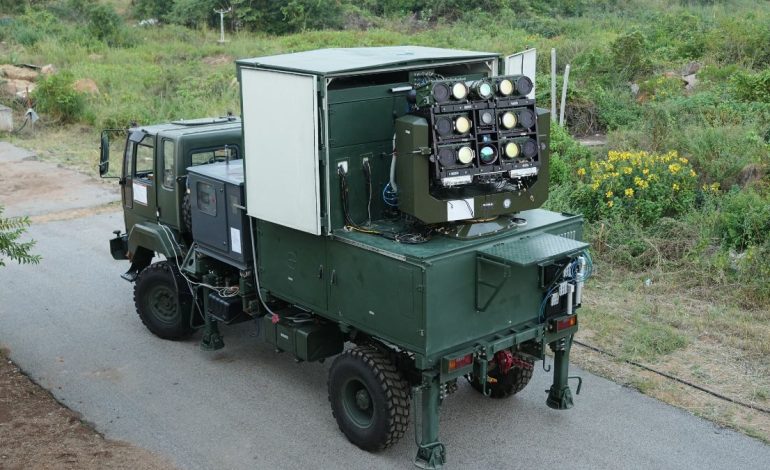
File photo of a DRDO laser-directed energy weapon.

New Delhi: India is preparing to move its indigenous 30-kilowatt counterdrone laser weapon towards production, with the Defence Research and Development Organisation (DRDO) planning to seek an industry partner within six months. The truck-mounted system is designed to engage unmanned aircraft and surveillance sensors at ranges of up to 5 kilometres, potentially giving the armed forces a less expensive way to counter some aerial threats.
The next step involves selecting a manufacturer to develop the first production model, rather than immediately beginning large-scale manufacture or operational deployment. The director general for electronics and communication systems at DRDO, Dr BK Das, told Outlook that an expression of interest would be issued within the six-month period, while a decision on the first-of-production model remained pending.
Final trials concluded in August 2025, with Das saying the underlying technology had been proven. The proposed industry partnership would take the programme into its next phase, connecting the demonstrated capability with the work required to produce a military system.
The Mk II(A) laser-directed energy weapon was publicly demonstrated at Kurnool in Andhra Pradesh on April 13, 2025, by DRDO’s Hyderabad-based Centre for High Energy Systems and Sciences (Chess). According to DRDO’s account, reported by Akashvani, the demonstration involved defeating a fixed-wing unmanned aerial vehicle and swarm drones, causing structural damage and disabling surveillance sensors.
The programme addresses an increasingly difficult calculation for air-defence planners: inexpensive drones can force defenders to expend missiles worth considerably more than the incoming target. Media reports linked the requirement to Operation Sindoor in May 2025, when Pakistani drones were used to probe Indian defences and attempt to reveal air-defence positions.
A high-energy laser concentrates light on a target to damage its structure or vulnerable components, including sensors. Its beam travels at the speed of light, but disabling a drone still depends on factors such as distance, the point being targeted and how long the beam remains focused on it.
That distinction also matters when describing its ability to counter swarms: high-energy lasers generally engage individual targets, rather than destroying an entire group with one broad burst. Their potential advantage lies in repeated engagements with a lower expenditure on ammunition, provided sufficient power and cooling are available.
Weather remains a constraint, with fog and storms capable of reducing a laser beam’s range and effectiveness. These limitations make lasers a complementary element of air defence, alongside weapons able to deal with threats under different conditions.
India’s smaller laser systems are further along the path to production, according to the recent reports, with a 2-kilowatt system being manufactured through Adani, Astra and Bharat Electronics Limited (BEL). A 10-kilowatt programme, intended to engage targets at up to 2 kilometres, has Larsen & Toubro and BEL as development-cum-production partners.
The reports place the 30-kilowatt weapon within India’s broader effort to build layered air defences under Project Sudarshan Chakra, while DRDO pursues more powerful 50-kilowatt and 100-kilowatt systems. The immediate milestone, however, is industrial: securing a partner and progressing towards a production model before the demonstrated laser capability can become equipment available to the armed forces.