




AfD’s Saxony-Anhalt landslide jolts Merz. Why the party’s rise alarms Germany and Europe
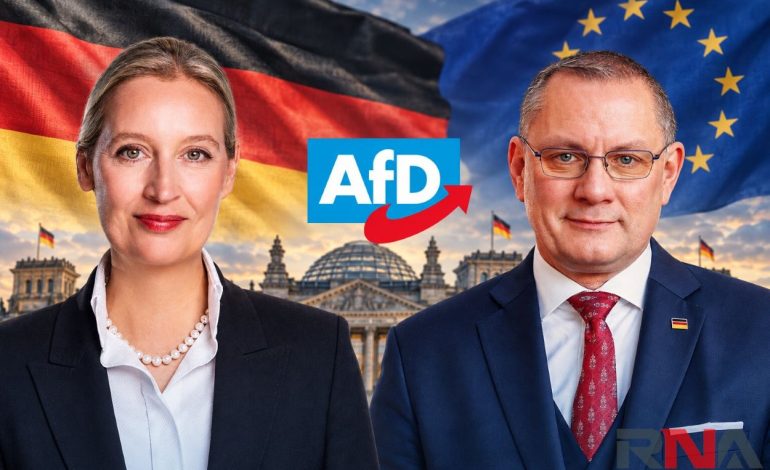
Germany’s Alternative for Germany (AfD) party is led by co-leaders Alice Weidel (L) and Tino Chrupalla. (RNA Media illustration.)

New Delhi: Germany’s far-right Alternative for Germany (Alternative fur Deutschland or AfD) won a sweeping victory in the state of Saxony-Anhalt on Saturday, bringing it closer to leading a state government and delivering a severe setback to the chancellor, Friedrich Merz. However, the party fell short of an outright parliamentary majority, leaving its ability to take office dependent on support from other lawmakers.
Preliminary results put the AfD at 43.8%, more than double its 20.8% share in 2021, while Merz’s Christian Democratic Union (CDU) fell to 17.2% from 37.1%. The AfD secured 39 seats in the 83-member state parliament, three short of a majority, against the CDU’s 15.
The Social Democratic Party (SPD) received 9.3%, the Greens 8.9% and the Left party 8.6%, with each winning eight seats. The left-wing populist Sahra Wagenknecht Alliance (BSW) secured 5.3% and five seats, while the Free Democratic Party (FDP) failed to clear the 5% threshold, ruling out a renewal of the outgoing CDU–SPD–FDP coalition, according to the German news website Focus.
The AfD’s lead candidate, Ulrich Siegmund, claimed a mandate to govern and sought backing beyond his party. The BSW’s lead candidate, Thomas Schulze, indicated willingness to help elect an AfD state premier, although no governing agreement had been concluded.
Together, the two parties would have 44 seats, sufficient for a majority, but their shared positions on immigration and Russia do not erase differences on other issues. Siegmund also explored support from individual lawmakers, raising the possibility that defections could determine who governs.
Merz rejects cooperation and stands by Ukraine
Merz acknowledged the gravity of the defeat on September 7 but ruled out cooperation with the AfD. He also reaffirmed Germany’s support for Ukraine and its Nato alignment, rejecting a change of foreign-policy direction in response to the vote.
The AfD nevertheless appealed to conservative lawmakers to support what it portrayed as a centre-right governing majority. Its approach challenges the CDU’s prohibition on cooperation and puts pressure on Merz to maintain party discipline after a damaging electoral reverse.
The incumbent state premier, Sven Schulze, conceded defeat and said he did not intend to work with the AfD. He faced immediate demands from within the regional CDU to resign as its leader.
The AfD’s co-leader, Alice Weidel, presented the result as a springboard for national expansion and set a target of 40% at the next federal election, due by 2029. That is an ambition rather than a forecast, but it underlines the party’s intention to turn regional strength into a claim on national power.
Outside Germany, the French finance minister, Roland Lescure, expressed concern and said German business leaders had voiced similar apprehension. His reaction illustrated how closely Germany’s neighbours were watching a result with possible consequences for European economic and political cooperation.
Why AfD’s victory has caused alarm
The concern among Germany’s liberal, centrist and mainstream conservative parties goes beyond losing votes to a rival. They fear that an AfD administration could use executive authority to advance an exclusionary conception of national identity and weaken institutions intended to protect political pluralism.
In Saxony-Anhalt, that concern has a specific official basis: the state’s domestic intelligence authorities classified the regional AfD organization as right-wing extremist in 2023. Their assessment cites hostility towards fundamental democratic principles and an ethnically defined understanding of the German people that excludes individuals on grounds of ancestry or religion.
The authorities point, among other things, to statements by party officials disparaging German citizens with migrant backgrounds and targeting Muslims. The constitutional issue, in their assessment, is whether people enjoy equal dignity and belonging irrespective of their origins, rather than whether a government may enforce immigration controls.
The AfD rejects the extremist designation and describes it as politically motivated. That dispute should be distinguished from the party’s published programme, which provides a direct basis for examining what it proposes to change.
National identity, immigration
The AfD combines nationalism, opposition to immigration and European integration, and social conservatism with a claim that established parties have become detached from ordinary voters. Its foundational programme advocates direct democracy and a dominant German cultural identity, while rejecting multiculturalism and declaring that Islam does not belong to Germany.
Its 2025 federal programme calls for large-scale deportations under the term “remigration”, permanent national border controls and withdrawal from common European asylum arrangements. It also seeks to remove certain residence protections, including provisions benefiting people undertaking training or employment.
The party presents these measures as restoring control over migration, public expenditure and security. For its critics, the combination of broader removal powers and the exclusionary rhetoric documented by intelligence authorities raises concerns extending beyond the deportation of people without a legal right to remain.
The cultural divide is equally pronounced. The AfD promotes the traditional family, opposes policies associated with gender diversity and seeks restrictions on Islamic religious expression, including minarets and the call to prayer. These positions conflict with liberal commitments to religious equality, minority protection and recognition of different family and gender identities.
This does not mean every disagreement separates an unrestricted liberal position from a restrictive AfD one, or that mainstream parties agree among themselves. The fundamental dispute concerns the scope of the proposed restrictions, the treatment of minorities and the relationship between majority preferences and individual rights.
Why state power matters
The prospect of an AfD government makes these arguments more immediate because German states exercise substantial authority over policing, education and public administration. The party’s Saxony-Anhalt plans envisage major changes to schools, cultural policy and civic institutions, bringing its ideological programme into areas where a regional administration could act.
Writing for Verfassungsblog, the legal analysts Lukas Maria Hohner and Till Stoye warn that an AfD administration could influence the personnel, priorities and public communications of the state’s domestic intelligence structures. Federal safeguards would constrain wholesale dismantling, but they would not remove every opportunity for political interference or disruption of information-sharing.
That creates a particularly sensitive prospect. A party assessed as extremist could acquire influence over the administration responsible for monitoring extremism. The concern is therefore about the exercise of existing executive powers as well as the passage of new laws.
Russia, Ukraine and a different European order
The AfD’s foreign-policy demands challenge central elements of Germany’s established European orientation. Its programme seeks the removal of economic sanctions against Russia, restoration of the Nord Stream pipelines and a neutral Ukraine outside both Nato and the EU.
It also opposes further eastward enlargement of the two organizations and rejects a common European foreign and security policy. Instead, it advocates a looser association of sovereign states, placing national discretion ahead of deeper political integration.
These demands help explain why the party’s growth troubles governments committed to supporting Kyiv and maintaining pressure on Moscow. If adopted nationally, they would weaken the sanctions coalition and curtail Ukraine’s integration with western institutions – consequences that follow directly from the programme, although the state election itself cannot produce them.
The AfD’s defence stance nevertheless requires precision. It supports stronger German armed forces and renewed conscription, and does not demand an immediate, unconditional departure from Nato. Its programme retains Nato membership as a central security component pending the creation of an independent European military alliance, while opposing the deployment of long-range US weapons in Germany.
The dividing line is therefore partly about the purpose and alignment of German power. Mainstream pro-European parties favour strengthening defence within existing Western institutions, whereas the AfD seeks greater national autonomy alongside accommodation with Russia.
Pressure on European cooperation
The party’s opposition to the existing EU and the euro raises a separate concern for countries whose economies and diplomacy are closely intertwined with Germany’s. Its federal programme envisages replacing the current EU with a different European association, presenting a challenge to the framework through which Germany and its neighbours exercise shared authority.
A Saxony-Anhalt government could not implement that transformation, but it would participate in federal decision-making through the Bundesrat, which represents Germany’s states. More fragmented regional politics can complicate the domestic agreements Berlin needs to legislate and negotiate effectively in Europe.
The European Policy Centre’s director for European and global affairs, Almut Moller, argues that Germany’s European influence depends heavily on its ability to build consensus at home. A weaker and more divided Germany would consequently be less able to lead negotiations on the EU budget, economic competitiveness and security.
The centre’s policy analyst, Tabea Schaumann, similarly distinguishes the vote’s limited immediate institutional effect from its substantial political consequences. She warns that the AfD’s advance could constrain German compromises on migration, climate policy and European spending even without the party entering government.
Breakthrough, but no takeover
The result has intensified the dilemma surrounding the mainstream parties’ “firewall” against the AfD: maintaining it increasingly requires difficult governing arrangements between parties with conflicting programmes. Writing in Internationale Politik Quarterly, the commentator Henning Hoff warns that abandoning it, or losing CDU lawmakers to the AfD, could instead threaten a conservative party split.
Hoff also cautions against treating Saxony-Anhalt as representative of Germany as a whole, pointing to its small population, older demographic profile and history of outward migration. Its circumstances help explain the AfD’s exceptional strength without making a comparable national result inevitable.
In a pre-election assessment for the Atlantic Council, the analyst Phyllis Berry similarly judged speculation about Merz’s imminent removal premature. She identified a weakened governing coalition and diluted reforms as a more plausible near-term outcome, while warning that ineffective government could reinforce the dissatisfaction benefiting the AfD.
The immediate question remains whether Siegmund can assemble a parliamentary majority. The wider concern is that a party seeking substantial changes to Germany’s understanding of national belonging and its European commitments has moved closer to acquiring the executive powers needed to begin that process.