
India, US map Indian Ocean push as strategic venture turns to security and connectivity
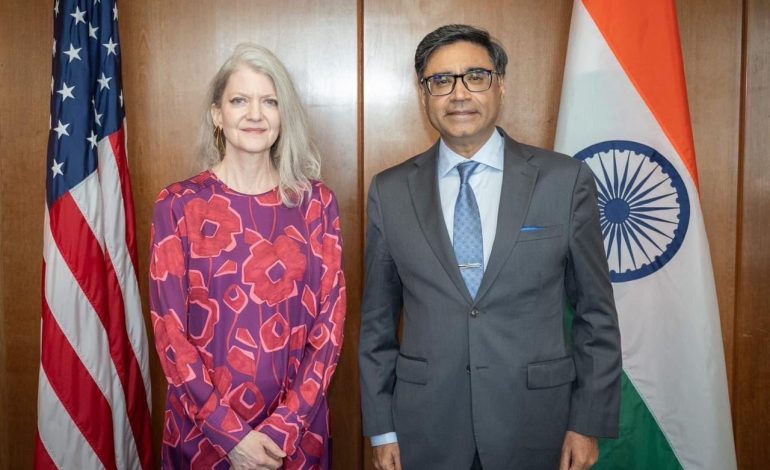
Vikram Misri (R) and Allison M Hooker. (Photo: MEA)

New Delhi: India and the United States have opened a fresh round of discussions on converting the India-US Indian Ocean Strategic Venture into practical cooperation across maritime security, infrastructure and regional connectivity. The talks signal an attempt to move the initiative beyond its broad political launch and identify areas in which the two countries can work together without disregarding the priorities of smaller Indian Ocean nations.
The foreign secretary, Vikram Misri, discussed the initiative during a telephone conversation with the US undersecretary of state, Allison M Hooker, the Ministry of External Affairs said on Tuesday. According to the ministry’s statement, the two officials examined opportunities for complementary action in maritime security, strategic infrastructure and connectivity.
The ministry described the conversation as “productive”, but did not announce any specific project, funding commitment or implementation schedule. Its emphasis on the priorities of partner countries nevertheless suggested that New Delhi and Washington intend to develop the programme in consultation with Indian Ocean governments rather than present it as an exclusively bilateral strategic arrangement.
The Indian Ocean Strategic Venture was launched by the prime minister, Narendra Modi, and the US president, Donald Trump, during their meeting in Washington on February 13, 2025. Conceived as a bilateral, whole-of-government forum, it was intended to coordinate investments in economic connectivity and commerce across the Indian Ocean region.
The joint leaders’ statement issued after that meeting acknowledged India’s role as a development partner, humanitarian responder and security provider in the region. It also committed the two governments to deeper dialogue across the Indian Ocean, where commercial shipping, energy flows, digital networks and military interests increasingly intersect.
One of the most concrete elements associated with the initiative was Meta’s proposed multibillion-dollar undersea cable system, planned to extend more than 50,000 kilometres and connect five continents. India, according to the joint statement, intended to support the financing, maintenance and repair of submarine cables in the Indian Ocean using trusted vendors.
This focus gives the venture a wider purpose than conventional naval cooperation because undersea cables, ports, logistics networks and coastal infrastructure have become strategic assets. Disruption to these systems can affect financial transactions, communications, energy supplies and military operations even without an armed confrontation at sea.
Maritime security under the initiative could eventually encompass information-sharing, surveillance, protection of commercial shipping, humanitarian assistance, disaster relief and greater coordination against piracy, trafficking and other transnational threats. India and the US already cooperate through naval exercises, logistics arrangements, the Quad and maritime-domain-awareness initiatives, giving the new mechanism an established operational base on which to build.
The geographical stakes are considerable because the Indian Ocean links the Strait of Hormuz and Bab el-Mandeb in the west with the Malacca Strait in the east. The International Institute for Strategic Studies has described the region as an unbroken strategic theatre, reflecting how a disruption at one chokepoint can rapidly affect energy prices, shipping schedules and supply chains elsewhere.
For India, the venture broadly complements its MAHASAGAR doctrine – Mutual and Holistic Advancement for Security and Growth Across Regions – announced in March 2025 as an expansion of the earlier SAGAR vision. It also supports New Delhi’s effort to remain the principal first responder and a preferred development partner in its maritime neighbourhood without turning regional engagement into a stark choice between competing powers.
The initiative could combine India’s geographical position, political relationships and experience in capacity-building with American finance, technology and private-sector reach. Potential cooperation could include resilient ports, secure digital cables, maritime surveillance systems, clean-energy infrastructure and transport corridors, although neither government has yet identified a formal project pipeline.
It also carries an unmistakable strategic dimension as China expands its economic and naval presence across the Indian Ocean through port investments, infrastructure financing and more frequent deployments. New Delhi and Washington, however, are likely to avoid presenting the venture solely as an instrument for containing Beijing because many Indian Ocean countries maintain extensive economic relations with China and resist pressure to align with one bloc.
The renewed dialogue is therefore important, but its significance will ultimately depend on execution rather than diplomatic terminology. Unless the two governments establish financing arrangements, define responsibilities and deliver projects that meet local requirements, the India-US Indian Ocean Strategic Venture risks remaining another ambitious framework with limited visibility on the ground.