


Nearly 18 years after 26/11, India moves to try Hafiz Saeed and Lakhvi in absentia
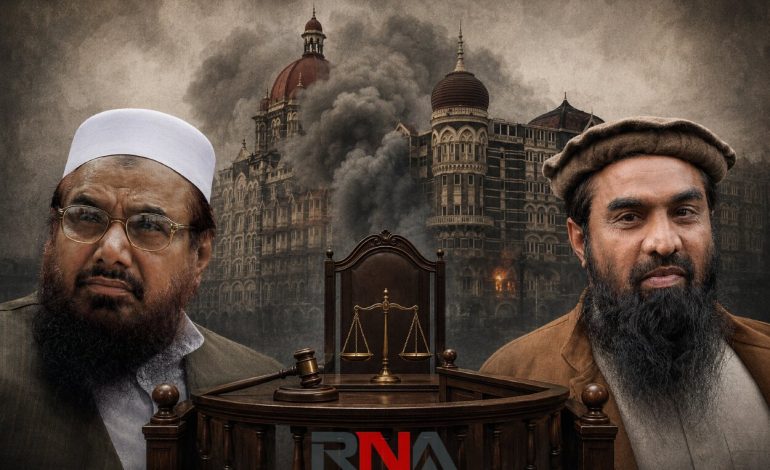
This RNA Media illustration shows 26/11 terror attacks alleged masterminds Hafiz Saeed (L) and Zaki-ur-Rehman Lakhvi.

New Delhi: Mumbai Police have begun the legal process to try six Pakistan-based accused, including Lashkar-e-Taiba founder Hafiz Saeed and commander Zaki-ur-Rehman Lakhvi, in absentia for their alleged roles in the 26/11 Mumbai terror attacks. The move, nearly 18 years after the assault, seeks to prevent their continued absence from indefinitely holding up the Indian proceedings and could enable the court to pronounce judgments without securing their custody first.
The other accused covered by the proceedings are Sajid Mir, Abu Alqama, Asim alias Abu Qahafa and Major Abdur Rehman Pasha. A special court hearing the 26/11 case issued a proclamation requiring the six men to appear before it on or before August 18, after which the prosecution can press ahead with its application.
The Mumbai Police commissioner, Deven Bharti, has written to the special public prosecutor, Ujjwal Nikam, asking him to initiate an expeditious trial under Section 356 of the Bharatiya Nagarik Suraksha Sanhita (BNSS). Nikam said the court was expected to consider a report on compliance with the proclamation before the prosecution took the next procedural step.
According to Nikam, the proceedings would represent the first use of the BNSS’s trial-in-absentia provision in an Indian terrorism case. The new criminal procedure code, which replaced the Code of Criminal Procedure and came into force on July 1, 2024, allows the judicial process to continue against certain proclaimed offenders who remain beyond the reach of the authorities.
What a trial in absentia means
Section 356 applies when a person declared a proclaimed offender has absconded to avoid trial and there is no immediate prospect of arresting him. After recording its reasons in writing, the court may conduct the proceedings and deliver judgment as though the accused were present.
The provision does not permit an immediate trial merely because an accused has failed to appear. At least 90 days must have passed since the charges were framed, and two consecutive arrest warrants must have been issued at intervals of no less than 30 days.
The authorities must also publish a notice in a newspaper circulating around the accused’s last known address, inform a relative or friend where possible, and display the notice at his residence and the relevant police station. If the accused is not represented, the state is required to appoint a defence lawyer at public expense.
A person convicted under Section 356 cannot appeal unless he presents himself before the appellate court, and the law sets a three-year limit for challenging the conviction. The mechanism therefore allows India to complete the judicial process, but it does not by itself compel Pakistan to extradite an accused or transfer a prisoner to Indian custody.
The prosecution’s case
Indian investigators allege that the six accused participated at different levels in planning, preparing, training for and directing the attacks. Saeed is accused of occupying a central position in the conspiracy, while Lakhvi, Abu Alqama and Abu Qahafa were allegedly present in a control room established at Malir in Karachi from where the gunmen were guided.
The prosecution says the handlers monitored television coverage of the assault and communicated with the attackers as the operation unfolded. Sayyed Zabiuddin Ansari, better known as Abu Jundal, an Indian accused now imprisoned in Mumbai, was allegedly in the same control room after helping train the attackers in Hindi and familiarizing them with expressions used in Mumbai.
Nikam said investigators possessed sufficient evidence to prosecute the six, including material collected during the original investigation and disclosures attributed to Ajmal Kasab, the only attacker captured alive. The National Investigation Agency’s separate Mumbai conspiracy case also names Saeed, Lakhvi, Mir and Major Abdur Rehman among senior Lashkar-e-Taiba figures whose alleged roles emerged during the investigation.
Ten Lashkar-e-Taiba gunmen sailed from Karachi and attacked Mumbai between November 26 and November 29, 2008, killing 166 people and injuring more than 300. Their targets included the Taj Mahal Palace hotel, the Oberoi-Trident complex, Chhatrapati Shivaji Maharaj Terminus, Nariman House, Cama Hospital and Leopold Cafe.
Nine attackers were killed during the security operation, while Kasab was arrested, tried and sentenced to death. He was executed at Pune’s Yerawada Central Jail on November 21, 2012, after the Supreme Court upheld his conviction.
Saeed remains in Pakistani custody following convictions in seven terror-financing cases, according to the United Nations Security Council’s sanctions committee. The UN has listed him since December 10, 2008, for his association with Lashkar-e-Taiba and participation in activities supporting the organization.
The proposed Mumbai proceedings are legally separate from the terror-financing convictions handed down in Pakistan and will examine the six men’s individual criminal liability for the 26/11 conspiracy. Even if their physical custody remains elusive, a completed trial would place the evidence against them before an Indian court and ensure that the case no longer remains suspended solely because they are outside the country.