

Colombia earthquake toll rises to 265 as rescuers race to find survivors, hundreds still missing
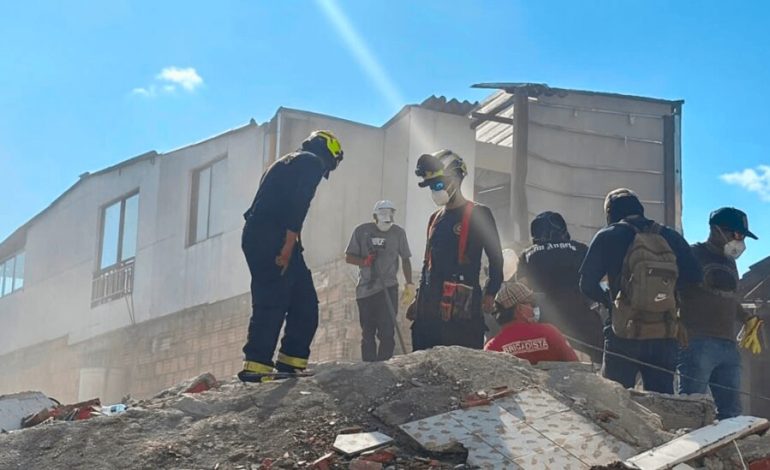
The team that rescued of Daniela Largos Sanchez, who remained under the rubble for 36 hours before being pulled out alive. (Photo: Bogota fire department)

New Delhi: The death toll from the powerful earthquake that struck western Colombia has risen to at least 265 as rescue teams race against time to find survivors beneath collapsed buildings. Nearly 500 people remain officially listed as missing, although civilian-run databases indicate that more than 4,100 people may still be unaccounted for.
As RNA Media had reported, the magnitude-7.4 earthquake struck shortly after 7.30am local time (6pm IST) on Monday, causing extensive destruction across Cali, Pereira, Manizales and Quibdo. The US Geological Survey located its epicentre near San José del Palmar in Chocó department, at a depth of about 107 kilometres.
The president, Abelardo de la Espriella, said more than 25,800 families had been affected by the disaster and that the search for missing people remained the government’s immediate priority. Authorities said at least 3,770 people were injured and more than 9,550 homes were destroyed, while hospitals, schools, roads and other essential infrastructure also suffered damage.
Search teams worked through unstable ruins as the operation approached the end of the 72-hour period generally considered crucial for finding people alive. Rescuers nevertheless reported detecting possible signs of life beneath several collapsed structures in Cali, where operations were concentrated around seven buildings.
The mayor of Cali, Alejandro Eder, said every remaining minute was critical as emergency workers used sensors, trained dogs and heavy machinery to locate those trapped. Police restricted access by crowds of volunteers at some sites because noise and vibrations could interfere with detection equipment and expose people to dangerous aftershocks.
In Pereira, rescuers pulled 32-year-old Daniela Largo Sanchez alive from a collapsed building after she had remained trapped for 36 hours. Emergency workers spent about 12 hours opening a passage through the debris, freeing her pinned arm and stabilizing her with intravenous fluids before taking her to hospital.
Thousands of displaced residents have moved into temporary shelters established in schools, sports arenas, parks and other public spaces across the affected region. Many survivors said their homes were either completely destroyed or too badly damaged to occupy, leaving them dependent on emergency food, water and medical assistance.
De la Espriella announced an economic emergency and promised to establish a reconstruction fund for damaged homes, hospitals, schools and public infrastructure. The government has not yet disclosed the size of the proposed fund or explained how the wider emergency measures will be financed.
The disaster has become the first major test for de la Espriella, who assumed office only three days before the earthquake. His administration has faced the immediate challenge of coordinating national agencies, local governments, security forces, volunteers and international rescue teams across a wide area.
Aid and specialist personnel have begun arriving from Mexico, Peru and El Salvador, while other governments and humanitarian organizations have offered assistance. Colombia’s foreign minister, Omar Bula, rejected reports that Bogota had refused foreign help and said the government was coordinating incoming shipments according to requirements on the ground.
Several local authorities have imposed night-time curfews to prevent looting and keep damaged areas clear for emergency teams. Soldiers and police personnel have joined residents and firefighters in removing debris, maintaining security and distributing relief supplies.
The earthquake has also disrupted transport through Colombia’s western coffee-growing region, with landslides affecting important roads and inspections temporarily halting operations at Buenaventura port. The country’s coffee federation said exports were being redirected mainly through Caribbean ports, reducing the immediate impact on overseas shipments.
Seismologists said another earthquake of comparable strength in the same area was unlikely but cautioned that further seismic activity and aftershocks could not be ruled out. For families waiting beside the ruins, the rescue effort remains a contest against time as crews continue searching for survivable spaces beneath the debris.