



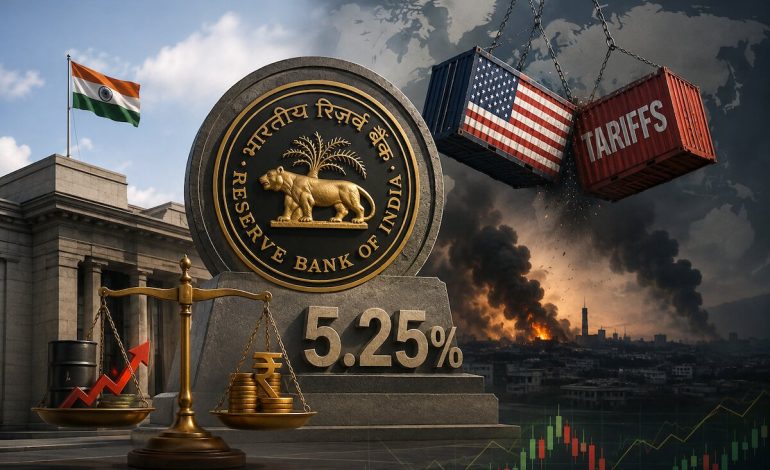
RBI holds repo rate at 5.25%, cites West Asia conflict and US tariffs as key risks
RNA illustration for representation.

New Delhi: The Reserve Bank of India has kept its policy repo rate unchanged at 5.25% for the second straight bi-monthly review, with the Monetary Policy Committee also retaining its neutral stance. The decision, announced in Mumbai on Wednesday, weighs global trade uncertainty and the fallout from the continuing conflict in West Asia against a domestic economy that the central bank still regards as resilient.
Announcing the outcome, the governor of the Reserve Bank of India, Sanjay Malhotra, said the six-member committee had voted unanimously to hold rates steady after assessing both domestic macroeconomic conditions and the shifting global outlook. He was speaking at the conclusion of the three-day MPC meeting, held from Monday to Wednesday, ahead of a news conference later in the day.
Alongside the repo rate, the standing deposit facility rate was held at 5%, while the marginal standing facility rate and the bank rate remained unchanged at 5.5%. These ancillary rates together form the corridor within which short-term borrowing costs in the banking system are expected to move.
Malhotra attributed the committee’s caution chiefly to the ongoing conflict in West Asia, which he said had disrupted trade routes and supply chains, stoked market volatility and dampened business sentiment worldwide. Fresh tariff measures imposed by the United States had further clouded the outlook for global trade, he added, even as crude oil prices and currency markets kept swinging with each turn in the conflict.
Growth revised up
Despite these external pressures, the RBI raised its growth projection for the current financial year to 6.7%, up from the 6.6% estimated in June, citing a favourable monsoon, improving agricultural prospects and steady foreign capital inflows. The inflation forecast for the year was trimmed by 10 basis points to 5%, with consumer price inflation expected to average 5.3% in the first quarter and 4.7% in the second, before climbing to a peak of 5.9% in the third quarter and easing to 5.5% in the fourth.
Malhotra said headline inflation was likely to rise further in the near term, driven mainly by higher food and fuel prices, and to peak around the third quarter before moderating. Inflation nonetheless remained within the central bank’s tolerance band, he said, which gave policymakers room to hold rates steady while continuing to watch price trends closely.
The Reserve Bank’s inflation-targeting framework requires it to keep retail inflation at 4%, within a band of 2% to 6%. A neutral stance, as opposed to an accommodative or restrictive one, signals that the committee is prepared to move rates in either direction depending on how growth and price data evolve.
Incipient stress flagged
The latest decision follows the MPC’s June 2026 review, when the committee had also held the repo rate at 5.25% but had projected a lower FY27 growth rate of 6.6%, citing geopolitical tensions and rising energy costs at the time. At Wednesday’s briefing, Malhotra acknowledged the emergence of incipient stress in certain sectors of the economy, even as he maintained that the broader domestic outlook remained resilient.
On other matters raised at the news conference, Malhotra said there was no proposal at present to revisit succession planning or compensation frameworks for the chiefs of Indian banks. He also said the central bank was still studying stakeholder feedback on a proposed framework that would let lenders remotely restrict borrowers’ mobile phones in cases of loan default, adding that final guidelines would follow once the consultation process concludes.
With this pause, the RBI has now left the repo rate unchanged for two consecutive reviews, opting to keep its powder dry while global risks remain in flux. The next scheduled MPC meeting will determine whether the current stance holds or shifts in response to how inflation, growth and external shocks play out over the coming months.