
President Murmu felicitates all-women triservice crew after historic Samudra Pradakshina voyage
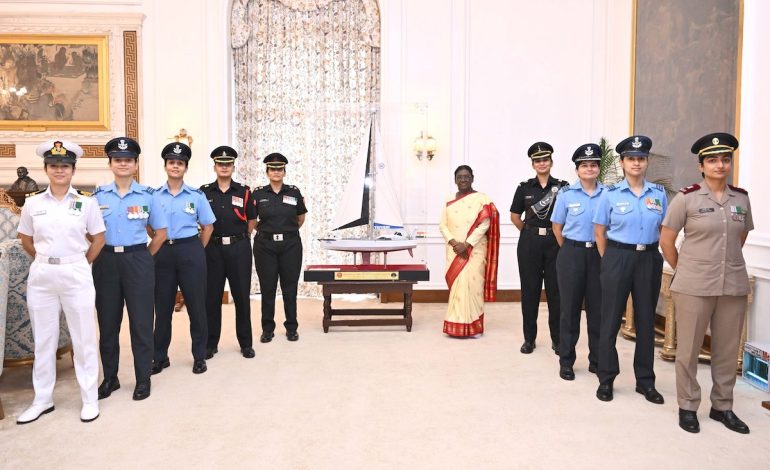
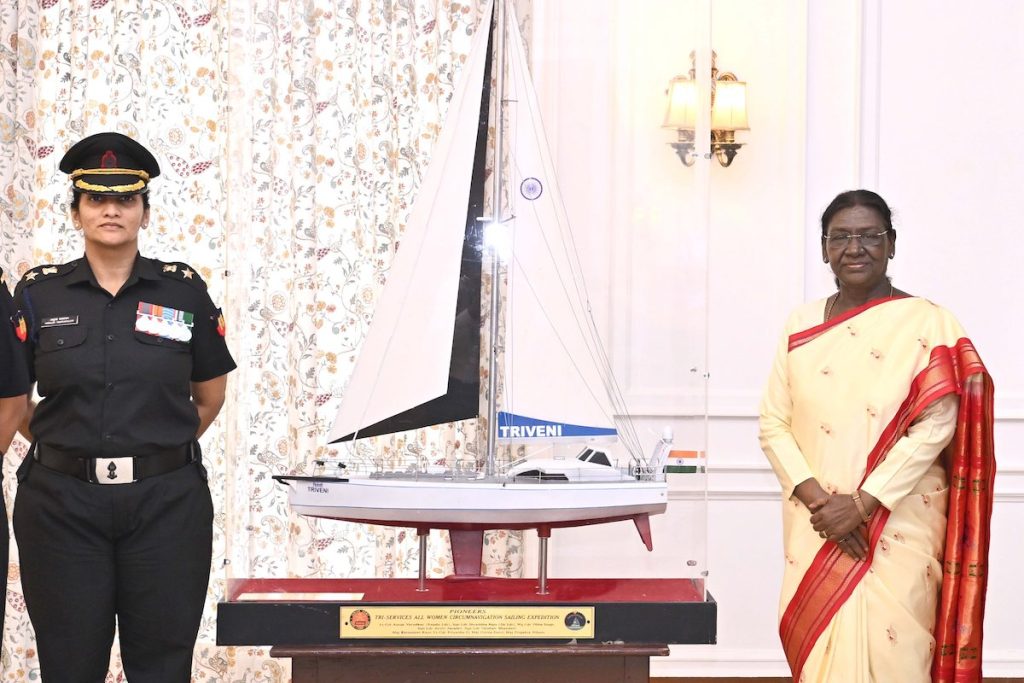
President Droupadi Murmu with the IASV crew. (Photo: Rashtrapati Bavan)

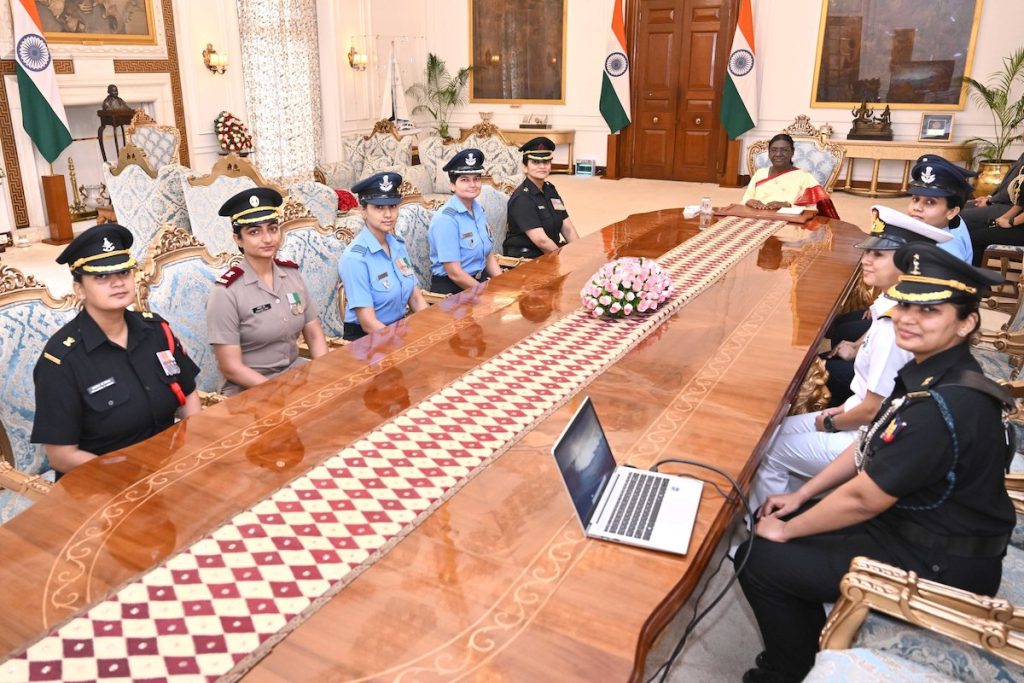
New Delhi: The nine women officers who sailed the Indian Sailing Vessel (IASV) Triveni around the world called on the president, Droupadi Murmu, at Rashtrapati Bhavan on Monday. The visit closed out Samudra Pradakshina, the first triservice all-women circumnavigation ever undertaken by the Indian armed forces.
Murmu commended the crew for its courage, resilience and professionalism through a voyage of more than 25,000 nautical miles across some of the roughest waters on the planet. She said the expedition would encourage young Indians, particularly women, to think ambitiously and serve the country with commitment.
Samudra Pradakshina set out from the Gateway of India in Mumbai on September 11, 2025, when the defence minister, Rajnath Singh, flagged off the vessel. Over the following 314 days, the crew covered close to 25,500 nautical miles across four oceans aboard the indigenously built sailing vessel.
The route took Triveni round the Cape of Good Hope, Cape Leeuwin and Cape Horn – the three capes that define classical circumnavigation. Rounding the Horn through the Drake Passage also earned the officers entry into the International Association of Cape Horners, a distinction held by a small number of sailors worldwide.
The crew crossed every line of longitude, the equator twice and the international date line, fulfilling the internationally recognised conditions for a genuine circumnavigation. Nine officers drawn from the Army, Navy and Air Force sailed the full route, led by Lieutenant Colonel Anuja Varudkar.
Before the Rashtrapati Bhavan meeting, the defence minister had already felicitated the crew in New Delhi on July 30, calling the voyage a demonstration of Nari Shakti and of jointness among the three services. General Dhiraj Seth, the chief of the Army staff, was present alongside the defence secretary, Rajesh Kumar Singh; the vice-chief of the Air staff, Air Marshal Ashutosh Dixit; and the vice-chief of the Naval staff, Vice Admiral Ajay Kochhar.
The officers described sustained mental and physical strain during the voyage, and said their resolve to do the country credit kept them going. The defence ministry credited the outcome to two years of intensive training, meticulous planning and a round-the-clock shore support network.
The crew for the full circumnavigation was drawn from a pool of 41 volunteers, who trained for two years before selection. A shorter trial voyage – a 55-day passage from Mumbai to Seychelles and back, covering some 4,000 nautical miles – had tested a 12-member crew in April 2025 as preparation for the main expedition.
That preparatory leg was flagged off by Lieutenant General AK Ramesh, commandant of the College of Military Engineering, from the Indian Naval Watermanship Training Centre in Colaba. The lessons from it fed directly into the planning of the longer voyage that followed a few months later.
Samudra Pradakshina builds on a lineage of Indian circumnavigations that includes Captain Dilip Donde’s solo voyage of 2009–10, Commander Abhilash Tomy’s non-stop passage of 2012–13, and the Navy’s two Navika Sagar Parikrama missions, completed in 2017–18 and 2024–25 respectively. This expedition was the first to bring officers from all three services together on a single vessel for the entire route. Beyond the sporting and training achievement, the voyage also functioned as a form of military diplomacy. Triveni’s port calls abroad gave the crew occasions to present India’s maritime traditions and cultural heritage to foreign audiences, alongside the vessel’s own credentials as an indigenously designed platform.