

New 17-kilometre rail line to north Bengal’s Jaldhaka to tighten India’s grip near China-Bhutan trijunction
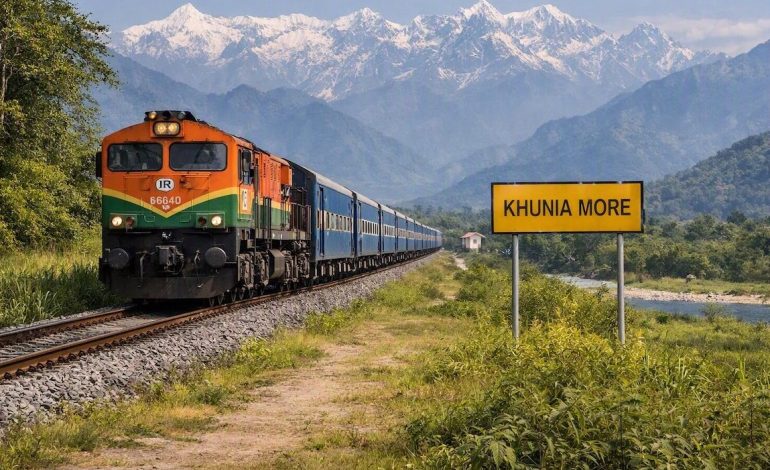
RNA Media illustration for representation.

New Delhi: India has taken a fresh step to reinforce transport links and strategic security close to the India-China-Bhutan trijunction in Doklam, with the Ministry of Railways sanctioning a new line from Khunia More to Jaldhaka in north Bengal. The Lok Sabha MP from Darjeeling, whose constituency takes in Siliguri, Raju Bista, disclosed the details of the approval in an Instagram post, giving the project far more prominence than the routine announcement it began as.
The railways ministry has cleared about ₹272 crore for a roughly 17-kilometre strategic line running from Khunia More, near Chalsa, to Jaldhaka. The alignment cuts through forested terrain under the Jalpaiguri and Kalimpong forest divisions before reaching its destination close to the Bhutan border.
Bista said the line would do double duty. It would strengthen transport connectivity while giving a lift to tourism in remote frontier settlements such as Jaldhaka, Bindu and Todey Tangta, alongside the wider Dooars region. A joint survey by Indian Railways and the West Bengal forest department is expected to begin once the monsoon clears, ahead of a detailed project report.
According to Bista’s post, the significance of the line lies as much in geography as in engineering. The Jaldhaka river, after which the line is named, rises near the Kupup – also called Bitang – lake close to the Jelep-la in Sikkim, before flowing on through India, Bhutan and Bangladesh.
That source lies in strikingly close proximity to the disputed trijunction at Doklam, where Indian and Chinese troops faced off for 73 days in 2017 after Chinese road-construction crews pushed towards the Jampheri ridge overlooking the Siliguri corridor. With China continuing to expand infrastructure on its side of that plateau, Bista’s post framed the new line as part of a roughly 200-kilometre network expansion India is pursuing from Chalsa towards the border.
Second line to region’s China frontier
The Jaldhaka line will not stand alone. It comes as the Sevoke-Rangpo line – already under construction to bring Sikkim onto the rail map for the first time – carries a separate proposal for extension up to the Nathu-la.
Taken together, Bista described the Jaldhaka project as the second significant railway line aimed at the China border, after Sevoke-Rangpo line. Neither the railways ministry nor the defence ministry has issued its own statement spelling out troop-movement or logistics benefits, so the framing so far rests chiefly on the MP’s account.
The Jaldhaka line follows a run of other connectivity moves in the region. They are India’s decision last September to fund two cross-border lines into Bhutan – the 69-kilometre Kokrajhar-Gelephu link and the 20-kilometre Banarhat-Samtse link, at a combined cost of over ₹4,000 crore. It also sits close to work already underway to bring Sikkim onto the broad-gauge network via Sevoke-Rangpo.
Beijing, meanwhile, has kept building its own railhead towards Yadong in the Chumbi valley, having already completed lines linking Lhasa to Shigatse and Nyingchi over the past decade. Seen against that backdrop, a modest 17-kilometre stretch of track in the Dooars carries weight well beyond its length – which is precisely the point Bista’s post was making.