

Nato eyes expanded nuclear deterrent in Europe as perceived Russian threat grows
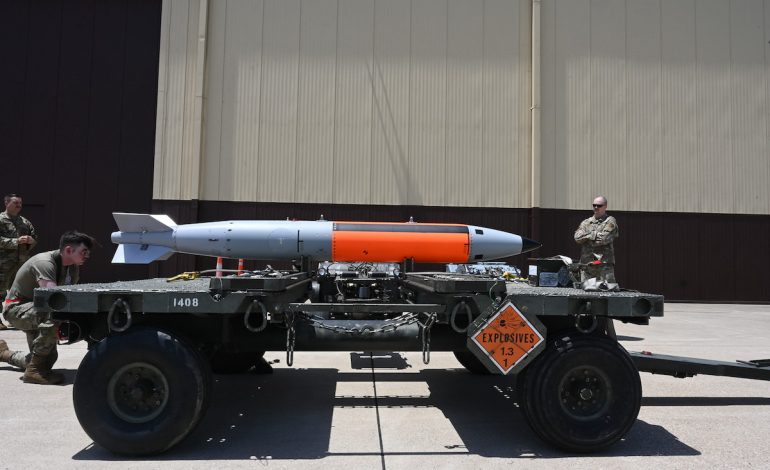
A US B61-12 bomb. (Photo courtesy: United States Department of War)

New Delhi: Nato is drawing up plans to widen its nuclear deterrent in Europe, driven by mounting concern over Russia under the president, Vladimir Putin. Research published by the German Press Agency (dpa) on Friday indicates that the alliance is actively reviewing options that include stationing additional American nuclear weapons on the continent.
One option under consideration is deploying more US non-strategic nuclear weapons across Europe. Nuclear experts believe such munitions may already be arriving, with some suggesting Washington has quietly moved B61-12 gravity bombs to RAF Lakenheath in the UK.
The B61-12 is a modernized, low-yield thermonuclear bomb with an adjustable explosive output. Analysts at the Bulletin of the Atomic Scientists say the weapon is compatible with the F-35A Lightning II, and unconfirmed reports point to jets of the US Air Force’s 48th Fighter Wing at Lakenheath as a likely carrier platform.
Neither the US’s defence department nor Britain’s defence ministry has confirmed these reports. Washington maintains a longstanding policy of neither confirming nor denying the location of its nuclear arsenal.
Eastern flank in frame
Should the security situation in Europe deteriorate further over the war in Ukraine and other developments, Nato planners could also look eastward. Poland, Finland, and Lithuania – all bordering Russia or its ally Belarus – are being examined as potential future basing sites, according to dpa’s findings.
Such a move would mark a significant shift in the alliance’s nuclear posture.
Basing non-strategic weapons closer to Russia would sharply cut the time needed to strike Russian military infrastructure in the event of conflict. That prospect alone illustrates how far the conversation inside Nato has travelled since the drawdown years that followed the Cold War.
The plans chiefly concern so-called non-strategic, or tactical, nuclear weapons. These are designed for use against enemy troops, airfields, ports, command centres, and other military infrastructure, rather than for long-range strikes on cities or industrial centres.
Compared with strategic warheads, non-strategic weapons typically carry a lower explosive yield. They are usually delivered by fighter aircraft or by shorter-range missiles and cruise missiles, rather than by intercontinental ballistic missiles or submarines.
Arsenal shrunk since Cold War
Nato’s American-supplied nuclear stockpile in Europe has fallen sharply since the Cold War ended. Nuclear experts estimate that only around 100 US B61-12 bombs remain in storage on the continent, spread across six air bases in Germany, Belgium, Italy, the Netherlands, and Turkey.
That is a fraction of what Nato held at the height of the Cold War.
The Nato secretary general, Mark Rutte, was asked about the prospect of additional US nuclear weapons in Europe in a recent interview with dpa. Rutte did not rule out the possibility but declined to discuss the specifics of ongoing reviews and consultations, citing confidentiality.
That reticence is itself telling. Nato has traditionally kept the details of its nuclear-sharing arrangements deliberately vague, a posture analysts describe as calculated ambiguity, designed to deter adversaries without inviting a public arms-control debate.
Money already moving at Lakenheath
Independent evidence suggests preparations at Lakenheath are already under way. Contracting records reviewed by open-source defence trackers and media point to roughly $253 million earmarked for new facilities at the base, including secure storage intended to support nuclear operations.
If confirmed, any deployment would mark the first return of US nuclear weapons to British soil since at least 2008, when the last B61 bombs were withdrawn from Lakenheath. It would also represent a rare, if unofficial, signal of how far Nato’s deterrence posture has hardened since Russia’s full-scale invasion of Ukraine in 2022.
For India, the story fits a wider pattern of renewed great-power nuclear competition, stretching from Europe to the Indo-Pacific. New Delhi has traditionally kept its own nuclear posture separate from Nato’s internal debates, but any expansion of the alliance’s forward-deployed arsenal is likely to feature in broader discussions on global strategic stability and arms control.