



Japan jolted by 7.1-magnitude earthquake, 13 confirmed dead as country races to free trapped survivors
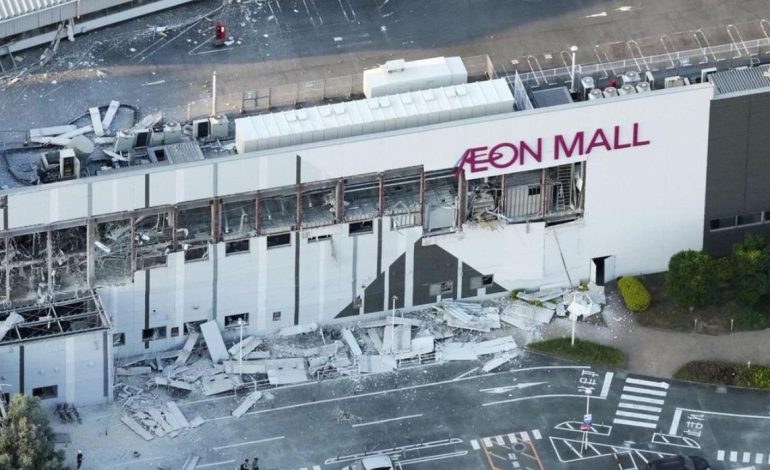
This aerial photo shows the collapsed Aeon Mall in Kashima town. (Photo: X/@Will466513)

New Delhi: A powerful earthquake jolted southwestern Japan on Tuesday, causing several deaths and destruction of buildings. The number of confirmed dead when last reports came in stood at 13, with rescue teams working through the night to reach people still buried under rubble at a collapsed shopping mall and a paper factory in Kumamoto prefecture.
The earthquake, measured at magnitude 7.1 by the Japan Meteorological Agency, struck the Kyushu region at 4.27pm local time on Tuesday, at a depth of around 10 kilometres. It registered the maximum level of seven on Japan’s seismic intensity scale – the first tremor to do so since the Noto Peninsula earthquake of January 2024, and the first time Kumamoto itself has been jolted that hard since a pair of intensity-seven quakes struck the prefecture in April this year.
Speaking on Wednesday morning, the Japanese prime minister, Sanae Takaichi, said the death toll stood at 13 and that rescuers were still working to reach an unknown number of people believed trapped. “There are people who are still waiting to be rescued, and it’s a race against time,” she said, adding that the government would “go all out to find and rescue as many people as we can.” She earlier established an emergency disaster task force under her own direction and ordered the deployment of 3,600 members of the Japan Self-Defense Forces to support search and relief operations, acting on a request from the Kumamoto governor.
The worst of the damage was reported in Kashima town, where the second floor of the Aeon Mall collapsed, trapping shoppers underneath. Local fire officials said an explosion, believed to have been triggered by a gas leak, followed the initial collapse. Rescuers freed two survivors from the wreckage on Wednesday, while the bodies of two others were recovered from the same site, according to prefectural officials. Separately, a chimney came down at a Nippon Paper Industries factory in Yatsushiro, burying workers beneath debris; as of Wednesday, seven people were still feared trapped there.
More than 100 people have been injured across the affected area, with two hospitals alone reporting more than 50 patients each admitted since the quake struck. Damage was also reported to older structures further afield, including the roof of the Yatsuhiro Shrine, which was mid-way through a decades-long restoration project.
The main shock was followed by a series of aftershocks, among them a magnitude-6.1 tremor at 5.08pm on Tuesday, with the US Geological Survey recording at least six significant aftershocks in total. Shinji Kiyomoto of the Japan Meteorological Agency urged residents to remain alert for further strong aftershocks over the next two to three days, warning that quakes of similar intensity could not be ruled out. A tsunami advisory of up to one metre, issued for the Ariake and Yatsushiro coastlines shortly after the quake, was lifted within hours after no waves were recorded.
The disaster disrupted transport across the region. JR Kyushu suspended all its rail services, including Shinkansen lines, along with local operators the Minamiaso Railway and Kumamoto Electric Railway. Kumamoto airport was shut for several hours before reopening later on Tuesday evening. Power supplier Kyushu Electric Power reported no abnormalities at the nearby Sendai and Genkai nuclear power plants.
Japan sits astride the Pacific “Ring of Fire” and records hundreds of earthquakes each year, most of them minor. Kumamoto’s 2016 quakes killed more than 270 people, while the country’s deadliest recent disaster, the magnitude-9.0 Tohoku earthquake and tsunami of March 2011, left roughly 18,500 people dead or missing.
The disaster has drawn swift expressions of solidarity from India. The external affairs minister, S Jaishankar, wrote on X that he was “deeply concerned” by the earthquake and offered India’s support to the government and people of Japan, along with prayers for the safety and recovery of those affected. The message continues a pattern of reciprocal condolence exchanges between New Delhi and Tokyo during recent disasters in either country, reflecting the depth of the two nations’ strategic partnership.
Search and rescue operations were continuing into Wednesday, with officials cautioning that the death toll and the number of those still missing could rise as assessments continue.