

US-Iran pause in fighting holds, but drone attacks spread across the Gulf
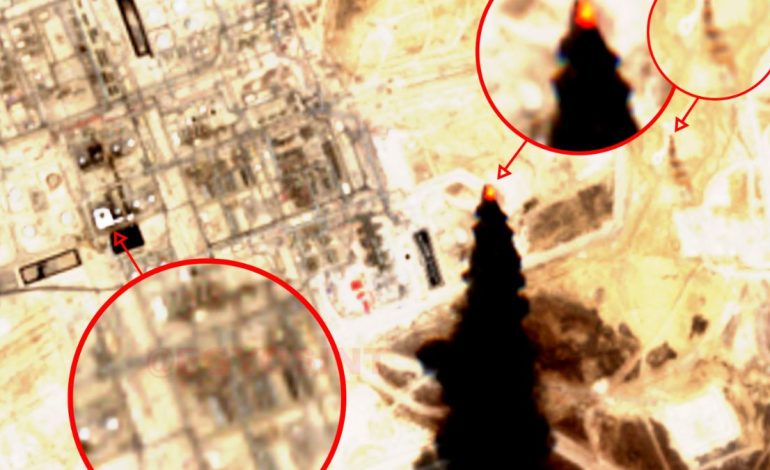
Saudi oil infrastructure comes under renewed spotlight amid escalating regional tensions. Image Credit: X / @EGYOSINT

New Delhi: The US and Iran completed a third consecutive night without exchanging attacks on Monday. The Pentagon had suspended its bombing campaign late on Friday, after nearly two weeks of strikes.
The top US military commander in the Middle East advised halting the campaign. He said Iran’s ability to threaten shipping had already been significantly degraded, and that most designated targets had been struck.
The US president, Donald Trump, has said he believes there is a good chance of reaching an agreement with Tehran, but has warned that Washington would resume strikes if talks fail. Iran has denied that direct negotiations are under way, though it has said messages continue to pass through mediators.
Iran’s foreign ministry spokesperson, Esmaeil Baghaei, said on Monday that Iran’s only ongoing talks are with Oman, regarding the Strait of Hormuz. He said the strait’s status remains unchanged and closed.
Saudi Arabia blames Iran-backed groups
Saudi Arabia’s defence ministry said its air defences intercepted drones aimed at oil facilities in its Eastern Province and in Riyadh. A ministry spokesman, Major General Turki Al-Malki, said the drones had been launched by Iran-backed militias from Iraq. Saudi Arabia said it reserved the right to respond, and later carried out air strikes on Houthi military facilities in Yemen’s Hodeidah port.
This was the second major attack on Saudi energy infrastructure within three days. Earlier strikes had hit facilities in Jazan and the Red Sea port of Yanbu.
Iraq’s prime minister, Ali al-Zaidi, ordered an investigation into the Saudi claim. His spokesperson said Iraq remained committed to preventing its territory from being used as a launch point for attacks on neighbouring countries.
Yemen’s Houthi movement separately claimed responsibility for drone strikes on Saudi oil transport infrastructure connecting the Eastern Province to Yanbu. A Houthi military spokesperson, Yahya Saree, said the attack was in retaliation for Saudi drone incursions into Yemeni airspace.
Drones also hit Israel and Jordan
The Israeli military said it shot down two drones near its border with Jordan, close to the Dead Sea. The drones did not cross into Israeli territory, and their origin is under investigation.
Jordan’s air force separately shot down two drones over its territory, with no casualties reported.
This is not the first time Iraq has faced such accusations. Saudi Arabia and the UAE reported similar drone attacks launched from Iraqi territory in May, which drew criticism from the Gulf Cooperation Council.
It remains unclear whether Iran directly ordered Monday’s attacks. The armed groups involved are widely considered aligned with Tehran, though officials have not confirmed whether the strikes were centrally coordinated.
Oil prices fall
Oil markets reacted sharply to the de-escalation. Brent crude closed at $85.87 a barrel on Monday, down 11.3%, its steepest single-day fall since April. US crude dropped about 7% to $82.61 a barrel.
Israel’s prime minister, Benjamin Netanyahu, travelled to Washington on Monday for talks with Trump at the White House on Tuesday.
It will be Netanyahu’s seventh visit to the White House, and his first face-to-face meeting with Trump since the Iran war began. He departed from an Israeli Air Force base rather than the country’s main airport, which Israeli media linked to security concerns.
His visit coincides with the funeral of US senator Lindsey Graham, a longtime supporter of Israel who died last week. Trump is also separately scheduled to host Ukraine’s president, Volodymyr Zelensky, at the White House the same day.