China, Thailand pledge deeper AI and defence ties as Bangkok balances Beijing and Washington
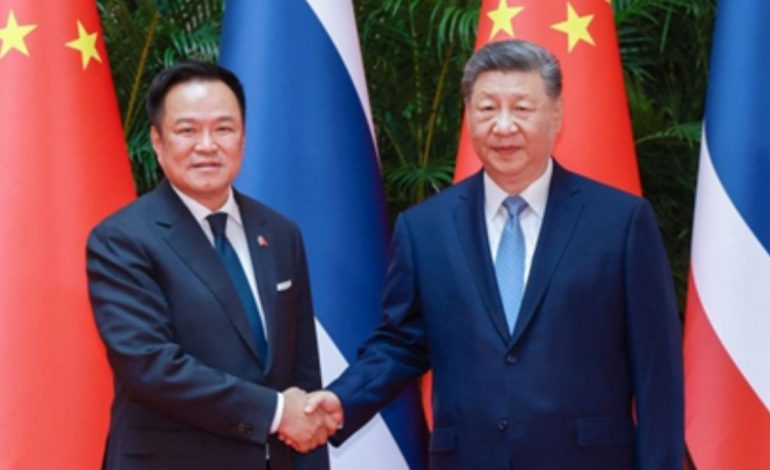
Chinese President Xi Jinping meets Thailand's prime minister, Anutin Charnvirakul, in Shanghai during the latter's official visit to China. Image Credit: X/@MOFCOM_China

New Delhi: Thailand’s prime minister, Anutin Charnvirakul, concluded a five-day official visit to China on Monday. During the visit he met the Chinese president, Xi Jinping, in Shanghai and signed a joint statement pledging deeper cooperation in artificial intelligence, advanced technology, supply chains and defence.
The visit, held from July 16 to 20 took Anutin through Shanghai, Chengdu and Beijing. This was his first as prime minister, though he had earlier visited China accompanying Thailand’s King on a state visit last year.
In Shanghai, Anutin attended the 2026 World AI Conference and held a bilateral meeting with the Chinese premier, Li Qiang. In addition he meet Zhao Leji, chairman of the standing committee of China’s National People’s Congress.
The joint statement, released late on July 20, described the goal as building a “China-Thailand community with a shared future.” It called for deeper cooperation in artificial intelligence, advanced electronics, aerospace, automobiles, clean energy, agricultural technology, health technology and advanced materials.
Both countries agreed to strengthen industry and academic research cooperation, aimed at securing and reinforcing their supply chains. They also agreed to advance construction of the China-Thailand high-speed railway, with Thailand aiming to complete a 250km section by 2030.
On security, Thailand’s deputy prime minister and foreign minister, Sihasak Phuangketkeow, announced a new 2+2 dialogue between the two countries’ foreign and defence ministers, to be co-chaired initially by China. The mechanism is aimed at strengthening cooperation against transnational crime, including online scam networks, human trafficking and money laundering.
Sihasak called the visit a historic success, saying it elevated the countries’ comprehensive strategic partnership across political, economic, security and technology sectors. The two sides also began preparations for the 50th anniversary of diplomatic relations in 2027, with Thailand expressing hope that Xi would make a state visit to Thailand next year.
Among the visit’s outcomes was the opening of a new board of investment office in Chengdu, aimed at attracting investment from western China. The visit also included a business forum that brought together more than 150 Thai executives with Chinese companies. The Thai delegation also visited a leading Chinese AI company. The firm expressed interest in partnering with Thailand and recommended the country formulate a national AI strategy.
Why Thailand isn’t picking sides
Despite the deepening ties with Beijing, Thailand’s decades-old security relationship with Washington remains intact. Thailand is the oldest US treaty ally in Southeast Asia, with formal ties dating back to the 1833 Treaty of Amity and Commerce.
The modern security alliance rests on the 1954 Manila Pact and the 1962 Thanat-Rusk communiqué, and the US designated Thailand a major Non-Nato ally in 2003.
That alliance was on full display earlier this year. From February 24 to March 6, Thailand and the US co-hosted the 45th edition of Exercise Cobra Gold, the longest-running multinational military exercise in the Indo-Pacific. More than 8,000 personnel from 30 countries took part, in what organizers designated a “heavy year” featuring full-scale field training.
The exercise, held in Rayong province, covered land, maritime, air, space and cyber operations. It included humanitarian assistance and disaster relief drills, amphibious landings, live-fire training, and counter-drone operations, alongside core participating nations such as Singapore, Indonesia, Japan, South Korea and Malaysia.
A US Army general at the opening ceremony called Cobra Gold “a powerful symbol” of the two countries’ friendship. He described Thailand as one of America’s oldest allies in the Indo-Pacific.
Even so, Thailand has diversified its defence purchases in recent years. It has bought Chinese-origin equipment, including VT-4 battle tanks and VN-1 armoured vehicles, while still operating American platforms such as F-16 fighters, C-130 transport aircraft and Black Hawk helicopters.
This reflects what analysts describe as a hedging strategy. Rather than aligning exclusively with either power, Thailand has sought to benefit from its US security relationship while simultaneously deepening its economic, technological and defence engagement with China.