
Trump and Pezeshkian sign accord to end US-Iran war, but hard negotiations lie ahead
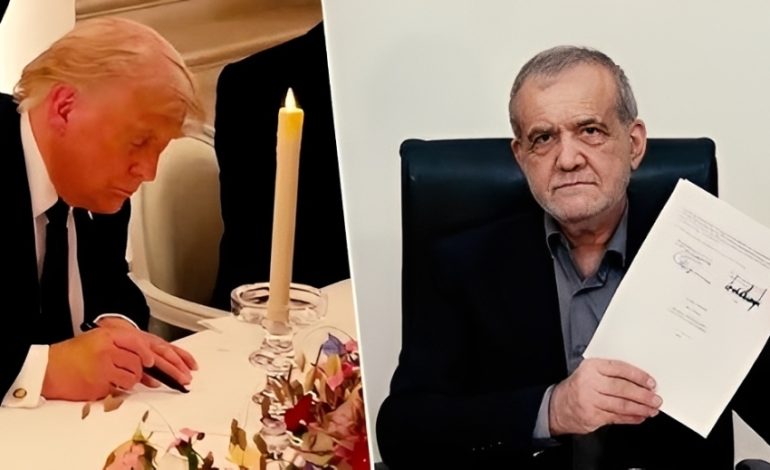
This combo photo shows Donald Trump (L) signing the US-Iran peace deal while Masoud Pezeshkian displays the remotely-signed agreement with the signatures.

New Delhi: The presidents of the United States and Iran have formally signed an agreement aimed at ending the West Asia war that erupted on February 28. This marks the most significant diplomatic breakthrough in the region in years and raised hopes of stability after more than three months of conflict that disrupted global energy markets and heightened fears of a wider regional war.
The agreement, signed electronically by the president of the United States, Donald Trump, and the president of Iran, Masoud Pezeshkian, transforms an earlier memorandum of understanding (MoU) into an active framework for ending hostilities, reopening the strategically vital Strait of Hormuz, and launching negotiations on a broader settlement covering sanctions, Iran’s nuclear programme, and regional security issues.
The war began after large-scale Israeli and American strikes targeted Iranian military and nuclear facilities, triggering months of missile attacks, naval confrontations, and disruptions to maritime traffic in the Gulf. The conflict sent oil prices soaring, rattled global markets, and forced governments across Asia, Europe, and the Middle East to prepare for a prolonged crisis.
According to details released by officials involved in the negotiations, the accord envisages an end to military operations, the gradual lifting of restrictions on Iranian shipping, the restoration of commercial traffic through the Strait of Hormuz, and the start of structured talks on Tehran’s nuclear activities. Iran has also committed not to pursue nuclear weapons, while economic concessions from Washington will be linked to future verification and compliance measures.
Yet diplomats and analysts caution that the signing itself is only the beginning.
The agreement provides a political framework rather than a comprehensive peace treaty. The most difficult issues, including the future of Iran’s enriched uranium stockpile, the scope and timing of sanctions relief, verification mechanisms, and Tehran’s ties with regional armed groups, remain unresolved and are expected to dominate negotiations over the coming weeks. Both sides are expected to use a 60-day window to attempt to convert the current arrangement into a binding and durable settlement.
For the region, the immediate impact is likely to be a reduction in the risk of a wider war. The reopening of the Strait of Hormuz, through which a substantial share of the world’s seaborne oil trade passes, is expected to ease pressure on energy markets and restore confidence among shipping companies and insurers. Oil prices have already fallen on expectations that Gulf exports will normalize and maritime traffic will resume without the threat of attacks or blockades.
The accord may also reshape the diplomatic landscape of the Middle East. Gulf Arab states, many of which feared being drawn directly into the conflict, are likely to welcome the reduction in tensions. European governments have similarly backed efforts to stabilize the region, while international institutions are expected to support mechanisms that prevent a renewed confrontation over Iran’s nuclear programme.
However, significant uncertainties remain.
As RNA Media reported earlier, Israel has not concealed its concerns that any agreement leaving Iran with residual nuclear capabilities could eventually strengthen Tehran’s strategic position. In Washington, critics argue that premature sanctions relief could provide Iran with economic benefits before concrete nuclear concessions are implemented. Iranian hardliners, meanwhile, are expected to scrutinize any arrangement that could be seen domestically as limiting the country’s strategic autonomy.
For India, the peace deal is critical – both economically and strategically. The stable and secure Strait of Hormuz is crucial for New Delhi considering that it relies heavily on crude oil and gas from the Persian Gulf. Reduced tensions could lower energy costs, ease pressure on inflation, and improve predictability in regional shipping routes that are critical for Indian trade with West Asia and Europe.
At the same time, New Delhi will closely watch the next phase of negotiations. A durable settlement could open the door to broader regional economic recovery and renewed connectivity projects, while any collapse of the accord could quickly reignite military confrontation and restore uncertainty to global energy markets.
For now, the signing of the agreement represents a rare diplomatic success after months of warfare. Whether it evolves into a lasting peace or merely a temporary pause will depend on the far more complex negotiations that begin now.