


Quad Agrees On Joint Maritime Surveillance, India-US Seal Rare Earths Deal, Modi Meets Quad Foreign Ministers
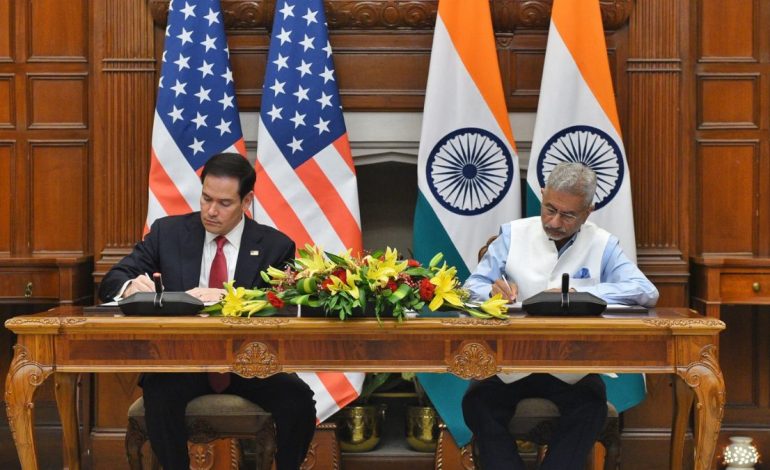
India’s External Affairs Minister Dr. S. Jaishankar and US Secretary of State Marco Rubio sign a strategic critical minerals and rare earths cooperation framework on the sidelines of the Quad Foreign Ministers’ Meeting in New Delhi. Image courtesy: X.com/@DrSJaishankar

The Quad, on Tuesday (May 26, 2026), agreed on an Indo-Pacific Maritime Surveillance Initiative, aimed at enhancing regional safety and maritime awareness. However, India clarified that this initiative was not the militarisation of the diplomatic grouping.
After the Quad Foreign Ministers’ Meeting in New Delhi, the four-nation grouping issued a detailed fact sheet announcing the launch of the first-ever Indo-Pacific Maritime Surveillance Collaboration (IPMSC).
The IPMSC would be a mechanism designed to integrate maritime surveillance efforts of India, the US, Japan, and Australia, with an initial operational focus on the Indian Ocean Region.
Under the IPMSC, the Quad would strengthen real-time information sharing, maritime domain awareness, and coordinated monitoring of unlawful activities through expert exchanges and table-top exercises.
At a media briefing later, the Indian Ministry of External Affairs (MEA) clarified that the Quad’s IPMSC was only aimed at enhancing regional safety and maritime awareness, and it did not mean the militarisation of the grouping, seeking to counter the perception that it was taking the shape of a military bloc.
MEA Additional Secretary K. Nagaraj Naidu said the IPMSC and the broader Indo-Pacific Partnership for Maritime Domain Awareness (IPMDA) should not be viewed as efforts to militarise the Quad.
As nations in the region lacked the technology for such surveillance, the objective was to help countries in the Indo-Pacific gain access to expensive maritime monitoring technologies and improve their ability to track unlawful activities at sea, Naidu said.
With the number of “grey ships” and “dark ships” in international waters growing, Naidu said, “the focus is to provide partners an enhanced picture of the kind of vessels operating in the waters.”
Quad partners would pool commercially available technologies and share maritime data to assist friendly countries in addressing safety and security concerns. Indian Navy’s Gurugram-based Information Fusion Centre in Gurugram would play a key operational role in the initiative.
He said the new IPMSC initiative would build upon the existing IPMDA framework, under which the four countries were already working to create a comprehensive “Common Operating Picture” by integrating real-time maritime information across Indo-Pacific waters.
The grouping also announced that India would host the next edition of the Quad-at-Sea Ship Observer Mission aimed at improving interoperability and operational coordination against unlawful maritime activities.
The Quad Foreign Ministers’ Meeting unveiled the expansive maritime surveillance initiative, apart from a digital connectivity agenda for the Indo-Pacific Region, indicating a growing shift towards operational coordination on security, emerging technologies, and critical infrastructure.
The Quad meeting’s agenda included a broader technology and connectivity initiative to build trusted and resilient digital ecosystems in the Indo-Pacific.
It agreed to intensify collaboration on next-generation telecommunications technologies, including Open RAN and 6G standards, while also working towards interoperability in digital identity frameworks, noting the secure 4G and 5G Open RAN networks deployment in Palau for alternative digital infrastructure.
The four nations would support undersea cable resilience and ensure the Pacific Island Forum nations were connected through undersea cable systems by 2026. They announced over $6-million funding for six international artificial intelligence-based research projects focused on agriculture, including crop yields, pest management, and food security.
In a significant statement on terrorism, the Quad nations hit out at cross-border militancy and its funders, and announced elevating counter-terrorism as a central baseline of their strategic alliance.
“Counter-terrorism is a significant pillar of Quad cooperation. The ministers strongly condemned terrorism in all its forms and manifestations, including cross-border terrorism,” Naidu said.
“The joint statements specifically condemned the terrorist attack in Pahalgam in April 2025 and the Bondi Beach attack in Australia in December 2025, and reiterated the need for decisive international action against terrorist entities and financial sponsors,” Naidu said.
To actively intensify collective defence frameworks against asymmetric threats, he said, the containment of transnational security threats remained a fundamental priority for the partner nations.
“We call for decisive and sustained international efforts to combat terrorism in accordance with international law, including action against globally proscribed terrorists and terror entities and their proxies, affiliates, sponsors and financiers,” the joint statement read.
Meanwhile, in a bilateral engagement, India and the US signed a framework to secure the supply and processing of critical minerals and rare earths as a key step to reduce dependency on vulnerable supply chains.
India’s External Affairs Minister Dr. S. Jaishankar and US Secretary of State Marco Rubio during Rubio signed the agreement on the sidelines of the Quad Foreign Ministers’ Meeting in New Delhi. Australian Foreign Minister Penny Wong and Japanese Foreign Minister Toshimitsu Motegi also attended the Quad meeting.
The rare earths agreement is significant for its bid to secure guaranteed access to critical minerals used in semiconductors, electric vehicles, batteries, defence manufacturing, and advanced technologies.
Rubio described the framework as a “tangible example” of the growing strategic partnership between Washington and New Delhi. “I have spoken often during my time here over the last few days about the strategic alliance between the United States and India and how important that is for our national interest in the United States. And today is a tangible example of it,” he said.
Rubio said both countries shared a common strategic interest in ensuring reliable access to critical minerals and supply chains essential for innovation-driven economies, noting that the partnership gained momentum after India joined the Critical Minerals Forum in the US in February.
He said countries like India and the United States “cannot afford to leave the foundational materials of these industries vulnerable to single-source monopolies.”
“These could deny us these things, not just in a time of conflict, but as a leverage point contrary to our sovereign national interests,” Rubio added.
Jaishankar said the agreement would strengthen cooperation across the entire supply chain, including mining, processing, recycling, and investments linked to critical minerals and rare earths.
The framework aimed to build resilient and diversified supply chains while also improving collaboration in financing and effective management of critical minerals. “It is one more sign of how close our cooperation is in a world where there are so many challenges but also so many opportunities,” he said.
On the same day, Indian Prime Minister Narendra Modi held back-to-back engagements with Penny Wong and Toshimitsu Motegi. Modi posted on X that he was “happy to receive” Wong to discuss the India-Australia Comprehensive Strategic Partnership across key sectors.
He said the talks focused on expanding cooperation in defence, trade, technology, and enhancing supply chain resilience between the two countries, adding that India and Australia would continue working together for a “free, open, secure and prosperous Indo-Pacific.”
The Prime Minister said he was “delighted” to receive Motegi and reaffirmed the importance of the India-Japan Special Strategic and Global Partnership in promoting peace, stability, and prosperity across the Indo-Pacific and beyond.
Wong said the Indian PM Modi will travel to Australia in the “near future” as announced by Australian Prime Minister Anthony Albanese, as diplomatic engagement continues to grow.
Motegi highlighted how the Quad served as an important platform for advancing cooperation in the Indo-Pacific region and expressed optimism that the discussions at the Foreign Ministers’ Meet would deepen collaboration between the partner countries.
“This Quad meeting signifies the firm message to the world that Quad will strongly promote cooperation to realise a free and open Indo-Pacific,” he added.