Iran-US Deal On Ending War Imminent, As Munir Concludes Tehran Visit
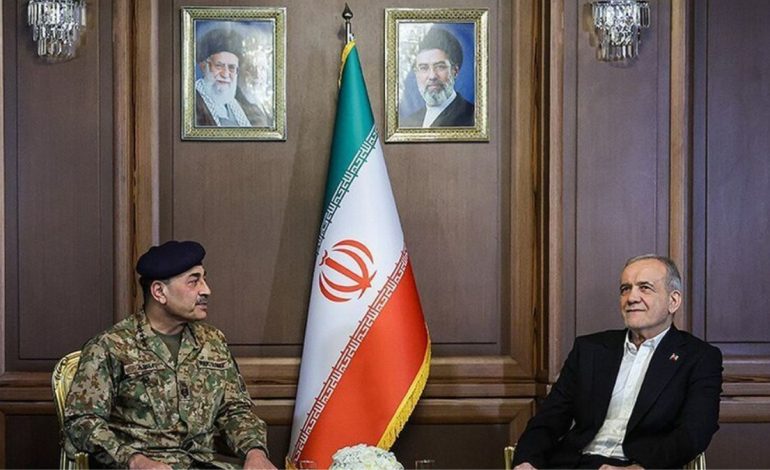
Pakistan Army chief General Asim Munir meets Iranian President Masoud Pezeshkian in Tehran during high-level talks aimed at advancing negotiations to end the ongoing West Asia conflict and revive US-Iran diplomatic engagement. Image courtesy: Wikimedia Commons.

Pakistan Army chief Asim Munir, on Saturday (May 23, 2026), claimed the negotiations with the Iranian top brass had led to “encouraging progress” towards a solution to the West Asian war, as he wrapped up his visit to Iran.
“Negotiations over the past 24 hours have led to encouraging progress toward a final understanding,” the Pakistan Army said on the outcomes from the intensive diplomatic engagement of Munir in Tehran on Friday (May 22) and Saturday (May 23).
An Iranian state-run news agency reported that the indirect negotiations had shown some movement towards narrowing differences between the sides involved in the peace process.
Munir was in Tehran to discuss with the Iranian leadership a possible return to the negotiation table with the US to find an amicable end to the West Asian war that began on February 28.
Munir’s fresh diplomatic efforts in Tehran followed high-level military and political engagements linked to the ongoing regional conflict and meant to prevent further escalation.
The Pakistani Army statement said the “discussions focused on accelerating the ongoing consultation process to support peace and stability in the region.”
Meanwhile, Iran’s chief negotiator, Mohammed Bagher Ghalibaf, on Saturday (May 23), cautioned the US of severe retaliation if President Donald Trump resumed military strikes on Iran.
He said Tehran had reconstructed its military during the six-week ceasefire. “Our armed forces have rebuilt themselves during the ceasefire period in such a way that if Trump commits another act of folly and restarts the war, it will certainly be more crushing and bitter for the United States than on the first day of the war,” he said.
Ghalibaf told Munir during their talks in Tehran on Saturday (May 23) that the US was dishonest in the negotiations to end the war and that Iran would not compromise on its national rights.
He said Iran would continue to pursue its “legitimate rights” on both the battlefield and diplomatic fronts, adding that Tehran would not trust “a part that has no honesty at all.”
Munir had also met with Iranian President Masoud Pezeshkian, when the two sides focused on the 14-point peace negotiations agenda proposed by Iran.
Meanwhile, a Western media report claimed the US and Iran were close to finalising a memorandum of understanding to end the ongoing war, with mediators pushing for a deal to extend the current ceasefire by another two months.
The report said the extension of the ceasefire would open the door for wider negotiations on Iran’s nuclear programme, a sticking point with the US in the peace talks.
Iranian Foreign Ministry spokesperson Esmael Baghaei said Tehran was working on the MoU as the first phase towards ending the war before entering into detailed talks over the next 30 to 60 days on other points of contention with the US.
The proposed arrangement could include discussions on the reduction of Tehran’s weapons-grade uranium stockpile and a gradual reopening of the blockaded Strait of Hormuz, apart from easing the US blockade of Iranian ports and limited sanctions relief.
Another report claimed the US and Iran were reviewing a Pakistan-backed proposal that could be approved over the next two days. The Pakistan proposal seeks to end the war first, followed by deeper negotiations over the next one to two months on other issues.
The same day, US President Donald Trump said he would decide by Sunday (May 24) whether to continue the negotiations with Iran or to relaunch the military operations.
“I think one of the two things will happen. Either I hit them harder than they have ever been hit, or we are going to sign a deal that is good,” Trump said, describing the chances of an agreement as a “solid 50/50.”
The reports claimed talks were moving in a positive direction and Iran could show greater flexibility on the nuclear concerns once the conflict ended.