

65 Pakistani terrorists on security radar as Kashmir valley sees sharp decline in local militancy
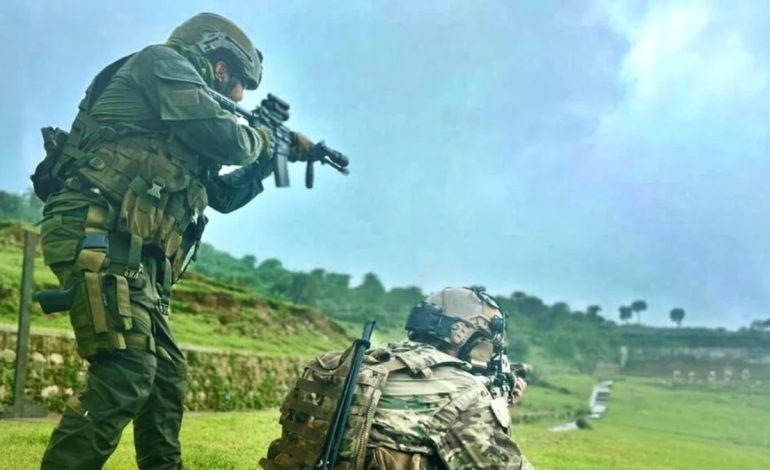
Security forces intensify hunt for Pakistan-based terrorists in Jammu & Kashmir. (Image courtesy: Wikimedia Commons)

New Delhi: The security forces have intensified operations to track an estimated 65 foreign terrorists believed to be active in Jammu & Kashmir, following the killing of the last known active local terrorist in the Kashmir valley. Intelligence assessments indicate that most of the remaining operatives are affiliated with Pakistan based Lashkar-e-Taiba (LeT) and Jaish-e-Mohammed (JeM), with security agencies concentrating on suspected hideouts in the Jammu region.
Of the 65 suspected foreign terrorists, 35 are believed to be linked to LeT, 25 to JeM and five to other banned organizations, ANI reported on Wednesday, citing security officials. The figures are based on inputs from multiple intelligence agencies and may change as suspects frequently shift locations.
Pakistan-based LeT and JeM have been linked to several major terrorist attacks in India, including the 2016 Uri attack and the 2019 Pulwama bombing, respectively. Security agencies have long identified cross-border infiltration and logistical support networks as central challenges in counterterrorism operations along the line of control (LoC).
Last known local terrorist killed in Kulgam
The latest assessment follows the killing of 22-year-old LeT terrorist Mohammad Lateef Bhat in Kulgam district on November 18, after an eight-day search operation. The Union home minister, Amit Shah, in an official statement issued the same day, described Bhat as Lashkar’s last known active local terrorist in the valley and commended the coordinated operation involving Jammu & Kashmir Police, the Army, Central Reserve Police Force (CRPF) and intelligence agencies.
Bhat’s killing followed the death of his associate Umar Nisar Dar near the Laroo bypass on November 16. Both were reportedly linked to the November 11 attack on a CRPF checkpoint in Kulgam that injured three personnel.
Security officials believe local terrorist recruitment has fallen to almost zero, marking a significant shift in the valley’s security landscape. However, the absence of known active local terrorists does not rule out the presence of overground workers, logistical facilitators or attempts at fresh recruitment.
The estimated number of active terrorists across Jammu & Kashmir has declined from 135 in 2022, including 85 foreigners and 50 locals, to 91 in 2024 and approximately 65 currently, according to officials cited by ANI.
The Jammu & Kashmir lieutenant governor, Manoj Sinha, addressing a passing-out parade at the Sher-i-Kashmir police academy in Udhampur on November 18, expressed confidence that the Union Territory would soon become terror-free. He said only a handful of foreign terrorists remained active, while emphasizing continued efforts to eliminate terrorism.
High-altitude bases strengthen counterterrorism operations
The security agencies are monitoring suspected terrorist movements across Poonch, Rajouri, Kishtwar and Doda, where dense forests and mountainous terrain complicate surveillance. Officials believe foreign operatives are exploiting remote caves, forest shelters and difficult terrain to evade detection.
More than 80 temporary operating bases (TOBs) have been established across remote areas, several at altitudes exceeding 10,000 feet, India Today reported, citing intelligence sources. Personnel from the Army, CRPF and Jammu & Kashmir Police are deployed at these locations to maintain surveillance and restrict terrorist movement through forested areas.
The strategy also relies on local intelligence and informants to locate suspects avoiding conventional communications. The first such base was reportedly established at Fakir Gujri near Srinagar in July 2025, following heightened security concerns after the Pahalgam terror attack.
Earlier counterterrorism operations included the elimination of a seven-member JeM group led by Saifullah, which had reportedly infiltrated in April 2024. The operations culminated in Operation Trashi-I in the Chatroo area of Kishtwar on February 22, 2026, according to The Times of India.
Snowfall poses new challenges for counterinfiltration operations
With winter approaching, heavy snowfall is expected to render several high-altitude mountain passes along the LoC inaccessible, potentially restricting traditional infiltration routes. However, reduced movement across snowbound passes does not eliminate the threat, as foreign terrorists already operating in Jammu & Kashmir may exploit remote forested areas and isolated settlements to evade detection.
The changing seasonal conditions present an opportunity for the Indian Army to consolidate its counterinfiltration grid through sustained surveillance, intelligence-led operations and closer coordination with Jammu & Kashmir Police and other security agencies. Maintaining an effective winter security presence, supported by modern surveillance technology, unmanned aerial systems and reliable logistical infrastructure, could help prevent terrorist groups from exploiting difficult terrain. Particular emphasis on disrupting local support networks and maintaining operational readiness before mountain routes reopen in spring would strengthen a year-round counterinfiltration posture.
Security agencies continue to prioritize preventing cross-border infiltration, identifying local facilitators and dismantling foreign terrorist networks operating in the region.