
India pushes for stronger Indian Ocean security front as Ajit Doval calls for deeper regional cooperation
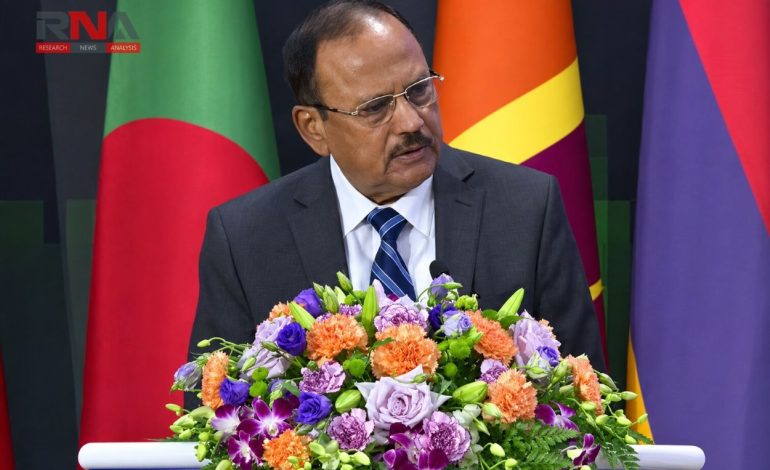
Ajit Doval during his address at the Colombo Security Conclave at the Maldivian capital Male.

New Delhi: India has called for closer strategic cooperation among Indian Ocean nations to counter emerging security threats, protect vital maritime routes and safeguard the region’s collective economic interests. Addressing the eighth national security advisers’ meeting of the Colombo Security Conclave (CSC) in Male, Maldives, on Wednesday, the national security advisor, Ajit Doval, reaffirmed New Delhi’s commitment to strengthening the six-nation regional security mechanism.
Doval emphasized that the Indian Ocean should remain a maritime space that brings countries together rather than become an arena of division and geopolitical confrontation. His remarks come at a time when intensifying great-power competition, disruptions to international shipping and increasingly sophisticated transnational security threats are reshaping the strategic environment across the Indian Ocean region (IOR).
The three-day meeting, being held from November 24 to 26, has brought together senior security officials from India, the Maldives, Sri Lanka, Bangladesh, Mauritius and Seychelles. The deliberations are focused on expanding institutional cooperation, strengthening collective response capabilities and addressing security vulnerabilities that transcend national boundaries.
Drawing attention to the historical and civilizational links among Indian Ocean countries, Doval said generations of people had benefited from maritime connectivity through commerce, cultural exchanges and shared traditions. He stressed the importance of preserving this legacy for future generations by ensuring that the ocean remained a unifying force.
From maritime cooperation to a regional security architecture
The CSC originated in November 2020 when India, Sri Lanka and the Maldives decided to broaden their existing trilateral maritime security arrangement into a more comprehensive regional framework. The subsequent expansion of the grouping to include Mauritius, Bangladesh and Seychelles has considerably widened its geographical reach, extending its footprint from the Bay of Bengal to the western Indian Ocean.
An important milestone in its institutional development came on August 30, 2024, when participating countries signed the CSC charter and a memorandum of understanding to establish a permanent secretariat in Colombo. The establishment of the secretariat and appointment of a secretary general have provided the grouping with an administrative structure to ensure continuity between high-level meetings.
The conclave’s framework for regional security cooperation encompasses five principal areas – maritime security and safety, counterterrorism and counter-radicalization, human and narcotics trafficking and transnational organized crime, cybersecurity and critical infrastructure protection, and humanitarian assistance and disaster relief (HADR).
Unlike conventional military alliances, the CSC concentrates on addressing shared security concerns through coordination, capacity-building and institutional exchanges. This allows participating countries to cooperate on practical security matters without necessarily adopting identical foreign policy positions or strategic alignments.
India’s Neighbourhood First and Mahasagar vision
Doval described the CSC as a convergence of India’s Neighbourhood First policy and its broader Mahasagar vision. He assured participating countries that New Delhi would provide the assistance necessary to advance the grouping’s common objectives.
The Mahasagar initiative – Mutual and Holistic Advancement for Security and Growth Across Regions – was unveiled by the prime minister, Narendra Modi, during his visit to Mauritius in March 2025. It represents an expansion of India’s earlier Sagar (Security and Growth for All in the Region) doctrine, announced in 2015, and envisages deeper engagement with countries across the Global South.
India has increasingly sought to translate these policy commitments into operational cooperation through joint maritime exercises, hydrographic surveys, training programmes, defence assistance and information-sharing arrangements. Such engagements are particularly important for smaller island nations, which have extensive exclusive economic zones but often possess limited maritime surveillance and enforcement capabilities.
As RNA Media reported earlier this year, India, Sri Lanka and the Maldives have been strengthening operational coordination through the trilateral Dosti coastguard exercise. Similarly, the Navy’s IOS Sagar initiative involving personnel from 16 countries reflects New Delhi’s efforts to develop multinational maritime partnerships.
Larger geopolitical significance
The strategic significance of the CSC extends beyond conventional maritime policing and disaster response. The Indian Ocean accommodates some of the world’s most important commercial shipping routes, connecting the energy-producing countries of West Asia with the industrial economies of Asia, Europe and elsewhere.
For India, safeguarding these routes is directly linked to its energy security, international trade and economic stability. Developments around critical maritime chokepoints, including the Strait of Hormuz, Bab al-Mandab and the Strait of Malacca, have repeatedly demonstrated the vulnerability of global supply chains to regional conflicts and security disruptions.
China’s expanding naval presence in the Indian Ocean, coupled with its investments in port infrastructure across the region, has introduced another dimension to New Delhi’s maritime security calculations. Although Doval did not explicitly identify China as a threat in his reported remarks, strengthening regional security partnerships is consistent with India’s efforts to preserve its strategic influence and prevent excessive dependence on extra-regional powers.
The CSC also provides New Delhi with a platform to maintain security engagement with countries despite occasional difficulties in their bilateral relationships with India. The participation of Bangladesh and the Maldives is particularly significant in this respect, given the political and diplomatic fluctuations that have characterized their respective ties with New Delhi in recent years.
Reinforcing defence ties with the Maldives
Ahead of Wednesday’s deliberations, Doval held bilateral talks with the Maldivian minister of defence and national service, Hassan Rasheed, on November 24. The discussions covered ways to expand bilateral defence and security cooperation, besides other matters of mutual interest.
The engagement underlines the continuing strategic importance of the Maldives, whose geographical location places it close to major international shipping lanes. For New Delhi, sustained security cooperation with Male remains integral to its wider maritime security objectives.
Ultimately, the effectiveness of the CSC will depend on its ability to translate political commitments into sustained operational cooperation, timely intelligence exchanges and coordinated responses to regional emergencies. For India, the grouping offers an opportunity to shape an inclusive regional security architecture in which Indian Ocean countries themselves assume greater responsibility for the stability of their shared maritime neighbourhood.