



Britain moves RAF warplanes under cover as drone threats mount
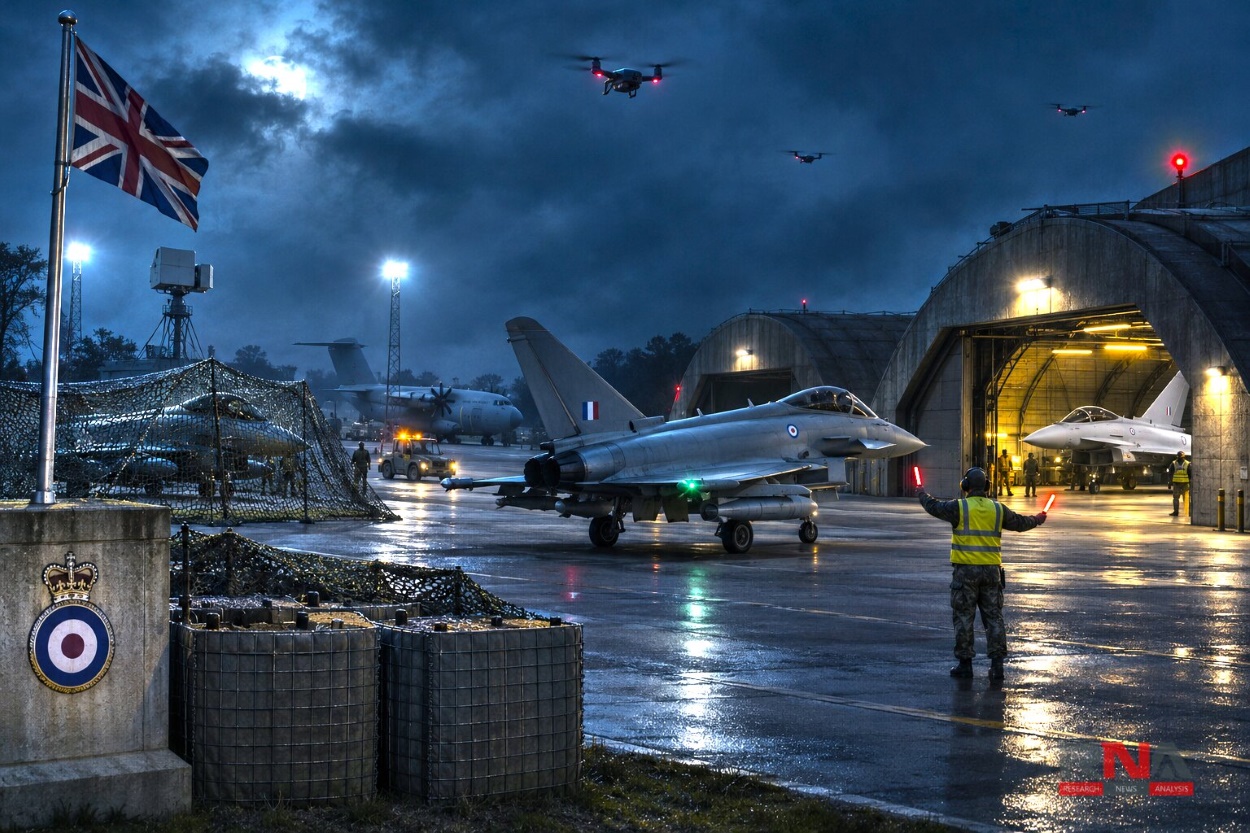
RNA Media illustration for representation.

New Delhi: Britain’s Royal Air Force has begun moving military aircraft into hangars and hardened shelters at night amid growing concerns over potential drone attacks on military installations across the country. The service is also reportedly considering protective anti-drone netting for aircraft parked in the open, adopting defensive measures that have become commonplace on the battlefields of Ukraine.
The development, reported on Wednesday, by Sky News and the Times, reflects a growing reassessment within Britain’s military establishment of the vulnerability of its domestic defence infrastructure. Although the precise scale of the new measures remains officially unconfirmed, the RAF leadership has acknowledged that British airbases can no longer be regarded as immune to hostile action.
Speaking at an event organized by the Freeman Air and Space Institute on Tuesday, the British chief of the air staff, Air Chief Marshal Sir Harv Smyth, emphasized the need to prepare for military operations under conditions in which even home bases could come under attack. His remarks pointed towards a fundamental change in Britain’s approach to maintaining combat readiness.
“There is no sanctuary at home, you are fighting from the UK but you need to get on the move,” ACM Smyth said.
Growing security concerns at British airbases
The reported measures follow a series of security incidents and intelligence warnings involving British military establishments, including those hosting United States forces. Concerns have intensified over suspected threats linked to Iran, alongside wider apprehensions about Russian sabotage and hostile intelligence activities on European soil.
The Pentagon has already withdrawn bomber aircraft from RAF Fairford in Gloucestershire following reports of a suspected Iranian plot against the installation. American military aircraft were subsequently relocated from RAF Mildenhall in Suffolk after another reported security threat.
On November 13, American military personnel responded to suspected unauthorized drone activity at RAF Lakenheath, another major British installation hosting US forces. American and British defence authorities subsequently said the incident had been resolved, with no reported damage to aircraft or infrastructure.
There is, however, no publicly established evidence linking all these incidents to a single hostile actor.
Separately, on November 24, Britain’s domestic intelligence agency, MI5, and the ministry of defence issued a security warning to British companies supplying military equipment to Ukraine. The authorities said Russia had intensified attempts to sabotage European defence-related establishments, prompting the government to organize security briefings for executives from strategically important industries.
How drone warfare has changed airbase security
The proliferation of relatively inexpensive unmanned aerial vehicles (UAVs) has fundamentally altered the economics of air warfare. Military aircraft costing tens of millions of dollars can potentially be damaged or destroyed on the ground by drones costing a fraction of their value, without an adversary having to establish conventional air superiority.
The Russia-Ukraine war has demonstrated the importance of protecting military assets against such asymmetric threats. Both countries have increasingly incorporated physical barriers and counter-drone systems into their military infrastructure, supplementing conventional air defence capabilities.
Protective netting provides an additional layer of passive defence, although it cannot substitute for hardened aircraft shelters or comprehensive air defence systems. The RAF’s reported interest in these relatively inexpensive measures illustrates how lessons from contemporary conflicts are influencing military planning even in countries geographically removed from active war zones.
The scale of the problem in Britain is evident from official figures. According to data released by the British defence ministry in February, 266 drone-related incidents were reported near military establishments in 2025, compared with 126 in 2024.
The British government has also proposed expanding the legal powers of military personnel to neutralize threatening drones without requiring police intervention. In February, it announced that counter-drone expenditure had quadrupled since the government took office, with more than £200 million allocated for such capabilities in 2026.
RAF revisits Cold War operational doctrine
Alongside strengthening physical protection, the RAF is reviving the Cold War-era practice of aircraft dispersal to ensure the continuity of military operations during a conflict. The approach, now incorporated into a broader operational concept known as agile combat employment (ACE), emphasizes reducing dependence on permanent operating bases.
The service recently gained practical experience in this approach during extensive runway refurbishment at RAF Brize Norton, Britain’s principal military air transport hub. Under an initiative called Project MACE, the RAF maintained its global transport operations despite the closure of the installation’s runway for four months.
ACM Smyth described the experience as an important demonstration of the service’s operational resilience, stressing the need for more such exercises. The challenge, however, is considerably more complex than during the Cold War, given the contraction of Britain’s military infrastructure following decades of post-Cold War restructuring.
In March, the RAF conducted Exercise Agile Warrior 26, a major homeland defence exercise designed to assess its ability to sustain operations under simulated hostile conditions. The exercise incorporated threats associated with contemporary warfare, including missile attacks and disruptions to military communications.
Implications for Britain and other air powers
The developments are consistent with Britain’s Strategic Defence Review 2025, which identified homeland defence and warfighting readiness as central military priorities. In July, the British government announced plans to spend £790 million over four years on strengthening protection against aerial, missile and drone threats at domestic and overseas military installations.
The evolving threat environment also carries considerable significance for countries such as India, where protecting expensive combat aircraft and other high-value military assets against asymmetric attacks is an increasingly important component of national defence planning. Investment in advanced fighter aircraft must consequently be accompanied by adequate expenditure on infrastructure protection, counter-drone capabilities and operational resilience.
For Britain, a country whose geographical position historically afforded it considerable strategic protection, the latest RAF measures underline a changing military reality. The ability to preserve combat power on the ground is becoming almost as consequential as the ability to establish superiority in the air.