‘I made the deal’: Trump claims credit for Jensen Huang’s Nvidia comeback, celebrates with bizarre red bra AI meme
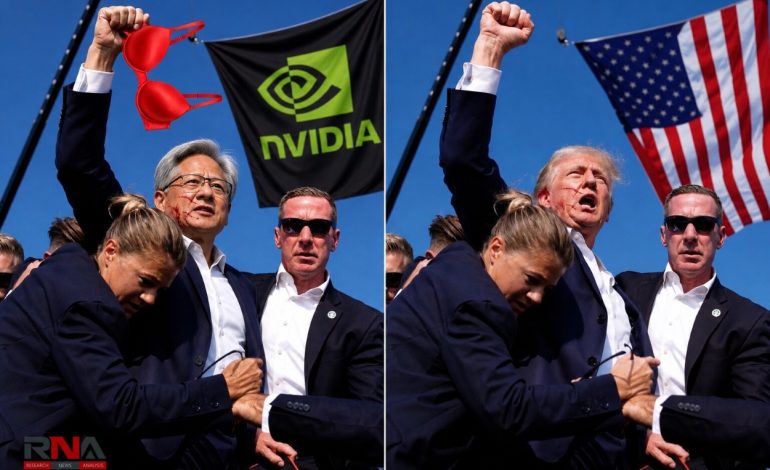
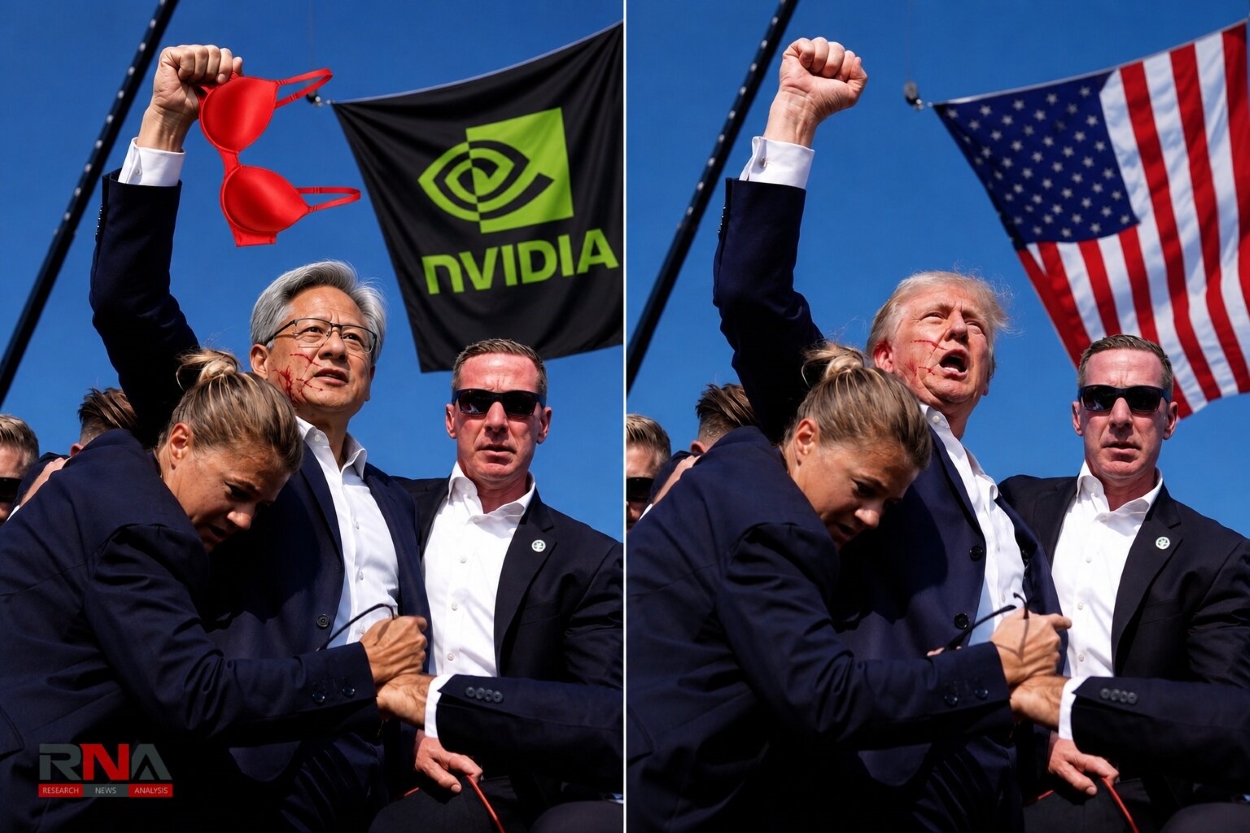
Donald Trump’s Jensen Huang meme (L) is a recreation of a widely circulated photograph of Trump (R) raising his fist after surviving an assassination attempt at a presidential election campaign rally in Butler, Pennsylvania, in July 2024.

New Delhi: The US president, Donald Trump, has revealed that he personally intervened to secure the reinstatement of Nvidia chief executive officer Jensen Huang, persuading the chipmaking giant’s board of directors that the technology billionaire’s return posed no threat to American national security. Trump subsequently celebrated Huang’s comeback by sharing an artificial intelligence-generated image of the Nvidia boss triumphantly brandishing a red bra, an apparent reference to the sex-and-espionage scandal that had forced his resignation.
The extraordinary presidential intervention in the affairs of one of the world’s most valuable publicly traded companies comes amid continuing investigations into suspected Chinese espionage and possible violations of American semiconductor export controls. Although Huang’s reinstatement triggered a spectacular recovery in global technology stocks on Monday, it has raised fresh questions in Washington over the relationship between corporate governance, political power, economic interests and national security.
Speaking to CNBC in a telephone interview on Monday, Trump disclosed that he had communicated with Nvidia’s directors both directly and indirectly to facilitate Huang’s return. The president left little ambiguity about who, in his view, was responsible for the board’s dramatic reversal.
“I convinced them,” Trump said, adding: “I made the deal.”
Trump revealed that Nvidia’s directors had sought assurances from his administration concerning the national security implications of bringing Huang back. He said the administration had provided those assurances based on the information available to the US government, which ultimately helped clear the way for the board’s unanimous decision.
The president also disclosed that he had spoken to Huang after the arrangements for his reinstatement had been finalized. Rather than discussing the controversies surrounding the executive, Trump said he urged Huang to concentrate on his work and maintain Nvidia’s technological lead over its competitors.
Trump argued that losing Huang could be more detrimental to American strategic interests than allowing him to return. He portrayed the 63-year-old Taiwan-born American entrepreneur as an exceptional technological talent whose departure could potentially undermine the United States’ competitive advantage in the global AI industry.
When asked whether the massive stock-market sell-off following Huang’s resignation had influenced his decision, Trump acknowledged that it probably had. However, he maintained that Nvidia’s longer-term technological prospects and Huang’s ability to develop next-generation computing systems were his principal considerations.
As RNA Media reported on Monday, Trump had earlier described Huang as a great patriot and national treasure whose leadership was essential to American economic prosperity. He also said the US attorney general, Todd Blanche, had confirmed that the federal government possessed no evidence of unlawful conduct by the Nvidia executive.
According to CNN, the president had enlisted the vice-president, JD Vance, to work behind the scenes with Huang and Nvidia’s directors to facilitate his reinstatement. The discussions reportedly involved reassuring the board that the administration did not believe Huang had committed a crime or that his return would compromise national security.
Trump’s intervention reverses Nvidia board’s position
Huang had resigned on November 12 following revelations about multiple extramarital relationships, including an alleged affair with Alice Huang, a Chinese businesswoman suspected by American authorities of having links with China’s intelligence establishment. Reports of his relationships with at least two Nvidia employees had further intensified concerns about his personal judgement and adherence to corporate standards.
Alice Huang, who is unrelated to the Nvidia chief, was a senior executive and controlling shareholder of Megaspeed, a Singapore-based technology company that had emerged as a major purchaser of Nvidia’s advanced AI processors. US authorities have been investigating whether the company facilitated the unauthorized transfer of sophisticated American semiconductors to China.
As recently as November 17, Nvidia’s directors had categorically ruled out Huang’s reinstatement, despite mounting pressure from influential technology executives, investors and employees. The company had appointed its chief financial officer, Colette Kress, as interim CEO and initiated measures to strengthen oversight of national security and export-control matters.
However, in a stunning boardroom U-turn on Monday, Nvidia announced that its directors had unanimously approved Huang’s return as president, CEO and a member of the board. The company explicitly acknowledged that information received from senior US government officials had influenced its assessment of the national security implications of his reinstatement.
Nvidia’s board chairman, Harvey C Jones, expressed confidence in Huang’s ability to lead the company and maintained that his return would serve the interests of shareholders, employees, customers and business partners. Kress will continue as chief financial officer, while Jones will remain chairman.
Trump celebrates Huang’s return with bizarre AI image
Hours after taking credit for Huang’s reinstatement, Trump offered an unusual public celebration of the technology executive’s comeback, posting an AI-generated image on his social media platform, Truth Social.
The fabricated picture depicted a bloodied but defiant Huang raising a clenched fist holding a red bra while surrounded by US Secret Service agents. A flag bearing the Nvidia logo appeared in the background, replacing the American flag in the original photograph on which the image was modelled.
The picture recreated the widely circulated photograph of Trump raising his fist after surviving an assassination attempt at a presidential election campaign rally in Butler, Pennsylvania, in July 2024. By substituting Huang for himself and introducing the red bra, Trump appeared to draw a parallel between the Nvidia executive’s professional comeback and his own political resilience.
The choice of imagery was particularly striking given that the controversy surrounding Huang involved not merely allegations of marital infidelity but also a potentially serious foreign intelligence operation targeting the head of America’s most influential AI semiconductor company.
During his CNBC interview, Trump suggested that the publicity surrounding Huang’s extramarital relationships might ultimately work to the executive’s advantage rather than permanently damage his reputation. He appeared to dismiss concerns that the scandal would diminish Huang’s standing among investors or the wider public.
“Sex sells, fellas,” Trump remarked.
The comments marked a departure from the more cautious language employed by Nvidia’s directors in announcing Huang’s return. While the company emphasized renewed confidence in its founder alongside the need for continued investigations, Trump framed the reinstatement as a personal triumph for Huang and a victory for American technological interests.
Bipartisan backlash in Washington
Trump’s intervention and his public treatment of the scandal have not gone down well on Capitol Hill, where lawmakers from both the Republican and Democratic parties have questioned the wisdom of restoring Huang to Nvidia’s leadership before the investigations have concluded. The controversy has also reignited concerns about whether commercial considerations are taking precedence over American national security objectives.
The Senate minority leader, Chuck Schumer, said Democrats would investigate possible wrongdoing involving the Trump administration, Huang and other Nvidia executives. Republican senator Kevin Cramer, a member of the Senate armed services committee, also expressed concern that the board’s decision could transfer the national security risks associated with Huang’s reinstatement to the American military and citizens.
Huang is scheduled to face congressional questioning on December 1 and appear before the Senate banking committee on December 3. The proceedings are expected to examine Nvidia’s dealings with companies suspected of circumventing semiconductor export restrictions and the circumstances surrounding Huang’s relationship with the suspected Chinese intelligence asset.
Meanwhile, Nvidia has confirmed that its independent investigation into whether Huang was targeted by a foreign intelligence operation will continue. It has also established a national security and export-control committee comprising independent directors and begun searching for a chief compliance officer.
Wall Street celebrates as security concerns persist
As RNA Media reported on Tuesday, Nvidia’s shares closed at $165.05 on Monday, registering a gain of approximately 31.5 per cent and adding around $950 billion to the company’s market capitalization. The recovery triggered a broader rally across American and Asian technology stocks.
However, within hours of Huang’s reinstatement, the US commerce department blacklisted Megaspeed and six other Southeast Asian entities over concerns involving the diversion of sensitive American technology. Megaspeed has previously denied allegations that it unlawfully transferred advanced Nvidia processors to China.
The apparently contrasting developments illustrate the competing priorities confronting Washington in its technological rivalry with Beijing. While the Trump administration considers Huang’s leadership important to maintaining American dominance in AI, it must also prevent sensitive computing technologies from strengthening China’s military, intelligence and industrial capabilities.
Trump’s intervention has effectively ended Nvidia’s immediate leadership crisis, but his assurances and celebratory social media posts cannot substitute for the findings of independent investigations. Huang’s extraordinary comeback has restored investor confidence; whether it can withstand congressional and regulatory scrutiny remains an altogether different question.