

Rajasthan highway horror: Nine of Maharashtra family killed as pilgrims’ vehicle rams parked truck in Kota
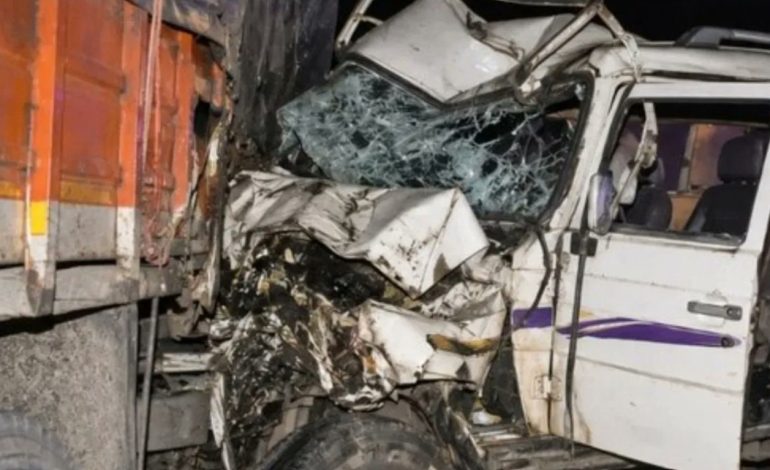
Screenshot of a widely circulated video on X showing the crashed vehicle.

New Delhi: Nine members of a family from Maharashtra, including women and children, were killed when their vehicle crashed into a stationary truck on the Kota-Udaipur national highway in Rajasthan in the early hours of Sunday. The victims were returning home after offering prayers at the famous Khatu Shyamji temple in Sikar district when their pilgrimage ended in tragedy near Shambhupura in Kota district.
Several other passengers sustained injuries in the collision, which occurred during the night between Saturday and Sunday, with police suspecting that the driver of the pilgrims’ vehicle may have fallen asleep at the wheel. The victims belonged to an extended family from Maharashtra’s Dhule district, and the accident has raised fresh concerns about overnight highway travel, driver fatigue and the dangers posed by stationary heavy vehicles on poorly illuminated roads.
According to initial police accounts, the family was travelling in a Cruiser utility vehicle when it struck a truck parked along the highway. The impact severely damaged the passenger vehicle, trapping several occupants inside and forcing emergency personnel to undertake a rescue operation.
The superintendent of police, Kota City, Tejeshwani Gautam, reached the accident site with other senior officials and supervised the operation to extricate the victims. The injured were subsequently taken to the New Medical College Hospital in Kota, where medical teams began treating them as authorities initiated procedures to identify the deceased and conduct post-mortem examinations.
The additional district collector, Rajesh Joshi, confirmed that nine people had lost their lives and said the administration’s immediate priority was ensuring appropriate treatment for the survivors. Initial accounts indicated that 16 family members were travelling together, although subsequent reports differed on the number of injured, with figures ranging from six to eight.
Driver fatigue suspected
Preliminary investigations have suggested that the Cruiser’s driver might have dozed off shortly before the collision, although investigators have yet to establish the precise sequence of events. Police are also examining whether the stationary truck was sufficiently visible to approaching motorists and whether its position on the road contributed to the crash.
According to a PTI report, the truck driver, identified as Haroon, said he had stopped his vehicle along the roadside after noticing a mechanical fault. He claimed that he was standing a short distance away when the Cruiser struck the truck, causing an impact powerful enough to throw him several feet from the road.
Haroon reportedly suffered injuries to his head and knees and briefly lost consciousness before recovering sufficiently to contact the police and ambulance services. His account provides investigators with an important eyewitness description, although the truck’s exact position, visibility and compliance with roadside safety requirements remain matters requiring examination.
An investigating officer, Shivraj Singh, reportedly indicated that the driver of the passenger vehicle might not have noticed the parked truck in the darkness. Such circumstances make it important to determine whether warning triangles, hazard lights or other appropriate signals had been deployed to alert approaching traffic.
A relative of the victims told the Week that around 36 family members had undertaken the pilgrimage in three vehicles. The vehicle involved in the accident had reportedly moved ahead of the others after the group stopped for a meal, leaving relatives travelling behind to learn about the collision through a telephone call.
Leaders express grief
The president, Droupadi Murmu, conveyed her condolences to the bereaved families and wished the injured a speedy recovery. The prime minister, Narendra Modi, also expressed sorrow over the deaths and announced financial assistance from the Prime Minister’s National Relief Fund for the affected families.
According to the Prime Minister’s Office, the next of kin of each deceased victim would receive ₹2 lakh, while each injured person would receive ₹50,000. Meanwhile, the Rajasthan administration continued coordinating medical assistance and the formalities necessary for handing over the bodies to relatives.
Another reminder of India’s highway safety crisis
The accident has once again exposed the risks associated with long-distance journeys undertaken overnight, particularly when drivers must negotiate stationary commercial vehicles, limited visibility and extended periods behind the wheel. Driver fatigue can impair judgement, slow reaction times and cause brief episodes of involuntary sleep, potentially leaving motorists unable to respond to hazards even on otherwise familiar roads.
The scale of the problem is reflected in India’s official road safety statistics, which show that highway accidents account for a disproportionately large share of the country’s traffic fatalities. According to the Union Ministry of Road Transport and Highways’ Road Accidents in India 2024 report, India recorded 177,175 road deaths in 2024, with national and state highways accounting for approximately 59 per cent of fatalities despite constituting only about five per cent of the road network.
More recent government data reported for 2025 indicated that road accidents had risen to 513,563, claiming 183,382 lives. These figures underline the continuing difficulty of reducing fatalities despite investments in highway infrastructure, vehicle safety and emergency response systems.
The Kota collision also highlights the need for effective roadside warning systems, adequate illumination and enforcement of regulations governing the parking of heavy vehicles on highways. However, determining whether any such failures occurred in this particular accident will depend on the findings of the police investigation rather than preliminary accounts alone.
For the families affected, the immediate concern remains the recovery of the injured and the return of the deceased to Maharashtra for their last rites. For investigators, the central questions are whether fatigue, excessive speed, inadequate warnings or a combination of these factors turned a routine journey home from a religious pilgrimage into a fatal collision.